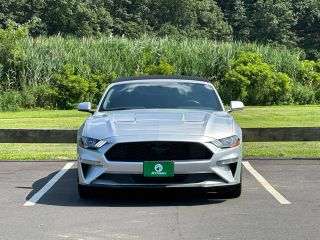
Mustang is equipped with two types of engines: one is a 2.3-liter four-cylinder turbocharged engine, and the other is a 5.0-liter V8 naturally aspirated engine. The 2.3-liter four-cylinder turbocharged engine delivers 299 horsepower and a maximum torque of 434 Nm. This engine can output maximum power at 5,600 rpm, with peak torque available at 3,000 rpm. It is paired with a 10-speed automatic transmission. The 5.0-liter V8 naturally aspirated engine produces 466 horsepower and a maximum torque of 556 Nm. This engine reaches its maximum power at 7,000 rpm and peak torque at 4,600 rpm, also mated to a 10-speed automatic transmission. The Ford Mustang has a body length of 4,794 mm, width of 1,916 mm, height of 1,373 mm, and a wheelbase of 2,720 mm.

As a long-time car enthusiast, I have to talk about the evolution of the Mustang's engines. The first-generation 1964 Mustang featured the classic 289 cubic-inch V8, with a rugged and captivating sound, delivering impressive horsepower. In the 1970s, due to the oil crisis, it shifted to smaller displacements like the 4.2L V8, sacrificing some power for better fuel efficiency. The 1990s saw a revival, with the GT's 5.0L V8, and by 2011, the Coyote engine was introduced, significantly boosting performance. Nowadays, mainstream models like the 2023 Mustang use a base 2.3L EcoBoost turbocharged four-cylinder engine, producing 315 horsepower—efficient and practical. High-performance versions like the GT500 come with a 5.0L V8 or even a supercharged 5.2L V8, exceeding 700 horsepower. This evolution reflects the adaptability of American muscle cars, transitioning from raw mechanical feel to modern electronic tuning, with the Mustang consistently attracting younger generations through its engines. Each era has its story—the deep rumble of the V8 remains a core allure, but in the eco-conscious era, four-cylinders have also won market share. Ultimately, choosing an engine comes down to personal taste—those who value historical significance naturally lean toward the V8.

I've been driving a Mustang with a 2.3L EcoBoost engine, which is quite cost-effective as an urban car owner. This turbocharged four-cylinder engine runs smoothly and quietly, with daily commuting fuel consumption controlled at around 7.5L per 100km. On weekends, it accelerates quickly on highways with responsive throttle. Of course, I've tried my friend's 5.0L V8 version, which delivers much more power and more thrilling acceleration with that strong push-back feeling, accompanied by a deep and powerful engine sound, but the fuel consumption rises above 10L. In terms of maintenance, the four-cylinder engine is simpler, less costly, and less prone to minor issues. If you're on a budget, the EcoBoost is suitable for beginners; if you're after excitement, the V8 is the real deal. However, the Mustang overall drives very stably, with good cornering support and perfect coordination with the engine, making it suitable for long-term ownership. I would recommend beginners to choose the four-cylinder version—it's worry-free and sufficient, and you can consider upgrading after driving it for a while.

When discussing Mustang's engine options, I'm most fascinated by the technical details. The base model is equipped with a 2.3L EcoBoost inline-4 turbocharged engine, delivering 310 horsepower and 475 Nm of torque, featuring a twin-scroll design for improved responsiveness. High-performance versions like the Mustang GT use a 5.0L Coyote V8 naturally aspirated engine, producing around 480 horsepower, with variable valve timing to optimize performance. The top-tier GT500 boasts a supercharged 5.2L V8, exceeding 700 horsepower. The ECU tuning is exquisite, ensuring smooth power delivery. The four-cylinder engine offers fuel efficiency of around 7L per 100km, while the V8 is perfect for high-speed driving, achieving 0-100km/h acceleration in the 4-second range. There's ample room for modifications, with simple ECU flashes increasing horsepower. The overall design balances reliability and explosive power, making Mustang engines always a hot topic.

As a track enthusiast, I absolutely adore the Mustang's 5.0L V8 engine! That deep growl paired with high-RPM explosiveness makes your whole body vibrate during straight-line acceleration – 0-100 km/h in just over 4 seconds is pure adrenaline. Mods are straightforward too; swapping intake/exhaust systems or ECU tuning can easily add 50hp. Compared to the EcoBoost four-cylinder, the V8's linear power delivery offers better track control with minimal turbo lag, making corner entry/exit rhythms flawless. Shelby's supercharged versions are next-level insane (though thirstier), perfect for hardcore gearheads. The Mustang engine thrives on performance unleashing – use high-octane fuel for longevity. True petrolheads know this embodies American muscle: excessive power isn't a bug, it's the feature.

When talking about Mustang engines, I focus most on practical use and the future. Mainstream options like the 2.3L EcoBoost four-cylinder and 5.0L V8 balance daily driving and fun. The EcoBoost saves fuel in the city at about 7L per 100km, making commutes comfortable; the V8 delivers thrilling power and an enchanting roar on open roads. -wise, the V8 costs slightly more but lasts longer. With current environmental trends, Ford may introduce hybrid options, like adding a 48V mild hybrid system to the Mustang to reduce fuel consumption while preserving torque. In the long run, the classic V8 will remain for enthusiasts. As a pragmatist, I recommend test-driving both before choosing—Mustang's design always strikes a great balance.