···
Log in / Register

Which Generation Does the 2021 Camry Belong To?

6Answers
Terri
09/06/2025, 01:48:46 AM

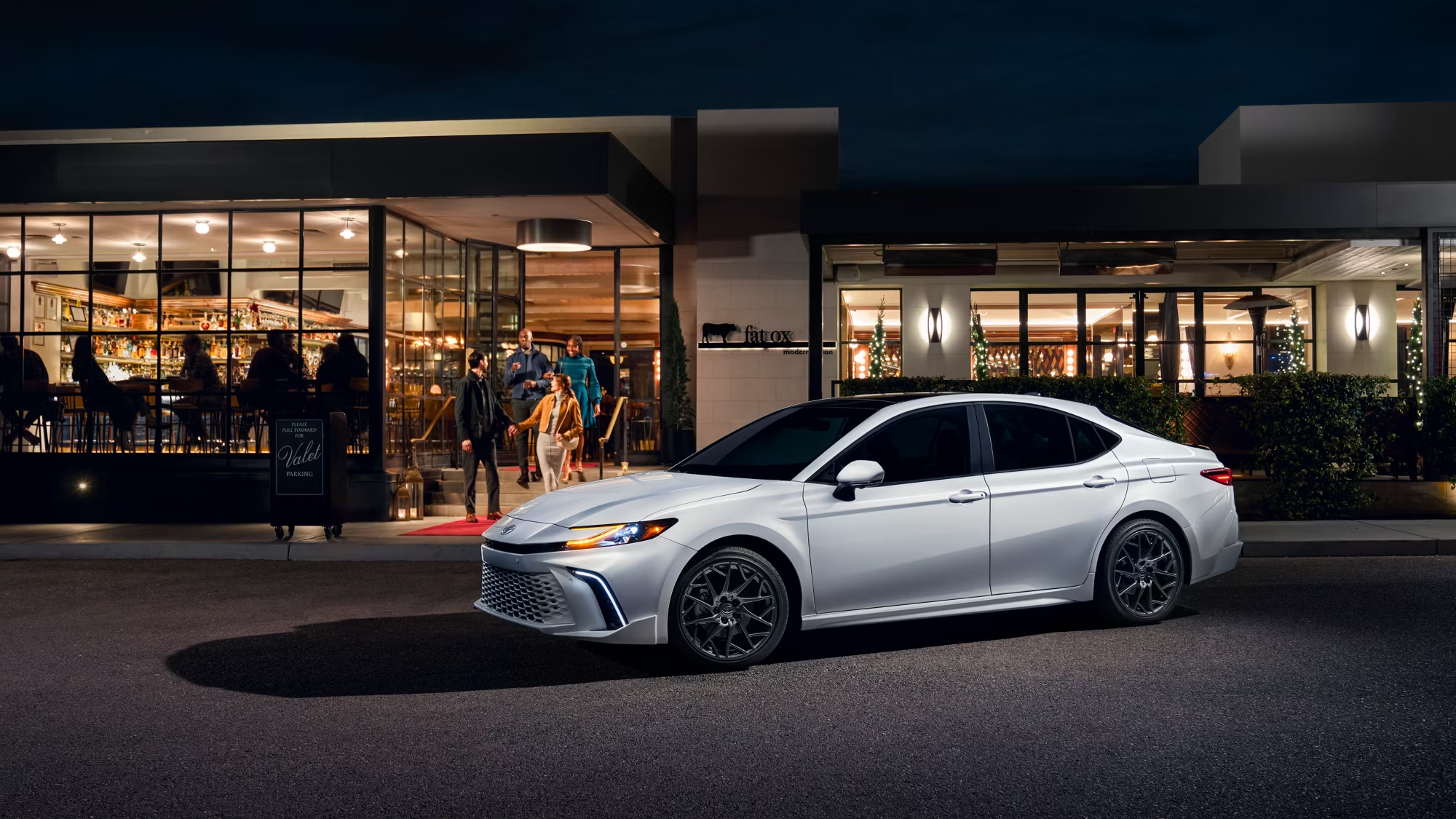
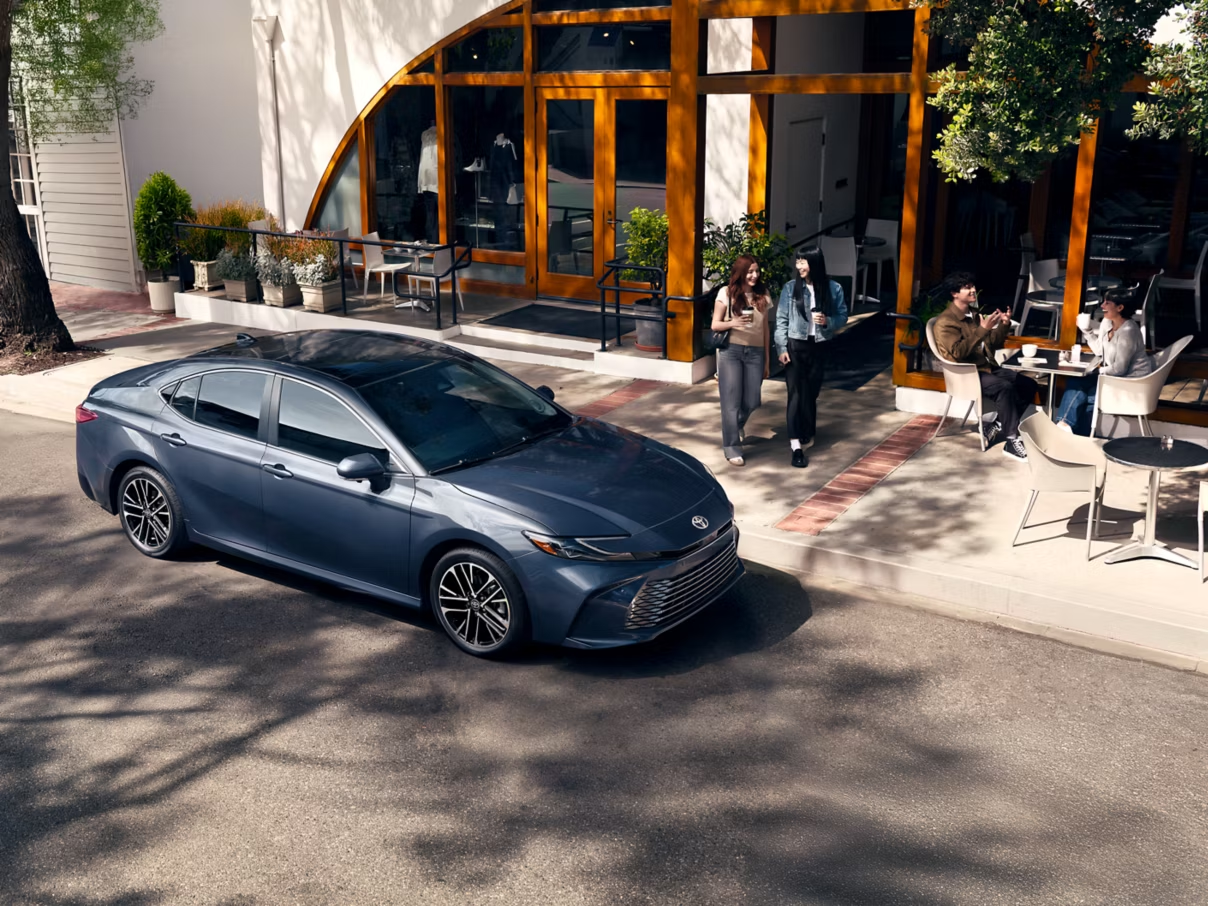
The 2021 Camry belongs to the eighth generation. The Camry models produced from 2017 onwards, including the latest versions, all fall under the eighth generation. The 2021 Camry comes in ten variants, all with the same body dimensions: 4885mm in length, 1840mm in width, and 1455mm in height, with a wheelbase of 2825mm. In terms of fuel tank capacity, the 2.5S Sport, 2.0E Elite, 2.5G Luxury, 2.5Q Flagship, 2.0G Luxury, and 2.0S Sport models have a 60L fuel tank. The Hybrid 2.5HQ Flagship, Hybrid 2.5HGVP Leading, Hybrid 2.5HS Sport, and Hybrid 2.5HG Luxury models have a 49L fuel tank. Regarding fuel consumption, according to the official NEDC combined figures, the 2.5S Sport, 2.5G Luxury, and 2.5Q Flagship models consume 6L/100km; the 2.0E Elite consumes 5.5L/100km; the Hybrid 2.5HQ Flagship, Hybrid 2.5HGVP Leading, Hybrid 2.5HS Sport, and Hybrid 2.5HG Luxury models consume 4.1L/100km; the 2.0G Luxury consumes 5.7L/100km; and the 2.0S Sport consumes 5.8L/100km. In terms of powertrain, this model is equipped with two engines: a 2.0-liter naturally aspirated engine and a 2.5-liter naturally aspirated engine. The hybrid version also uses a 2.5-liter naturally aspirated engine, but its tuning differs from the gasoline version. The 2.0-liter naturally aspirated engine delivers 178 horsepower and 210 Nm of maximum torque, achieving peak torque at 4400-5200 rpm and peak power at 6600 rpm. This engine features hybrid injection technology and an aluminum cylinder head and block. It is paired with a CVT transmission. The 2.5-liter naturally aspirated engine produces 209 horsepower and 250 Nm of maximum torque, achieving peak power at 6600 rpm and peak torque at 5000 rpm. This engine also features hybrid injection technology and an aluminum cylinder head and block. It is paired with an 8-speed automatic transmission. Historical Camry Release Timeline: First Generation: 1982-1986; Second Generation: 1986-1991; Third Generation: 1991-1996; Fourth Generation: 1996-2001; Fifth Generation: 2001-2006; Sixth Generation: 2006-2011; Seventh Generation: 2011-2017; Eighth Generation: 2017-Present.

Was this review help?
110
Share
AnastasiaRose
09/18/2025, 01:38:14 AM

I recall that the 2021 Camry belongs to the eighth generation, which Toyota launched in 2017 and continued until 2024. The eighth generation received major updates in design and technology, such as a more streamlined exterior and lower body height, making it feel sportier and more fuel-efficient when driving. A friend of mine bought this model, and he mentioned that the hybrid version is particularly practical, with daily commuting fuel consumption as low as 5 liters per 100 kilometers. Compared to the previous seventh generation, the 2021 model has a more refined interior and a larger screen, making it suitable for younger drivers. Toyota also added a pre-collision system and adaptive cruise control for enhanced safety, which makes highway driving much easier. When purchasing the car, the salesperson mentioned that this model has been consistently popular, with high reliability and strong resale value, making it quite hot in the used car market. Overall, the eighth generation is a classic worth owning.

Was this review help?
9
Share
Expand All
Genesis
11/01/2025, 02:01:54 AM

I believe the 2021 Camry indeed belongs to the eighth generation. Having driven several Toyota models myself, this generation has emphasized practicality and comfort since its launch in 2017. The body structure utilizes high-strength steel for enhanced durability, and the excellent sound insulation makes long drives fatigue-free. The hybrid option is a standout feature, offering quiet operation and fuel efficiency in urban settings, making it economically practical. The bold grille design adds distinctiveness, appealing particularly to younger drivers. Maintenance is straightforward with readily available parts at reasonable costs; regular check-ups on electrical systems and battery life can extend its service years. It holds its value well in the used car market, leading in resale value retention. As a daily commuter, it strikes a perfect balance between performance and family needs, delivering a stable and reliable driving experience.

Was this review help?
7
Share
Expand All
SanEvangeline
12/15/2025, 01:10:07 AM

Last year, I test drove the 2021 Camry, and the salesperson told me it was the eighth-generation model, part of the classic series that started in 2017. This generation offers spacious interiors, with enough room in the back seat for three people without feeling cramped, and a trunk large enough to accommodate bulky luggage, making it very convenient for family trips. The hybrid version is quiet and fuel-efficient, saving a lot on gas money for city commuting. It comes with numerous safety features, including automatic braking to help avoid accidents. The interior materials are durable and easy to clean. When buying a new car, the long warranty period and simple maintenance make it suitable for office workers and novice drivers. It drives smoothly without stress, with clear road feedback, responsive steering, and a well-tuned chassis that provides excellent shock absorption, ensuring a comfortable ride even on bumpy roads. It also has high resale value, moves quickly in the used car market, and offers outstanding cost performance.

Was this review help?
5
Share
Expand All
OCameron
02/04/2026, 02:04:09 AM

In the automotive world, the 2021 Camry represents the eighth generation introduced by Toyota in 2017. This generation showcases significant technological advancements, such as the TNGA platform that lowers the center of gravity and enhances handling. Both fuel efficiency and emissions have been optimized, with sleek and youthful body lines. The interior features a floating infotainment screen and smart interfaces that are user-friendly. The hybrid system boasts high efficiency, fast charging, and low noise levels. With strong sales figures, convenient maintenance, extensive service networks, and ample parts supply, it offers long service intervals and controllable costs. Its reliability stands the test of time, making it suitable for various road conditions and climates. The Camry holds its value well in the used car market, with strong liquidity. Before purchasing, it's advisable to check the battery life and suspension condition to ensure long-term performance stability. Overall, it's a well-balanced choice.

Was this review help?
13
Share
Expand All
DeColton
04/29/2026, 06:20:49 PM

I have personally followed the 2021 Camry, which is the eighth generation starting from 2017. Its design language is more aggressive, with a striking large-mouth grille at the front. The interior boasts a strong technological feel, featuring a digital instrument cluster with clear information display. The control interface is responsive and easy to operate. The chassis, based on a new architecture, has improved rigidity, enhancing stability during cornering. The hybrid version offers smooth electric-driven acceleration, excellent noise control, and long range, making it highly practical. The engine has high thermal efficiency and pairs smoothly with the transmission. It excels in reliability tests and enjoys a good global reputation. Maintenance is simple with few faults, making it suitable for both daily commutes and long-distance travel, offering a safe and comfortable driving experience.

Was this review help?
6
Share
Expand All
More Q&A

What is the fuel consumption of the Ford Everest?

Ford Everest's fuel consumption is within an acceptable range. Here is the relevant introduction of the Ford Everest: 1. Midsize SUV: The Ford Everest has a curb weight of over two tons, so its fuel consumption is naturally not low. The 2.0T gasoline engine model has an official fuel consumption of around 10L per 100 kilometers; the actual fuel consumption is slightly higher, approximately 11-12L per 100 kilometers, and it can be even higher in congested conditions, while it is lower on highways. 2. The Ford Everest's power is excellent among midsize SUVs: Whether it's the gasoline engine model or the diesel engine model, the power is very strong, making overtaking or climbing hills effortless. Even with its weight of over two tons, this car can still deliver a sense of acceleration, which shows how powerful its engine is.
105
Share

Can 360 Panoramic View Be Kept On All the Time?

360 panoramic view can be kept on all the time. Here are some relevant introductions about 360 panoramic view: 1. Background of demand: With the rapid development of computer technology, the types included in multimedia are increasing, and the effects that can be presented are also increasing. Some more traditional presentation methods are increasingly unable to meet the requirements of most customers for display methods. In traditional presentation methods, the means of display are nothing more than static flat images, dynamic videos, and displays through three-dimensional panoramas. Static images can only provide a certain angle of the scene. Even with a wide-angle lens, it is not possible to effectively and comprehensively represent the scene; while dynamic videos can give users a comprehensive understanding of the scene, the image perspective is still limited, and the viewing method depends on the photographer's shooting method, which is not free. The method of three-dimensional modeling can solve the problems existing in both static images and dynamic videos, but the cost is high, and the authenticity is not always satisfactory. Therefore, when it is necessary to present a scene in a real, comprehensive, and intuitive manner, 360 panoramic view is undoubtedly the best choice. 2. Industry applications: 360-degree panoramic technology provides unique methods for recording phenomena, discovering patterns, and predicting results. The application fields involved include human-computer interaction, geographic information, engineering management, environmental simulation, medical diagnosis, agricultural management, etc.
119
Share

Why is the Wrangler not afraid of wading through water?

The Wrangler is a body-on-frame off-road vehicle, so it is not afraid of wading through water. The Wrangler can handle a wading depth of 0.5 meters without any issues. Here are some additional details: Determining Water Depth: To avoid damaging the vehicle when driving through water (e.g., flooded roads), always determine the water depth before proceeding. The water level should not exceed one-quarter of the wheel height. Precautions: Drive at a walking speed (15-20 km/h). Higher speeds may create waves in front of the vehicle, potentially causing water to enter the engine intake system or other components. Do Not Turn Off the Engine: Under no circumstances should you stop, reverse, or turn off the engine while in water.
117
Share

What type of fuel does the Wrangler require?

Wrangler requires the use of 95-octane gasoline. Different grades of gasoline have varying octane ratings, with higher-grade gasoline having higher octane values. Gasoline with higher octane ratings also offers better stability. Many turbocharged engines require a minimum of 95-octane gasoline to prevent engine knocking. Here is a detailed explanation of engine knocking: Knocking is an abnormal combustion phenomenon in the engine that affects power output. It occurs during the compression stroke. During the compression stroke, both the intake and exhaust valves close, and the piston moves upward to compress the air-fuel mixture. As the mixture is compressed, its temperature and pressure rise. If the gasoline's stability is poor, the air-fuel mixture may ignite prematurely. Premature combustion forces the piston downward while it is still moving upward, negatively impacting engine performance. Severe knocking can even lead to connecting rod deformation or piston damage.
102
Share

Can a turbocharged car be turned off directly?

For turbocharged cars, it is best not to turn them off directly. Before shutting down, let the engine idle for 3 minutes to allow the turbo to cool down, which helps protect the turbo. Below is some relevant information about turbocharging: 1. The main difference between turbocharging and gas turbines: The turbocharging unit does not have a combustion chamber or corresponding systems. The turbo utilizes the exhaust energy of a reciprocating internal combustion engine, and the compressed air provided by the centrifugal compressor serves as the charge for the reciprocating internal combustion engine. In a turbocharger, the compressor impeller and the turbine are assembled on the same rotating shaft, called the rotor. Other components such as seals and thrust washers are also mounted on the same rotor shaft and rotate together. 2. Classification of turbocharging technologies: The main turbocharging technologies currently include mixed-flow turbocharging technology, variable turbocharging technology, two-stage turbocharging technology, and electrically assisted turbocharging technology.
101
Share

What is the mileage for a new car's break-in period?

The break-in period for a new car generally ranges from 1,000 to 3,000 kilometers. During this period, the speed should not be too high, usually controlled between 50-90 km/h. For some models, it can be slightly higher, with the maximum speed kept within 100 km/h and the engine speed not exceeding 2,200 rpm. The driving methods for a new car's break-in period are as follows: 1. The initial break-in mileage is typically around 500 kilometers. During this phase, the speed should not be too fast, maintained at 60-70 km/h, and the engine speed should preferably not exceed 2,200 rpm. From 500 to 1,000 kilometers, the mid-break-in period, the speed can be increased from 60-70 km/h to 90-100 km/h, while keeping the engine speed below 2,500 rpm. 2. From 1,000 to 1,500 kilometers, the late mid-break-in period, the speed can be increased to below 120 km/h. The break-in process should be gradual, and the engine speed should not exceed 3,000 rpm. It is best to turn the key to position 2 and wait for 10 seconds before starting the engine, allowing the oil pressure and fuel injection to adjust properly for optimal engine performance. 3. Avoid carrying heavy loads in the trunk during the break-in period; the lighter the car, the better. Avoid sudden braking and rapid acceleration, as these can compromise safety and damage the car. 4. Do not drive too fast or too slow during the break-in period, and avoid maintaining a single gear for extended periods. Each gear should be used appropriately, shifting from low to high in a cyclic manner while paying attention to speed control. 5. Regularly check the engine oil, coolant, and battery electrolyte levels during the break-in period. Since this is the first extended operation of the new car, any issues should be addressed promptly. Each break-in session should not be too long—drive for a few hours at most before taking a break.
120
Share
Cookie
Cookie Settings
© 2025 Servanan International Pte. Ltd.