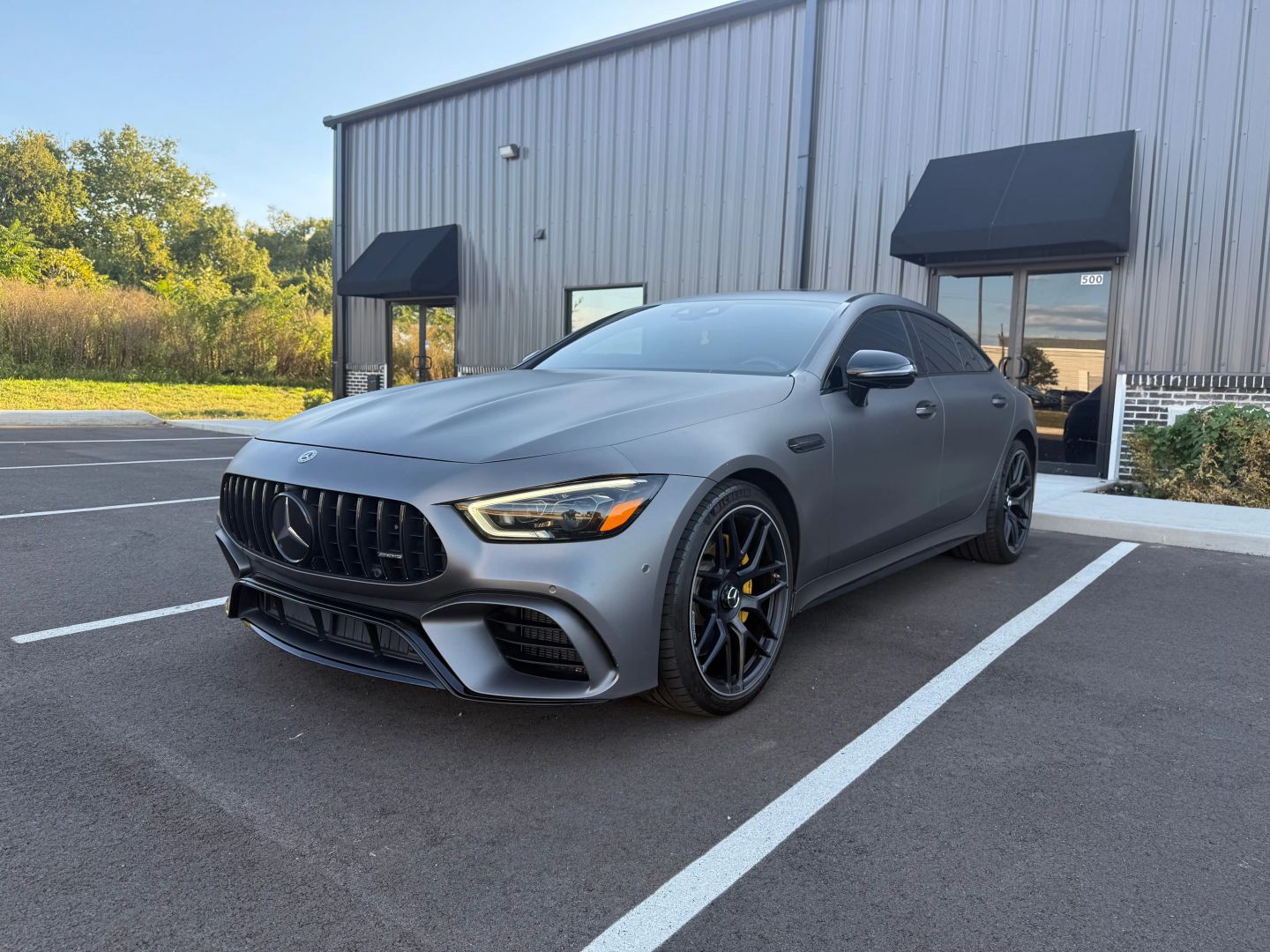
···
Log in / Register

What does Mercedes-Benz E260 CGI mean?

6Answers
SanJace
08/30/2025, 11:06:05 PM

It refers to the CGI engine technology, a direct fuel injection technology developed by Mercedes-Benz. This primarily includes direct fuel injection technology and turbocharging technology. Below are the relevant details: 1. Function: Direct fuel injection completely separates the fuel supply process from the intake valve and piston system, giving the ECU more control. This enables ultra-lean combustion beyond traditional injection theories and more diverse air-fuel ratios. During steady driving or low-load conditions, engines with direct fuel injection can enter an ultralean mode. In this setting, the engine only draws in air during the intake stroke, while the fuel injector supplies fuel during the compression stroke to achieve fuel savings. According to actual tests, it can achieve a maximum air-fuel ratio of 1:65, delivering not only impressive fuel efficiency but also maintaining a very smooth power curve. 2. Fuel Economy: The CGI engine replaces most of the previous supercharged engines with turbocharging, allowing the engine to provide more abundant energy while being more fuel-efficient. In terms of fuel economy, it saves up to 15% compared to the original.

Was this review help?
112
Share
MacColton
09/12/2025, 02:33:07 AM

That day we talked about the interesting naming rules of Mercedes-Benz, and I've studied the model E260CGI. The initial 'E' indicates that it belongs to Mercedes-Benz's mid-to-large luxury sedan series, which is the well-known E-Class. The number '260' in the middle is quite intriguing—Mercedes uses numbers to denote power levels. Although the specific displacement may vary in different periods, '260' generally positions it as a mid-range 2.0T powertrain. The most crucial part, 'CGI,' is actually an abbreviation for Charged Gasoline Injection, which essentially marks Mercedes' own direct fuel injection technology. I've test-driven this model, and the throttle response feels particularly quick, with significantly lower fuel consumption compared to older models—advantages brought by direct injection. Nowadays, the new versions are renamed EQ Boost, but these CGI-engine cars still hold their value quite well in the used car market.

Was this review help?
9
Share
Expand All
SanAurora
10/26/2025, 03:21:58 AM

A friend just bought a used Mercedes-Benz and asked me about the model designation, so I happened to explain the E260 CGI. This car belongs to the Mercedes-Benz E-Class family, featuring smooth body lines and a spacious interior. The '260' badge is quite interesting—it corresponded to a 2.5L naturally aspirated engine a few years back, but in the last decade, it's mostly been paired with either a 1.8T or 2.0T turbocharged engine. The most notable advantage of CGI technology lies in its fuel efficiency; last year, I helped a friend test it on the highway, and it averaged around 6L/100km. However, I reminded him to watch out for carbon buildup in the intake manifold, a common issue with direct-injection engines. For daily driving, the power is sufficient, and switching to Sport mode delivers noticeable acceleration. If the budget allows, I'd recommend opting for the version with the sport package, as the steering feels more responsive.

Was this review help?
19
Share
Expand All
MacRose
12/09/2025, 02:42:44 AM

Recently, while working on an old Mercedes-Benz, I finally understood its naming convention. Take the E260CGI as an example - it's quite straightforward when broken down: 'E' represents the mid-to-large-sized sedan class, '260' indicates the vehicle's power level, and 'CGI' is the code for direct injection technology. Compared to conventional port fuel injection engines, direct injection vehicles spray fuel directly into the cylinders, resulting in more thorough air-fuel mixture and higher combustion efficiency. In actual driving, you can feel the engine sound is crisper, and there's no sluggishness during low-speed acceleration. However, it's important to note that direct injection vehicles have higher fuel quality requirements - there were cases where customers used substandard fuel leading to clogged injectors. Nowadays, you rarely see the CGI badge on new Mercedes-Benz models as they've mostly been upgraded to turbocharged engines with mild hybrid systems.

Was this review help?
7
Share
Expand All
McRhett
01/29/2026, 09:01:09 PM

I researched Mercedes-Benz models when helping my cousin choose a car. The E260CGI focuses on CGI technology, which is equivalent to Mercedes-Benz's gasoline direct injection trademark. This design allows the fuel injector to spray directly into the cylinder, unlike older engines that sprayed into the intake manifold. The result is more horsepower with the same fuel consumption, with the 2.0T engine squeezing out over 200 horsepower. The number 260 in the Mercedes-Benz lineup represents the golden displacement, offering stronger power than the 200 while being more fuel-efficient than the 300. It's particularly suitable for city driving, with the transmission downshifting very actively. If buying a used one now, be aware that the valve cover gasket is prone to oil leaks, and the repair costs aren't cheap.

Was this review help?
2
Share
Expand All
VonPreston
04/24/2026, 03:16:22 PM

Research shows that Mercedes-Benz model names are like codes. In the E260CGI, the 'E' stands for executive-class sedan, '260' is Mercedes' unique power rating code, roughly equivalent to a 2.0-liter displacement level. What impressed me most about CGI technology was its widespread adoption around 2010, when it was considered cutting-edge, directly reducing fuel consumption by 15%. Its working principle involves a high-pressure fuel pump injecting gasoline into the combustion chamber, working particularly well with turbocharging. The newer models have now upgraded to piezoelectric injectors for better atomization. However, a well-maintained CGI version can easily last 300,000 km, and in the used car market, the E260CGI is much more popular than the contemporary BMW 525.

Was this review help?
12
Share
Expand All
More Q&A

How to Turn on the Heater in an Audi?

The steps to turn on the heater in an Audi are as follows: First, after starting the car, wait approximately 8 to 15 minutes for the water temperature to rise to the normal level. Then, adjust the heater switch on the center console to the red side and turn on the fan switch to activate the warm air. Next, set the air conditioning circulation mode to internal circulation. Finally, use the temperature adjustment to increase the temperature as desired. Audi is a luxury car brand under Audi AG, a subsidiary of the Volkswagen Group, headquartered in Ingolstadt, Germany. Its main models include the A1, A3, A4, A5, A6, A7, A8, Q1, Q2, Q3, Q5, Q7, Q8, TT, R8, as well as the S and RS performance series.
112
Share

Why is the Qin EV Travel Edition more expensive than the regular version?

The Qin EV Travel Edition is more expensive than the regular version because it offers a longer warranty. Warranty for the Qin EV Travel Edition: The Qin EV Travel Edition provides a warranty of 6 years or 600,000 kilometers, which can be considered as a lifetime warranty, while the regular version only offers a warranty of 3 years or 100,000 kilometers. The difference in warranty coverage between the two is quite significant. Introduction to the Qin EV Travel Edition: Its dimensions are 4765mm in length, 1837mm in width, and 1495mm in height, with a wheelbase of 2718mm. It is equipped with BYD's latest Blade Battery, featuring lithium iron phosphate battery cells with a capacity of 47.5 kWh, providing an NEDC pure electric range of 400km.
114
Share

What kind of car is kin?

Currently, there is no car brand named 'kin'. There is KIA, which is Dongfeng Yueda Kia Motors. Kia is a Sino-foreign joint venture engaged in automobile production and sales, with its headquarters located in Seoul, South Korea. Kia's vehicle lineup essentially covers various models from sedans to SUVs and MPVs. Kia's models include: K3, K4, K2, Rio, Soul, Forte, Cerato, Cadenza, etc. Taking the Kia K3 as an example, it is a compact car under Dongfeng Yueda Kia, with dimensions of 4600mm in length, 1780mm in width, and 1445mm in height, and a wheelbase of 2700mm. It is equipped with a 1.5L naturally aspirated engine and a 1.4T turbocharged engine.
105
Share

Where are the motors used in domestically produced Teslas manufactured?

Tesla's electric motors are independently designed and developed, and produced in Nevada, USA. Tesla is an automobile manufacturer from Silicon Valley, USA, with models including Model 3, Model S, Model X, Model Y, etc. Introduction to Tesla: The Model 3 is Tesla's entry-level model, a pure electric mid-size sedan. 2. Body dimensions: The wheelbase is 2875 mm, and the length, width, and height are 4694 mm, 1850 mm, and 1443 mm respectively. Tesla Suspension: The front suspension uses a double-wishbone independent suspension, and the rear suspension uses a multi-link independent suspension. The double-wishbone suspension consists of upper and lower wishbones, with a link between them.
109
Share

Is it normal for an automatic transmission car to make abnormal noises when shifting to P gear and stepping on the brake?

It is normal for an automatic transmission car to make abnormal noises when shifting to P gear and stepping on the brake, because there is a locking mechanism inside the gear lever. After stepping on the brake pedal, the locking mechanism will unlock, and some noise may occur at this time. When shifting from P gear to R gear, N gear, or D gear in an automatic transmission car, the brake pedal needs to be pressed. Similarly, when shifting from N gear to D gear, the brake pedal also needs to be pressed. However, shifting from D gear to N gear does not require pressing the brake pedal. An automatic transmission does not require shifting gears while driving. The control system of the automatic transmission automatically selects the appropriate gear based on the engine speed and load during driving, replacing the driver's subjective judgment of timing and gear shifting operations.
120
Share

What are the differences between electric vehicles and fuel-powered vehicles?

Electric vehicles and fuel-powered vehicles differ in the following aspects: 1. Different power systems: Electric vehicles use batteries as their energy source, with electric motors for propulsion and speed controllers for speed regulation; fuel-powered vehicles use petroleum products as their energy source, generating power through combustion in internal combustion engines and utilizing transmissions for drive control. 2. Different emissions: Electric vehicles produce no emissions, making them more environmentally friendly; fuel-powered vehicles burn gasoline, resulting in exhaust emissions containing significant pollutants. Electric vehicles refer to automobiles that use electrical energy as their power source, driven by electric motors, and belong to the category of new energy vehicles, including Battery Electric Vehicles (BEV), Hybrid Electric Vehicles (HEV), and Fuel Cell Electric Vehicles (FCEV).
118
Share
Cookie
Cookie Settings
© 2025 Servanan International Pte. Ltd.