Browse

Log in / Register
 Share

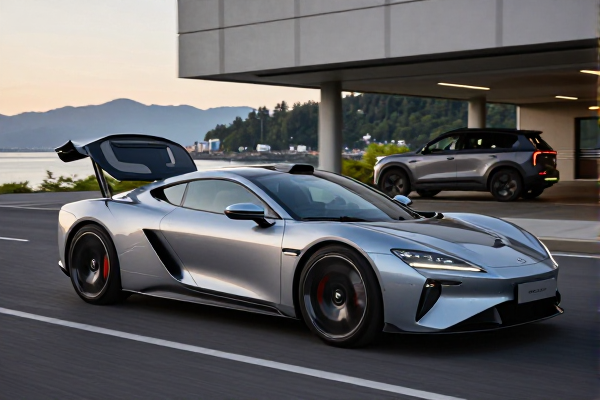
As of April 27, 2026, evo’s latest road-test feature puts the Czinger 21C in focus. Built in Southern California, this hybrid hypercar combines a bespoke twin-turbo V8 with proprietary metal 3D printing and a radical single-row cabin layout. In the same week’s photo gallery, the 21C looks less like a conventional supercar and more like a design experiment that escaped a laboratory.
The first word many viewers will say is “weird.” The body is all sharp angles, exposed mechanical elements and layered aerodynamic surfaces. There are no soft curves, no familiar GT proportions and no obvious homage to any existing model. Instead, the 21C looks like the product of a computer told to solve a physics problem without constraints. Even the wheels are dwarfed by the carbon-fibre and alloy structure around them, making the car appear to sit on tyres almost by accident.
The strangest feature is the interior arrangement. The two seats are positioned in tandem, with the driver ahead of the passenger, along the car’s centre line. This narrows the canopy and reduces frontal area. It also gives the driver a view straight down a long, sculpted nose, like a cockpit rather than a cabin. That layout forms the basis of the car’s aerodynamic story: the bodywork follows the cabin’s shape instead of hiding it.
Two configurations exist. The VMax is calibrated for straight-line speed, targeting more than 250mph. The standard version uses a high-downforce aerodynamic package and is aimed at circuit work. Both share the same powertrain: a bespoke 2.9-litre twin-turbo V8 paired with a hybrid system. Total output is 1,250bhp, and the redline sits at 11,000rpm. The car also weighs in at under 1,800kg, which makes the power-to-weight ratio genuinely extreme.
What is truly breakthrough is not the number, though. It is the manufacturing. Czinger developed a proprietary metal 3D printing process that can create shapes traditional machining, casting or forging cannot produce. These include components with internal lattices and interwoven structures inside a single part. On the 21C, the suspension arms and engine mounts look like Kryptonian engineering: delicate but dense, with material concentrated exactly along stress lines. The effect is structural art rather than mechanical fabrication.
Driving both versions back-to-back on California roads was an intense exercise. The car accelerates instantly and almost violently. The engine is high-strung, with a sharp, rasping soundtrack; the front electric motors add punch, and by 9,000rpm the noise becomes something like a racing motorcycle. Approaching the 11,000rpm cut-off, the delivery is so aggressive that the driver has little time to pull the paddle for the next gear. In context, the 21C feels less like a refined tourer and more like a road-going racing prototype.
The high-downforce car feels taut and alive on canyon roads. Because the seating position is centre-mounted, the sensation of rotation is different from a conventional supercar. The car seems to pivot around the driver rather than in front of them. The VMax, meanwhile, prioritises a different kind of capability, and on open roads it was the easier car to cover distance quickly. Both versions, however, share the same unlikely premise: a road car that behaves like a prototype in a video game.
Why does the 21C matter beyond prestige? At the start of 2026, hypercars increasingly match each other in outright performance, so innovation has shifted toward manufacturing and scalability. Czinger is using the 21C as a proof-of-concept for a more flexible production system. The same digital design and 3D-printing tools used for the 21C’s suspension are meant to reduce tooling costs for low-volume models. That could allow specialist companies to design, test and refine components in days instead of months. It is a different vision from traditional automaking, one where physical hardware is not constrained by stamping dies or casting molds.
Czinger has also positioned the technology for broader industrial applications. The 21C demonstrates what happens when the factory floor becomes a digital environment: parts are born from data, then grown from metal powder in a single step. For American buyers watching the luxury performance market, the 21C is an unusual answer to European dominance. It is loud, aggressive, uncompromising and very much American in its ambition.
The images from evo issue 351 capture that contrast nicely. There are shots of the skeleton-like suspension, the cockpit-like cabin, and the car moving through sharply lit landscape photos. On the road, the 21C asks the driver to adapt. In pictures, it asks the viewer to question what a hypercar should look like. The more important story, hidden behind those strange surfaces, is the engineering that makes the car possible.
As of the date line, no other production road car leans so heavily on 3D-printed metal for load-bearing chassis and suspension elements. Whether or not its looks are ever accepted as beautiful, the 21C has already made the argument that innovation can be just as compelling as symmetry. The photos from evo’s drive are the latest reminder that the future of high-performance cars may involve fewer stamped panels and more structures grown by algorithms.