Browse

Log in / Register
 Share

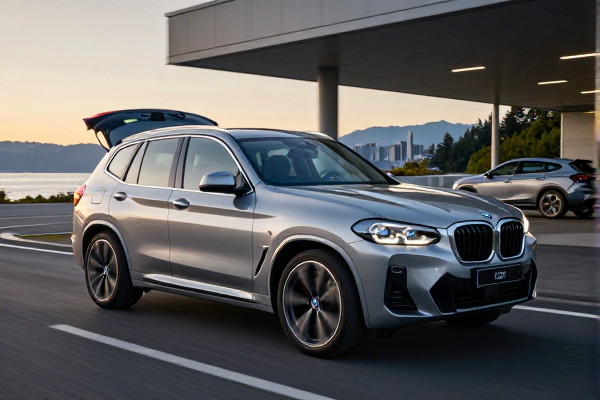
April 26, 2025 – BMW may have stolen the spotlight with the all-new gas-powered Neue Klasse 3-Series, but hidden among the headlines is a batch of fall updates that inject fresh life into some of the brand's most important models. The biggest surprise for enthusiasts: the X3 M50 performance SUV is now significantly more powerful, while the iX3 lineup adds an all-wheel-drive variant and the M5 gains wheels that look straight out of science fiction.
The gas-powered X3 M50 has been quietly upgraded to match the engine tune of the new M350 xDrive sedan, which debuted alongside the Neue Klasse 3 Series. That means the SUV's 3.0-liter inline-six turbo now produces 437 horsepower (443 PS), up from 393 hp (398 PS) — a gain of 44 hp. BMW hasn't published updated acceleration figures for the M50 yet, but the pre-upgrade version already sprinted to 62 mph in 4.6 seconds. Given the lighter M350 sedan claims a 4.1-second time with the same output, the X3 M50 should shave a few tenths off its old benchmark, even with its taller body and higher curb weight.
It's worth remembering that 437 hp puts this M Performance SUV dangerously close to the iconic E92 M3's 414 hp. For context, the previous-generation X3 M40i topped out at 382 horsepower. The current M50's 437 hp rating leaves that model far behind and makes the newest X3 the one to beat in this corner of the market. The X3 M50 isn't a full-fat M model, but it's now got more punch than many dedicated sports cars of the past decade. For shoppers who don't want to wait for a possible X3 M, this could easily be the sweet spot.
Interestingly, BMW hasn't been shy about aligning M Performance models with its latest sedan architecture. The decision to match the X3 M50's output with the M350 xDrive isn't just a number tweak; it suggests the same calibrations, the same engine programming, and possibly the same cooling upgrades are being shared across the lineup. For owners, that means a level of polish that used to be reserved for dedicated M vehicles.
The electric X3 family also receives a new addition. The previously rear-wheel-drive iX3 40, which launched earlier this year with a single 316 hp motor, can now be ordered with an additional front motor. This dual-motor setup – shared with the just-revealed i3 40 xDrive sedan – bumps total output to 369 hp (275 kW / 374 PS), a gain of 56 hp. More importantly, it brings the kind of all-weather confidence that a premium EV buyer in snowy climates will appreciate.
But there's a trade-off. BMW's WLTP figures show the xDrive version covers 320–386 miles (515–621 km) per charge, down from a maximum of 395 miles (636 km) for the rear-drive model. The battery remains the same 82.6 kWh unit, so the extra motor and drivetrain losses eat into efficiency. That's not surprising, but it's a useful reminder that AWD isn't free.
You'll also pay more for the privilege — and not just at the dealership. With the WLTP range dropping by up to 75 miles in the worst case, real-world charging stops will become more frequent. That's part of the cost of doing business with a heavy battery and two motors, and buyers in cities with strong charging infrastructure may not notice, but those planning long cross-country trips will want to run the numbers.
Meanwhile, the range-topping iX3 50 keeps its 463 hp (345 kW / 469 PS) output and its larger 108.7 kWh battery, which delivers up to 500 miles (805 km) on the WLTP cycle. It also charges faster, at 400 kW compared with 300 kW for the 40-badged cars. That difference alone could be the deciding factor for buyers who take frequent road trips and care less about the extra front motor.
BMW also unveiled new optional wheels for the M5 sedan and M5 Touring, and they're more interesting than your typical alloy upgrade. Available through the M Performance catalog, the 20- and 21-inch rims are made with a high-pressure casting process that BMW describes as an automotive first. The aluminum is cast under vacuum from the outside in, with the entire cycle taking just 0.05 seconds. According to BMW, the result is a wheel that's up to 20 percent lighter and stronger than conventionally cast wheels.
The process also allows for wilder designs. In theory, it could produce wheels with up to 70 bladed spokes — though we can only imagine how long it would take to clean brake dust out of every little gap. Practical or not, the new casting method shows BMW is willing to experiment with manufacturing tech even as it pushes electrified performance.
It's worth noting that lighter wheels do more than improve looks; they reduce unsprung mass, which can sharpen turn-in and ride quality. On a heavy luxury sport sedan like the M5, every pound saved on rotating mass has a meaningful effect on agility. BMW hasn't yet said whether the wheels will be offered for other models, but the process seems scalable — and we won't be surprised if it appears on the next generation of M cars.
Last but not least, BMW extended its Black Package to M Performance variants of the 2-Series, 4-Series, and 4-Series Convertible. This package — which requires the M Sport Package Pro as a prerequisite — adds carbon-fiber interior trim, black door sills, and black badges, tying the cars together visually with the darker appearance of the new wheels.
The Black Package is a classic example of BMW's approach to personalization: small visual tweaks that make a car feel special without touching the mechanical hardware. For buyers who already check the M Sport box, it's a low-cost way to make their coupe or convertible stand out in a crowded parking lot.
Taken together, these fall updates show BMW is raiding its parts bin to keep both combustion and electric models competitive. By giving the X3 M50 the same tune as the M350 xDrive, BMW creates a direct performance link between the new 3 Series and its popular SUV. Meanwhile, the iX3's new xDrive variant addresses one of the biggest criticisms of entry-level EVs: lack of traction in adverse conditions. And with the M5's innovative wheels, the brand is demonstrating that even the smallest design details can push engineering boundaries.
Perhaps the most significant takeaway is that BMW is now using the M Performance badge as a bridge between its combustion and electric lineups. The X3 M50's power upgrade aligns it with a brand-new sedan, while the iX3 gains an AWD trim that mimics the xDrive setups traditionally found on combustion BMWs. This not only gives buyers more choices, but also helps BMW maintain a consistent performance ladder across very different powertrains.
For buyers, the message is clear: BMW is covering all bases, from practical family haulers to high-performance luxury cruisers. The fall update cycle isn't just about incremental tweaks — it's a statement of intent from a company that wants to be everywhere at once.