Browse

Log in / Register
 Share

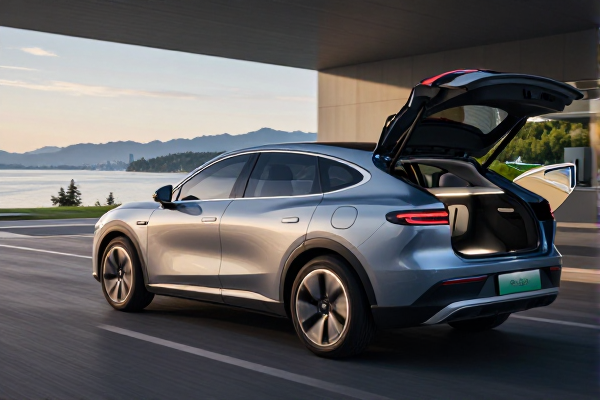
As of May 4, 2026, Xpeng has officially set its Philippine launch lineup. The L03 compact crossover starts at PHP 2.058 million, while the X9 seven-seat luxury MPV is priced from PHP 4.058 million. The company has also confirmed a six-dealership rollout before the end of 2026, giving the brand its first serious retail footprint in the country.
Xpeng enters the Philippine market with more than one message. In China, the parent group is known for software development, artificial intelligence and even flying-car research. But local buyers will deal with a simpler story: smart mobility wrapped in practical body styles, with the L03 and X9 aimed at completely different audiences.
The L03 is the volume-minded choice. It is pitched at young professionals and small families who want an EV that feels modern without leaning too heavily into luxury preaching. The X9 is the larger statement. As a seven-seat MPV, it is meant for households and executive shuttles, where cabin space, comfort and advanced safety matter more than outright performance.
Because the two models sit in different market tracks, Xpeng is not forcing Filipino buyers into a single design language. The L03 can reasonably compete in the compact crossover segment, while the X9 is positioned below the usual price levels of fully electric luxury MPVs in the region.
To put the sticker prices into perspective, PHP 2.058 million is roughly between $35,000 and $37,000 depending on the day’s exchange rate. The X9’s PHP 4.058 million translates to about $70,000 to $72,500. Those are not entry-level numbers, but they are aggressive for the amount of hardware and cabin equipment on offer.
One of Xpeng’s strongest talking points is that its vehicles are designed for software-driven evolution. The local versions of the L03 and X9 are equipped with camera systems, internal processing hardware and radar as standard. That hardware base is capable of accepting over-the-air updates, which means features can be added or improved without a dealership visit or a new car purchase.
Later, Xpeng’s Vision-Action-Language 2 self-driving technology can be switched on when the local operating environment is ready. What makes this system stand out is its real-time interpretation of actual driving conditions. The sensors are designed to account for weather, road quality and even traffic enforcers directing vehicles. In a market like the Philippines, where road patterns are less uniform than many cities overseas, that kind of adaptive processing could matter greatly.
None of that means the current models are bare-bones shells waiting for future software. The Philippine units include the Xpeng Next Generation Pilot suite, which brings adaptive cruise control, automated parking assistance and traffic-sign recognition into the standard feature list. Higher trims add Turing AI chips, and the range-topping Ultra variants carry multiple chips. The idea is simple: buyers who invest today are not locked out of tomorrow’s improvements.
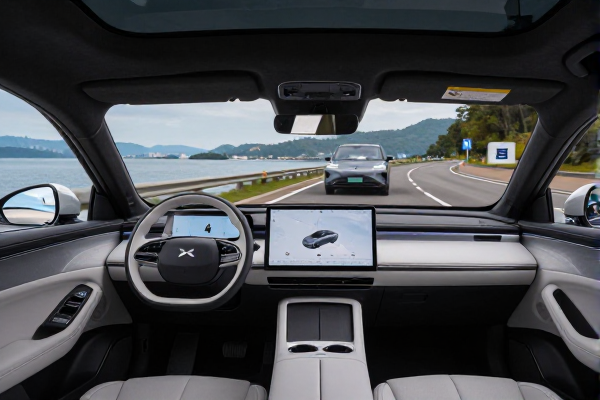
Inside, Xpeng follows the same philosophy as many modern Chinese EV brands: keep physical controls to a minimum and let the software handle the rest. Most cabin settings are controlled through voice commands or a scroll wheel on the steering wheel. The buttons that do remain are designed to feel deliberate and precise, with a solid click that suggests careful assembly.
Both the L03 and X9 use leather and soft-touch materials across the main interior surfaces. The audio system can be specified with up to 27 speakers, a figure usually associated with more expensive European luxury cars. Front seats are heated and ventilated, which should make long drives easier in a tropical climate. A head-up display is also included, reducing the need for drivers to look away from the road.
The central screen is the control centre for Xpeng’s own vehicle software. Navigation is based on Google Maps, which gives drivers a familiar mapping experience rather than a proprietary system that takes time to learn. Combining Google Maps with the vehicle’s range data should also help remove some of the guesswork about how far a driver can go on a single charge.
Xpeng claims the L03 and X9 can both reach upwards of 500 km between charges, depending on the variant and driving conditions. That kind of number is useful in the Philippines, where long intercity trips are common and charging networks are still expanding.
For buyers who want crossover toughness without relying entirely on charging infrastructure, a plug-in hybrid version of the L03 is planned. Final pricing for that variant has not been announced, making it a future addition to the lineup rather than a launch-day option. The existence of a hybrid model is a practical concession to market reality: full electrification takes time, and some buyers need the safety net of an internal-combustion range extender.
Alongside the car lineup, Xpeng is building a visible dealer network. Six dealerships are scheduled to open before the end of 2026, which suggests the company is thinking beyond a small pilot operation. Multiple variants of the L03 and X9 will be available from the start, giving car buyers enough choice to configure a vehicle around their budget.
For a brand still introducing itself, those dealerships are as important as the product itself. EV buyers in the Philippines often worry about aftersales support, software updates and parts availability. A six-location network does not solve all of those concerns, but it at least signals that Xpeng plans to be present for the long term.
Seen from the United States, this launch is less about a specific model and more about how Chinese EV makers are mapping out the world. With steep import restrictions limiting direct entry to the U.S. market, Southeast Asia has become a pressure-testing ground for affordability, software feature depth and brand-building.
Xpeng picked two vehicles with entirely different body styles and one common philosophy: load them with digital features and challenge more expensive competitors on price. If the Philippine rollout works, the same playbook can be repeated across other Asia-Pacific markets. The parent group’s flying-car work and autonomous-driving research will continue in China, but the L03 and X9 are now the first proof points of what Xpeng wants to be outside its home country.
The pair is only the opening hand for Xpeng in the Philippines. More models are likely to follow as dealerships open, and the brand’s low-price-plus-high-technology positioning could put real pressure on other EV importers in the region.
This article was produced in partnership with Xpeng Philippines.