Browse

Log in / Register
 Share

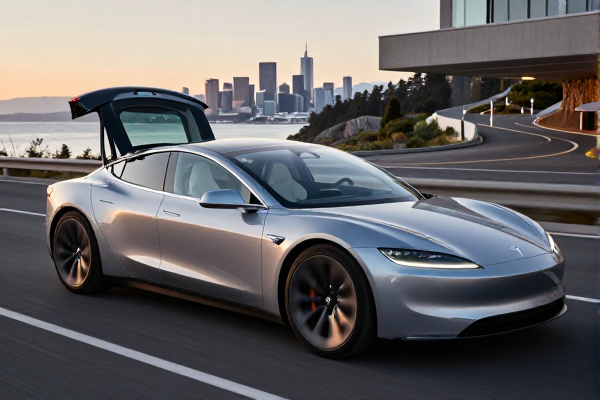
As of April 27, 2026, Tesla has finally taken the wraps off the next-generation Roadster. The long-awaited supercar is now on the order books in three trims, topped by a single-seat Rocket that uses cold-gas thrusters for short flying hops. Tesla quotes a 0-60 mph time of under 0.59 seconds for that version, and says every Roadster variant offers more than 300 miles of range.
The reveal closes what has been one of the longest waits in recent car history. Tesla first teased a new Roadster in late 2017 at the Semi event, calling it “one more thing” and promising a 1.9-second 0-60 mph time. That date came and went, and the program sat on the back burner as the company concentrated on other models. Now, after a weather-related delay and months of hints, the final production-style car is finally public.
Tesla is offering three distinct versions. The entry-level Performance is a two-seater built for the street, using active aero and a multi-mode suction system to gain extra grip on asphalt and track. Tesla rates it at 0-60 mph in under 1.6 seconds.
The middle configuration is called Thrust. It is still a two-seater, but it is set up for racing rather than road comfort. Thrust combines the same suction system with a bank of cold-gas thrusters mounted at the rear. Tesla says it reaches 60 mph in under 0.9 seconds.
At the top of the lineup sits Rocket. This one is a single-seater designed to fly, with cold-gas thrusters arranged around the car’s perimeter to provide forward, upward, and rotational movement. Tesla lists a 0-60 mph time of under 0.59 seconds and a top speed above 230 mph, while range stays over 300 miles.
The company also showed the Roadster performing in the real world. In a video posted on X, the car ran from 0-60 mph in 0.81 seconds, or 0.67 seconds when rollout is subtracted. Those numbers put it in a class of acceleration that was once reserved for purpose-built drag cars.
What makes the Roadster different from any other road car is the thruster system. Tesla notes that a conventional vehicle is ultimately limited by how much grip its tires can deliver. The Roadster’s cold-gas thrusters, by contrast, are designed to produce four to five times that force. The same mass gets pushed significantly harder, which is how the car can hit sub-second 0-60 runs.
The technology has a clear spaceflight pedigree. SpaceX has used cold-gas thrusters for spacecraft maneuvers for decades, but adapting the approach for a car that operates in open air instead of a vacuum required entirely new hardware and control logic. Tesla has filled every usable space in the Roadster with Carbon Fiber Overwrapped Pressure Vessels, or COPVs, to store compressed gas. All-electric actuators fine-tune the thrusters within fractions of a second to keep the car stable in flight. The company has not disclosed exact flight time or altitude figures beyond describing the Rocket as capable of short hops.
Even without the thrusters, the Roadster receives a meaningful grip boost. A multi-mode fan and ground-sealing system pulls air from underneath the car, creating enough suction that Tesla says the Roadster can hold itself upside down while standing still. Powered fans and active wings work with the suction system to increase traction and cornering speeds, providing substantial downforce even when the vehicle is not moving.
In Track Mode, Tesla says the Roadster transforms further. The company claims it has the best passive downforce package of any road car, approaching Formula 1 levels. One detail stands out: the rear wing is moved by the same actuator system Tesla developed for the Optimus humanoid robot, showing how the company is cross-pollinating components across very different product lines.
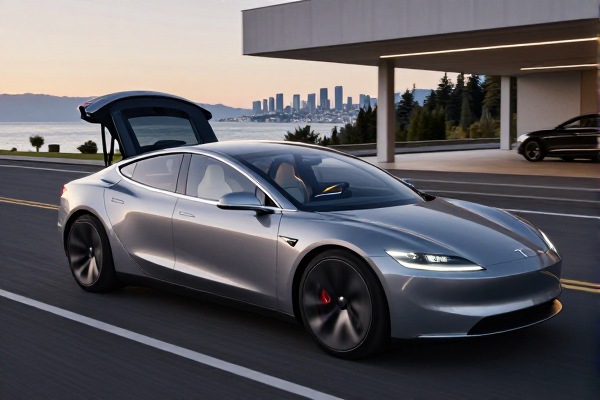
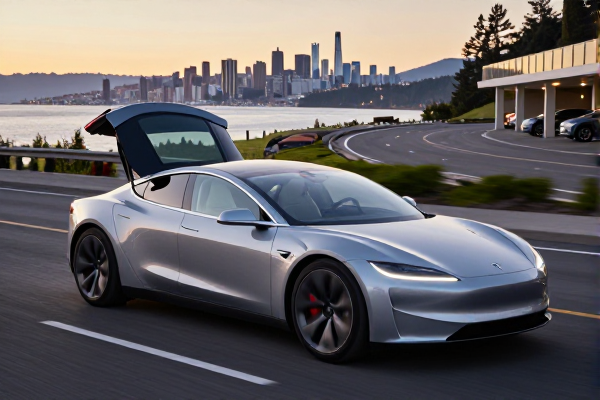
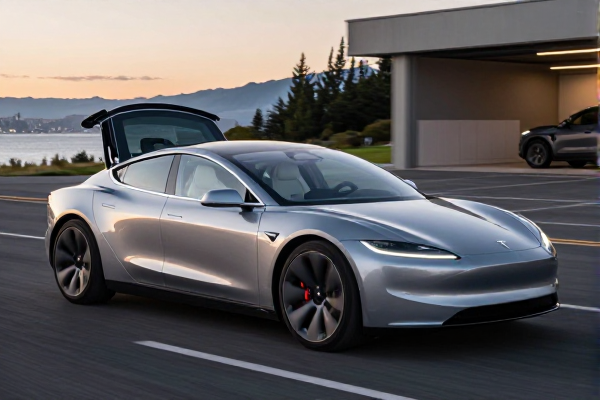
Design-wise, Tesla says the Roadster has come a long way since the original concept. The Cybertruck, Cybercab, and Optimus have all shaped the latest look. The new Roadster also takes visual cues from two iconic military aircraft, the SR-71 and the F-35. Exterior details include hidden headlights, a single full-width taillight, flush body panels, featherweight thin-spoke wheels, and an aerospace-grade Ano White finish built to resist UV, extreme cold, static, and corrosion. Gold-tinted glass, inspired by spacesuit visors, is trimmed in titanium.
Inside, the cabin stays firmly driver-focused. White surfaces are paired with gray microsuede accents and grippy bolstered seats. There are manual controls and a fixed seat to save weight, with magnesium, titanium, and carbon fiber used throughout. Tesla argues the lightweight approach lets the Roadster respond to driver inputs almost instantly.
The Roadster’s commercial positioning is just as deliberate as its engineering. Tesla has described the model as the “last best driver’s car.” That phrase carries weight as Tesla pushes toward autonomy, robotaxis, and hands-free transport. The original 2008 Roadster had one job: to prove that an electric car could be “fast, sexy & worth wanting.” The new Roadster is designed as a final celebration of human-driven performance before the company’s main focus shifts farther down that autonomous path.
The program gained momentum in the months before the reveal. Elon Musk said in April that the Roadster could debut “in a month or so.” Tesla executives confirmed in May that the car would be built in Texas. Reports in August pointed to a standard version and a separate SpaceX-assist variant. The launch was then moved because of severe weather, and the company finally delivered the full event days later.
From a market perspective, the new Roadster raises the bar significantly. The Rimac Nevera, which has boasted about its 0-60 mph acceleration in the 1.7-second range, is now well behind the claimed Rocket number. The Bugatti Chiron family also sits in the two-second range. Tesla’s real-world demo of 0.81 seconds, and its claimed 0.59 seconds for the Rocket, push the Roadster into a performance envelope that no production supercar has publicly targeted.
Pricing and delivery timing have not yet been announced. Reservations are open at Tesla.com/Roadster, and interested buyers can secure a spot with a deposit. The Roadster is not a car for everyone, but it is perhaps the clearest statement yet of what Tesla can do when it stops worrying about mass production and focuses solely on spectacle.
For now, the Roadster closes a nine-year chapter with a dramatic finale. It is a car that can out-accelerate almost anything on four wheels, while also — at least in Rocket form — leave the ground entirely. Whether it becomes the best-selling Tesla is beside the point. The Roadster is built to remind people why electric cars are worth wanting in the first place.