Browse

Log in / Register
 Share

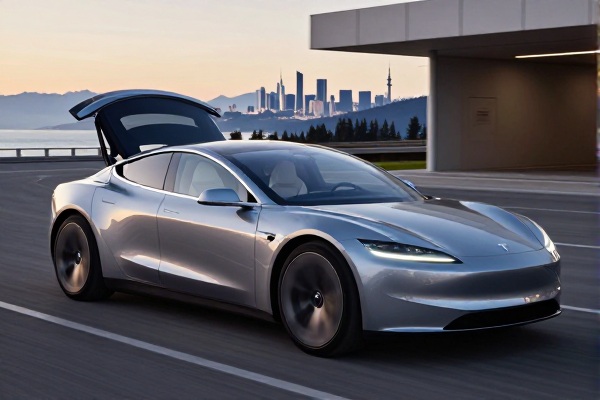
On Friday, May 8, 2026, Tesla CEO Elon Musk finally put the next-generation Roadster back in the spotlight. A prototype rolled onto a small stage and, after a burst of compressed air from its thruster system, executed a short, controlled flip before landing back on its wheels. It was the clearest signal yet that the sports car Musk has teased since 2017 is moving closer to production.
Musk had talked about Roadster “rocket tech” for years. On Friday, he showed it. “It can basically fly, like a rocket,” he said, standing near the car. That line is typical Musk, but the implication should not be taken literally. The Roadster is not a flying car. It is a high-performance EV with cold-gas thrusters, and the on-stage flip was the most dramatic way to show what that system can do.
The second-generation Roadster was first revealed in November 2017, during Tesla’s Semi truck event. It was positioned as the ultimate Tesla performance flagship, and the specs stole the show: around 620 miles of estimated range, a top speed above 250 mph, and a 0-60 mph time under two seconds.
Then came the delays. Tesla kept saying “next year,” and the target kept slipping. The Roadster became a punchline for people who track Tesla’s promises. Musk, though, never stopped raising the stakes. He repeatedly mentioned a SpaceX-developed thruster option, but there was little physical proof to show for it.
Friday’s event changed the conversation. The car on stage was not a static display model. It moved, fired its thrusters, and flipped. Musk did not show a final dashboard or a complete price list, but he did something Tesla has avoided for years: he let the hardware do the talking.
Cold-gas thrusters are not rocket engines in the traditional sense. They use pressurized air stored in composite tanks. When that air is released through a nozzle, it produces a short burst of thrust. There is no flame, no ignition, and no fuel burn.
On the Roadster, the system is designed to add force in brief moments. That can assist acceleration, sharpen braking, and shift weight distribution for better cornering. For the stage stunt, the thrusters did something more theatrical: they gave the car enough rotation to leave the ground and land back on its wheels.
The engineering challenge is packaging. A Roadster already needs batteries, motors, cooling, and safety structure. Adding high-pressure carbon-fiber vessels and high-flow valves makes that harder. The fact that a prototype completed a controlled flip suggests Tesla has solved at least part of the puzzle.
No. That is the short answer.
Musk’s “basically fly” quote is effective showmanship, but it is not a technical claim. The thrusters add brief impulses, not sustained lift. They are not replacements for the wheels. The phrase may create a good headline, but it gives the wrong idea about how the car works in the real world.
What the demo actually proves is that Tesla is willing to borrow ideas from its rocket program and put them into a road vehicle. That is a much more interesting engineering story than a car actually lifting off the ground.
Tesla still lists the base Roadster target as 0-60 mph in about 1.9 seconds, with an estimated range of roughly 620 miles. Those numbers were extraordinary in 2017. They remain competitive now, although the electric performance market has changed dramatically.
Rimac, Lucid, Porsche, and Pininfarina have all shown high-power battery cars with enormous acceleration figures. The Roadster’s main edge may come from the thruster package, not from just raw motor output. It gives Tesla a different story: not a bigger electric motor, but a car influenced by SpaceX engineering.
That positioning is the real reason for the on-stage flip. It is a reminder that Tesla still wants to be seen as the most ambitious automaker, not just the biggest seller of electric crossovers.
The Roadster is not a volume product. The Model Y is the financial engine of Tesla. The Roadster exists to generate attention, attract reservations, and reinforce the idea that Tesla can still produce world-beating performance cars.
The company has faced more competitive pressure in the EV market. Legacy automakers and newer startups have narrowed Tesla’s lead. A car that can perform a stage flip with rocket-derived technology is an effective way to cut through the noise.
There is also a practical reason to be cautious. Tesla has a history of impressive reveals followed by long waits. The thrusters may work in a controlled demo, but production validation includes regulatory approval for high-pressure tanks on a road vehicle. That process can be slow and expensive.
Friday’s event was a step forward, but Tesla still has not confirmed a firm delivery date. Musk said the car is getting close, yet he has said that before. The real milestones are the production-intent prototype, final homologation, and a clear order page with pricing.
Until those milestones arrive, the Roadster remains a very exciting promise. The on-stage flip was the strongest proof yet that the project is alive. It also showed exactly how Musk plans to sell it: as fast, dramatic, and closer to a rocket than any other road car.
None of that means the car is ready for customers. But for the first time in years, the next-generation Roadster no longer looks like a fantasy. It looks like a sports car that just might fly through its own part — without ever leaving the ground.