Browse

Log in / Register
 Share

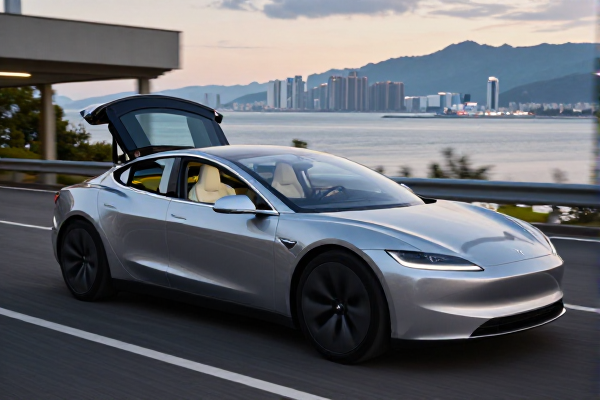
Elon Musk gave the long-delayed Tesla Roadster its most dramatic public preview yet last Thursday (Oct. 15, 2026) at a SpaceX testing site in Texas. The prototype drove up a curved ramp, held itself upside down, then floated down using air jets. It then cleared a row of parked vehicles while doing a 360-degree flip. As of Oct. 16, 2026, Tesla has not published a full specification sheet, but the event itself and the company's on-site explanations provide a clear picture of how the car moves.
Two stunts, one message
The first stunt was as simple as it was hard to process. The Roadster crawled up a curved ramp, stopped at the apex, and remained upside down for a few seconds, as if held by an invisible hand. Musk later explained that the car uses a fan system under its chassis to suck air out from underneath. That creates a low-pressure area between the floor and the ramp surface, pressing the car against the ramp with enough force to hold its weight.
After that, the car came off the ramp and made a smooth, air-cushioned landing. The second trick involved a line of parked cars as a makeshift ramp. The Roadster drove toward them, launched into the air, turned sideways and end-over-end, then came down on its wheels. Tesla called the move a "kick flip" — a skateboard term — rather than a barrel roll.
Suction: The "suck" system
Tesla refers to the underside arrangement as a multi-mode fan and ground sealing system. It works much like a giant vacuum. Fitted with edge seals, the car creates a partial vacuum under the floor. The higher pressure above the car pushes down, producing downforce. Tesla claims the effect is strong enough to "pull up to 2Gs", meaning a driver could feel twice their body weight pressing into the seat if the car were accelerating hard.
Downforce is not a new idea; Formula 1 cars use wings to generate it. But the Roadster's system does it at zero speed. Because the fan is electrically powered, it can hold the car to a vertical surface or a ceiling without needing airflow over the body.
There are limits, of course. The seal requires a smooth, continuous surface. Painted ramps and clean pavement work well. Gravel roads, potholes, or broken asphalt would defeat the vacuum, which is why the demonstration was done indoors on a curated course.
Thrusters: The "SpaceX" part
For actual hang-time, the Roadster turns to cold-gas thrusters. Two pressurized vessels hold roughly 250 kilograms of air; ten nozzles distribute that air around the car. When the driver or the autonomous system fires a nozzle, a jet of air shoots out, creating thrust in the opposite direction.
Musk said the system "can basically fly like a rocket and do rolls and crazy gymnastics." It works because the thrusters are driven by all-electric actuators that react in milliseconds, allowing the car's software to balance the vehicle during a jump.
Aerospace engineers will recognize the principle: cold-gas thrusters have been used for decades on satellites and spacecraft to make fine adjustments in orbit. The Roadster essentially miniaturizes that concept and attaches it to a car. The result is a vehicle that can alter its orientation outside the wheels' contact patch.
Musk said the tanks can be recharged by the car's own air compressor, but Tesla did not say how long it takes to fill them or how many thrust bursts a full charge allows.
Performance claims and track mode
Even in standard driving mode, the suction fans change the car's character. Tesla says the fans accelerate airflow under the vehicle, increasing grip and stability at all speeds. Musk predicts that the Roadster will "crush every track record" because the car can corner with a lateral grip unseen in a production vehicle.
The headline numbers are just as aggressive. Tesla says the Roadster will reach 60 mph from rest in 0.81 seconds. That works out to an average acceleration of nearly 3.4G, and it would place the car comfortably ahead of any current street-legal production model. Musk did not stop there: he wants engineers to push the car to half of Mach 1, roughly 383 mph at sea level. That would be faster than the accepted land-speed record for production cars, though he gave no timetable.
Safety and legality: Big question marks
Musk was candid about the vehicle's shortcomings. "This is not a safety-optimized car," he said. "I'm not sure if this is legal in all jurisdictions." The comment is rare for a company whose previous launches are heavily scripted, and it underscores how far the Roadster is from production.
Tesla's own literature admits the top Rocket variant is not approved for public roads. In the United States, that leaves the Roadster in a regulatory gap. The National Highway Traffic Safety Administration has authority over road vehicles, while the Federal Aviation Administration oversees anything that flies. No regulator has asked Tesla to submit plans yet, at least not publicly.
Three variants, one invite-only
Tesla says the Roadster will come in three configurations. The base Performance is road-ready, with two seats and the suction system. The Thrust variant adds acceleration thrusters, making it race-ready, but it still cannot fly. Only the Rocket variant includes the full flight system, seats one person, and is invitation-only. Reservations for the first two start at $50,000 and go to $250,000; the Rocket has no public price list.
The 2028 question
Musk says production will begin in 2028, and that the car will be "a buyable car." That is a bold timeline given that the Roadster was first shown in 2018 and has already blown through many internal deadlines. The technologies powering the stunt are real, but turning them into a reliable, safe, road-legal vehicle will take years. Even if 2028 holds, the Rocket variant will likely remain a showcase rather than a commuting option.