Browse

Log in / Register
 Share

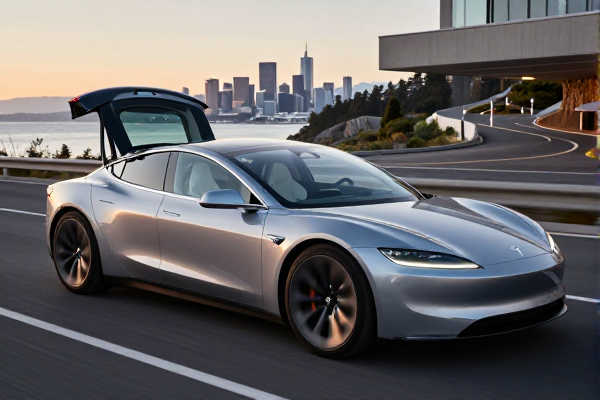
October 25, 2025 — Tesla has given its most detailed look yet at the next-generation Roadster's cockpit, and the fighter-jet theme is hard to miss. A 34-second video posted to X on Friday shows a black-and-red touchscreen built "around the pilot," with a rotating wireframe of the car on the home page, a full Track Mode telemetry suite and a thruster gauge reading 5,500 PSI. The timing lines up with a milestone: the Roadster is now on public display for the first time at the Petersen Automotive Museum in Los Angeles, running through October 27, with production still targeted for 2028.
Current Teslas treat the navigation map as the default state of the center display, with vehicle settings tucked behind menus. The Roadster goes the other way. A 3D wireframe of the car sits at the center of the home page, next to a squared-off yoke, and tapping different parts of the model summons the rear wing controls — low drag for top-speed runs, high downforce for corners. The charging page with its charge limit bar shares the screen, and a small music player is tucked in as well. A row of tabs along the bottom reads Home, Vehicle, Listen, Climate and Navigate, but the car itself is clearly the star.
It's a small rearrangement that says a lot about priorities. Navigation becomes just another app rather than the operating system. Tesla's Roadster page lists two smaller forward displays on either side of the main touchscreen, which would push the cockpit presentation even closer to aviation — but the Friday video keeps its focus on the center screen.
Most of the footage is spent inside Track Mode, and that's the real substance. The instrument cluster transforms into a live circuit map, a session lap-time list, and a set of temperature gauges for the brakes and motors, with each tire reporting its own pressure and heat. The setup page lets the driver choose Auto, Low Drag, High Downforce or Custom aero modes, adjust aero balance and brake balance, and switch off stability and traction control entirely. On a car with this much performance, those controls matter more than any entertainment feature.
The fact that the video reads like real firmware, not a static render, is notable. A functioning lap timer and live-looking telemetry suggest the software team is further along than the car's 2028 on-sale date might imply. Lap-time lists and per-tire readouts are exactly what owners will pull up at a track day, and seeing them rendered in a teaser is a quiet promise that the Roadster's software will be as serious as its hardware.
The most telling element sits at the bottom of the screen: "Thruster · 5,500 PSI" next to a "Boost Ready" indicator. That's a direct link to the hardware Tesla displayed near Waco, Texas, on October 15. The Thrust and Rocket trims use cold gas thrusters fed by carbon overwrapped pressure vessels — aerospace-grade tanks that hold high-pressure gas without the weight penalty of all-metal designs. Tesla quotes 0–60 mph times of under 0.9 seconds for Thrust and under 0.59 seconds for Rocket. The base Performance car instead relies on a fan and ground-sealing system for grip, and the aero settings in the UI line up with the active wings and suction hardware that generate its downforce.
Cold gas propulsion has no combustion chamber. It's a tank, a valve and a nozzle: compressed gas escapes, and the car gets thrust instantly. It's the same principle satellites use for attitude control in orbit. For the Roadster, that means no spool-up time and no ignition sequence — just pressure waiting at the valve. A "Boost Ready" readout implies the vessel can sit pressurized even when the car is off, which is a thoroughly un-vehicular way to think about readiness.
That's also where the fighter jet comparison stops being cosmetic. The interface reads like the multi-function displays in modern combat aircraft, with one screen managing a dozen subsystems, and the red-on-black graphics reinforce the cockpit theme. But unlike a fighter, the Roadster still has to be a usable road car. The squared yoke has to satisfy the same crash standards as any steering wheel, and the interface has to remain legible at highway speeds. Tesla's design challenge is making the fantasy work in the real world.
The software is not final, and the timeline still has room for surprises. Elon Musk said at the October 15 event that Roadster production begins in 2028. The Roadster was first teased in 2017, so any date comes with a note of caution, but Tesla has never been shy about changing details before delivery. Reservations are open with a $50,000 deposit; Thrust is listed as a limited release, while Rocket is invite-only. Tesla also notes the Rocket version is not approved for public road use, which would effectively restrict its owners to tracks and private land.
There's a strategic angle in showing the cockpit now. A $50,000 reservation is a real commitment, and it filters for people who are serious about this car. The video gives that group something to point at and talk about, and it gives everyone else a reason to revisit the brand's halo product. For a car that won't ship for three more years, this kind of marketing keeps the narrative moving without Tesla having to build a single production unit.
Tesla has not said whether Track Mode telemetry or the new layout will reach the Model 3 Performance or any other model. The Roadster has always existed as a separate experiment inside the company — a chance to build something uncompromising before returning to the volume business. If any of its cockpit language trickles down, the rest of the lineup will look different in a few years. If none of it does, the Roadster remains what it has always been: a halo, not a template.
The venue for this reveal matters. The Petersen Automotive Museum in Los Angeles is hosting the Roadster from October 24 through 27, according to Sawyer Merritt, and the museum's lobby is about as close as the public has been able to get to the car. Tesla typically controls access to its halo cars tightly, so a multi-day display suggests the design shown in recent teasers is close to what will eventually ship. For most people, it may be the only chance to see the next Roadster in person before 2028. Either way, the wait for the Roadster just got a little harder to ignore.