Browse

Log in / Register
 Share

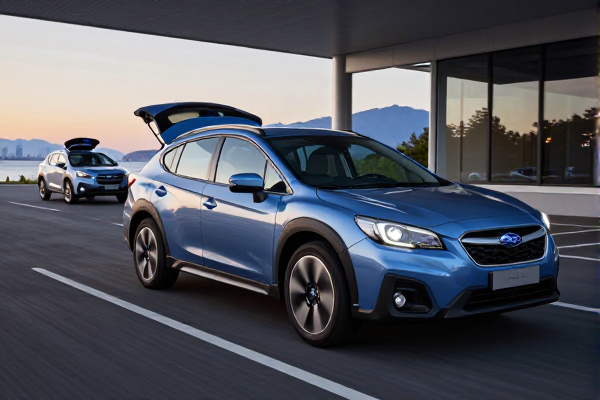
Subaru is taking a major step toward self-reliance in the electric-vehicle race. On Thursday, the Japanese automaker confirmed that it is building its own dedicated EV platform and powertrain, largely with in-house technology. A prototype showcased at Subaru’s proving ground north of Tokyo pairs the new chassis with a 510-horsepower dual-motor all-wheel-drive system. The company expects the first production model on this architecture to arrive around 2029.
The announcement, made during a media event in mid-October, signals a strategic shift and a move away from leaning on Toyota’s EV technology. While Subaru’s current electric lineup—Solterra, Trailseeker, Uncharted, and Getaway—sits on shared Toyota-developed underpinnings, this new platform is meant to give Subaru its own technical identity. It also arrives far sooner than many industry observers expected: Subaru says the development cycle took roughly half the usual time.
The prototype is not styled as a future showroom model. To validate the chassis and electric drivetrain, engineers fitted it to a previous-generation Outback body. Because the EV’s wheelbase is longer than that platform was designed for, the wheel wells had to be extended, leaving visible gaps around the tires. That’s a clear sign this mule is strictly for testing, not a design preview.
Power comes from two electric motors developed alongside Aisin, a Toyota Group supplier. The front unit delivers 150 kW (201 hp), while the rear motor produces 230 kW (308 hp), for a combined output of 380 kW, or about 510 hp. Subaru claims the AWD prototype accelerates from zero to 100 km/h in under four seconds. Executives declined to disclose battery capacity, range, or charging speed, but they were more forthcoming about the hardware itself.
The motors are described as smaller and lighter than those used in Subaru’s current EVs. Engineers say the new units are about 30 percent more efficient than the industry average. Battery supply comes from Panasonic Energy, which provided 4,000 cylindrical cells for the pack. Subaru says the pack is 25 percent lighter than the previous generation and targets an energy density that is 20 percent above industry norms. The dedicated platform also shaves roughly 100 kg (220 lbs) compared with Subaru’s existing structures.
Safety development is a central part of the architecture. The platform is designed not only to manage crash forces more effectively but also to protect the underfloor battery pack. Reinforcements above the front wheels help redirect impact energy away from the cabin, and the front motor is engineered to rotate during a collision to absorb kinetic energy. That kind of attention to crash behavior is crucial as automakers integrate large battery packs into vehicle structures.
Beyond the mechanical drivetrain, Subaru is introducing a new integrated electronic control unit. This single controller manages driver assistance, chassis and powertrain functions, and infotainment. It is built around a custom system-on-chip from Advanced Micro Devices, which enables AI processing and over-the-air software updates. For a Subaru-developed vehicle, that’s a first. The same ECU will also provide the computing foundation for future versions of EyeSight, Subaru’s signature driver-assistance suite.
This is not an abandonment of gasoline engines, though. Subaru said it will continue developing internal combustion engines, with a target of 50 percent thermal efficiency for future hybrids and conventional powertrains. The company has long argued that a mix of electrification and efficient gasoline engines gives it flexibility in markets where charging infrastructure remains thin.
The broader picture is strategic. Subaru entered the EV market thanks to Toyota’s cooperation, but its current models have often felt like rebadged versions of Toyota’s bZ4X, lacking the quirky character that defines Subaru’s crossover and rally heritage. Building its own platform lets the brand control the driving dynamics, all-wheel-drive tuning, and safety philosophy that owners expect. It also differentiates the showroom experience, which today can feel like two families under one roof.
Industry analysts see this move as a calculated hedge. Toyota remains a valuable partner for Subaru in areas like hybrid systems and platform sharing. At the same time, Subaru is unlikely to walk away from that relationship entirely. But having an independent EV architecture gives the company leverage and an identity that increasingly matters as electric vehicles become a bigger share of global sales.
With production still four years away, there are plenty of unknowns. Battery specs, charging performance, and pricing will all be critical. Yet the prototype’s existence proves that Subaru is serious about doing the engineering itself, not just borrowing someone else’s blueprint.
The timing also matters. Many legacy automakers are slowing their EV timelines, but Subaru appears to be accelerating its own development. By compressing the platform program into roughly half the industry-standard timeframe, Subaru is betting that a dedicated in-house EV can be both distinct and cost-effective. The 2029 launch window leaves room for battery technology to evolve—and for Subaru to refine the driving character that has long set it apart.
For now, the mule is just a test bed. But it already hints at what a real Subaru EV could feel like: quick off the line, secure in corners, and unmistakably designed by the company that made all-wheel drive famous. The countdown to 2029 has begun.