Browse

Log in / Register
 Share

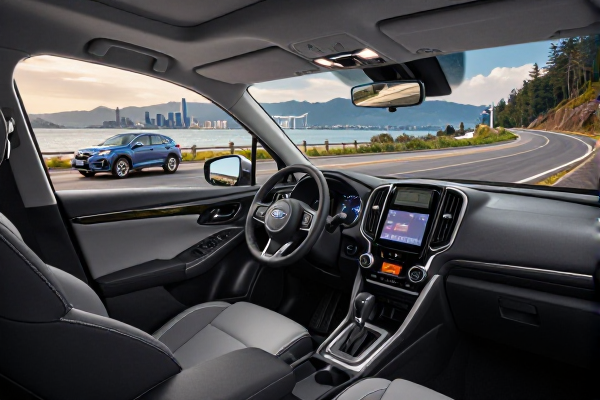
On October 18, 2025, at a test track north of Tokyo, Subaru pulled the cover off a modified Outback carrying a fully electric powertrain. As of this writing on October 20, 2025, the carmaker has revealed only a handful of hard specifications, but enough to know this is not a typical EV. The most important news: the prototype rides on Subaru's own dedicated electric platform, not the Toyota-built e-TNGA architecture found in the Solterra and Toyota bZ4X.
Power comes from two motors, tuned for the brand's AWD character
The front motor, supplied by Aisin, contributes 150 kW (201 hp). The rear motor is larger, producing 230 kW (308 hp). Combined output is about 510 hp. That gives the SUV enough punch to hit 62 mph in less than four seconds, according to Automotive News, with Motor1 reporting the figure. Even more important is how the power is split. Subaru uses a rear-biased distribution that still maintains continuous all-wheel drive. In effect, the car defaults rear-torque for agility but can shift power forward instantly when grip is needed.
This is exactly what Subaru does with its Symmetrical All-Wheel Drive on petrol and hybrid models. The difference is that the electric architecture lets the control system alter the front-to-rear balance without a center differential. The motors themselves are the differential.
A platform of its own: breaking from Toyota
Subaru's decision to build this prototype on its own platform is strategic. The current Solterra uses Toyota's e-TNGA, which forces certain structural and packaging choices. By moving to a proprietary setup, Subaru can tune motor response, torque vectoring, and regenerative braking with far more freedom. It can also place the battery where it wants, not where Toyota's architecture requires.
Company engineers at the unveiling were clear: the project started with the driving dynamics, not with a shared parts bin. That mindset has served Subaru well in the past with its boxer engines, and the company appears to be trying to carry that engineering voice into electrification.
Weight and battery innovation
Subaru says the new platform is about 220 pounds lighter than the platform in its current EVs. The battery pack uses about 4,000 cylindrical cells and is roughly 25 percent lighter than the previous unit. Subaru claims the pack's energy density is about 20 percent higher than the industry average. It has not published total capacity, charging speed, or driving range.
Those missing numbers might frustrate spec-chasers, but there is a reason to hold back. Subaru's focus seems to be on weight reduction first, range second. Lighter battery packs don't just improve efficiency—they also sharpen handling and braking response. For a brand that sells AWD crossovers to people who drive on dirt roads and mountain passes, a 25 percent lighter battery is a bigger selling point than a 10 percent longer range.
Battery cell choice has a reason
The prototype's battery pack holds roughly 4,000 cylindrical cells. Such cells are widely used in EVs because they are easy to cool, simple to integrate, and less expensive than pouch cells. Tesla was the first to mass-produce them with tabless designs. For Subaru, choosing cylindrical cells may also help reduce cost in a low-volume platform. The claimed 20 percent higher energy density, if true, would be a notable engineering achievement, but the lack of specific capacity figures makes independent verification impossible.
Software takes the wheel
The prototype also introduces a new integrated control unit that manages the electric motors, battery, and software under one roof. The unit is designed for over-the-air updates. Subaru says this will let engineers refine torque split, pedal mapping, and stability control after cars are delivered. It is the kind of flexibility that modern EV owners expect, and it marks a significant shift for Subaru, which has never offered OTA updates of this depth before.
Executives said that some of the technologies on the prototype could reach production in 2029. They did not specify whether it would be an Outback EV, a WRX-style sedan, or something else. But the 2029 timeline suggests the company is aiming for a second-generation EV platform, not a quick refresh of the Solterra.
Subaru's timing and market realities
Subaru's announcement comes during a difficult period for EV adoption in the U.S., where price, charging infrastructure, and consumer hesitation have slowed growth. In Japan, the market is even more conservative. Yet Subaru is still looking forward. It recently expanded its EV lineup in several global markets, and the brand's U.S. sales have remained stable, in part because of its rugged image. A performance EV with Subaru's hallmark AWD and torque split could become a halo for the whole lineup.
Where this leaves Subaru's EV strategy
Subaru is late to the electric party. The Solterra has been a solid but unexceptional entry, and its Toyota-derived platform limited how far Subaru could push it. This prototype is a direct answer to that criticism. It also makes clear that the company intends to keep its "all-weather, all-road" identity in the EV era.
From a competitive standpoint, the 510-hp electric crossover segment is getting crowded. The Ford Mustang Mach-E, Hyundai Ioniq 5 N, and Tesla Model Y Performance all offer similar numbers. What Subaru will bring to the table is off-road capability and a distinctly natural steering feel. If the company can hold onto those traits while going electric, it won't need to beat Tesla on 0-60 times. It just needs to be the EV of choice for people who take their cars to corners, hills, and places without charging stations nearby.
Our take: a high-risk, high-reward bet
Subaru's decision to develop its own EV platform is not without risk. Compared to shared architectures, proprietary ones carry higher development and manufacturing cost at a time when Subaru's overall profit margins are thin. But the payoff could be differentiation. General Motors and Volkswagen are both struggling to make separate EV platforms profitable. Subaru is a niche brand—its base is small, loyal, and more willing than average to wait for a car that still feels like a Subaru. If this prototype becomes the basis of an eventual WRX EV or Outback EV, it could give the brand a second life in the electric era.
Bottom line
The 510-hp prototype is a strong signal that Subaru is not content to be a footnote in the EV transition. By building its own platform, integrating its own control software, and chasing weight targets, the company is making a bet on engineered character rather than on badge sharing. Whether 2029 actually brings a production car is still uncertain—but the direction is clear.