Browse

Log in / Register
 Share

Updated: May 7, 2026
German President Frank-Walter Steinmeier opened his 2026 state visit to China with a stop at Volkswagen's Hefei R&D complex on Tuesday, choosing the venue to underscore how the two countries' automotive relationship has moved beyond assembly lines. The visit lands as EU-China trade negotiators make headway and German carmakers push local EV, software and autonomous-driving partnerships into the center of their strategy.
State broadcaster CCTV reported that Steinmeier arrived at Hefei Xinqiao International Airport early Tuesday, with Anhui province as the first leg of his Oct 27-31 program. Xinhua said it was his first China visit in nearly eight years.
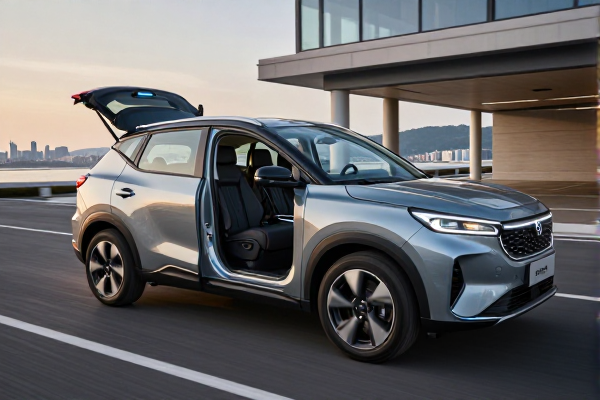
Inside VW's campus, Steinmeier toured labs where engineers test hardware-software integration and software-defined vehicle development. Volkswagen said the president saw work built around its locally developed China Electronic Architecture, or CEA. He also test-drove an ID. AURA T6 equipped with CEA and the Hyper Sense 8 advanced driver assistance system. According to VW, on an obstacle-filled test track he handed full control to the system, then used a smartphone to park the car remotely from outside the vehicle.
Ralf Brandstätter, chairman and CEO of Volkswagen Group China, said the group wants to combine China's speed at innovation with its own global engineering reach. Sharing technologies and development results across the group strengthens export business and overall competitiveness, he said.
Hefei is not an arbitrary choice. The city has become one of China's electric-vehicle nerve centers, home to NIO's global headquarters and a growing cluster of suppliers and software companies. VW's Hefei R&D center, known as Volkswagen Group China Technology Company, brings together vehicle development, component research, procurement and testing. That setup lets the company develop and validate models locally, cutting time to market by about 30%, according to Xinhua.
The economic stakes are large. Chinese customs data show China-Germany goods trade hit 1.2 trillion yuan ($179.96 billion) in the first three quarters of 2026, up 6.2% year on year. September trade alone reached 146.17 billion yuan, up 11.3%. Electrical equipment, electronic components and pharmaceuticals led bilateral trade flows.
The visit followed two strategic announcements by German auto groups. On Monday, Volkswagen Group China said it had obtained a Level 3 autonomous driving road-test permit in Hefei. Audi, for its part, outlined an updated "dual-brand, dual-partner" strategy: with China FAW Group, it will focus on the four-ring brand's new-energy and combustion models; with SAIC Motor, it will focus on the AUDI letter-mark marque and the NEV market.
Li Yong, senior research fellow at the China Association of International Trade, told the Global Times that Steinmeier's stop was loaded with symbolism. Volkswagen has been part of China-Germany auto cooperation for decades and has watched the country's industry evolve. The itinerary also gives the president a chance to hear directly from executives about their experience on the ground, particularly while EU-China automotive trade differences remain in focus.
Zhang Xiang, secretary-general of the International Intelligent Vehicle Engineering Association, said German automakers increasingly rely on their Chinese operations in R&D as they respond to changing market conditions. Developing new-energy vehicles in China lets them use local engineering talent, suppliers and the broader industrial ecosystem. Zhang said the relationship is moving from traditional manufacturing toward joint research, development and technological innovation.
The potential payoff is not limited to China. Reuters, citing Manager Magazin, reported Monday that Volkswagen could use China-developed software in future European mass-market cars. The CEA platform, co-developed with XPeng for Chinese models, could form the basis for future VW, Skoda and Cupra vehicles. That would mark a notable reversal: software designed in China, once mainly an input for local consumers, heading to Europe.
Li Yong said deeper cooperation helps Volkswagen keep pace with local product cycles and consumer demand while drawing on China's advances in new-energy vehicles and battery technology. The group can then combine those strengths with its own experience to build competitive products.
Zhang warned against letting trade friction block that kind of collaboration. China's comprehensive automotive supply chain and technical capabilities are valuable to European carmakers as they face electrification. Restricting cooperation, he said, would risk cutting off German brands from the very capabilities they need to compete globally.
For Steinmeier, the Hefei stop was a direct view of what the future of that partnership looks like. The German president saw not just a factory, but an R&D center where Chinese teams help shape global platforms. That may be the clearest sign yet that China-Germany auto ties are no longer just about making cars in China, but about co-defining the next generation of cars everywhere.