Browse

Log in / Register
 Share

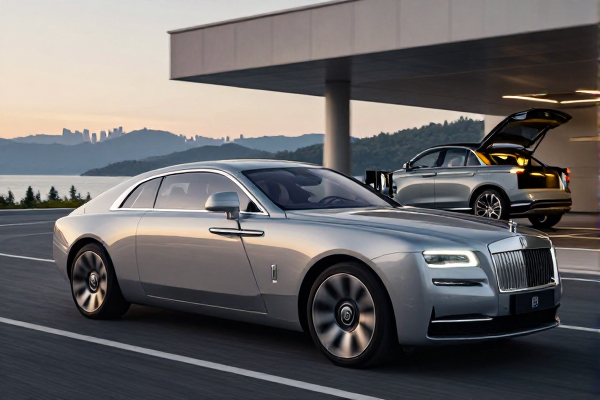
As of May 7, 2026, Rolls-Royce has confirmed that the first Project Nightingale prototypes are now undergoing on-road development in southern Europe. The announcement marks the transition of this ultra-exclusive electric convertible from design teaser to a fully engineered test programme. Project Nightingale is the inaugural model of Rolls-Royce's Coachbuild Collection, with only 100 examples planned for delivery to carefully selected clients.
The prototype images released by the company show the two-seat droptop in near-production form. With a length of 5.76 metres, the car presents a dramatic, uninterrupted profile that blends classic coachbuilt proportions with a modern, minimalist EV stance. Unlike many electric luxury cars that retain a traditional cabin volume, Project Nightingale's low bonnet and tapered tail signal that this is a design-led project, not a repackaged SUV platform.
What makes these images especially important is that they are real-world photographs, not renders. Rolls-Royce has historically been opaque about its development process, particularly for one-off and limited-build commissions. The fact that the company is willingly showing test vehicles suggests a deliberate effort to build momentum among existing clients and to reinforce the technical credibility of the Coachbuild division.
Project Nightingale is not a random codename. According to Rolls-Royce, the name comes from Le Rossignol — French for "The Nightingale" — which was the villa on the French Riviera where company co-founder Henry Royce housed his designers and engineers during his later years. Royce reportedly used the property as a retreat where he could focus on engineering experiments, most notably his series of "EX" test cars in the 1920s.
The connection to that era is not incidental. In a statement, Rolls-Royce CEO Chris Brownridge said: "Project Nightingale captures the same audacious spirit that drove Sir Henry Royce to build his experimental 'EX' motor cars in the 1920s: a desire to discover what Rolls-Royce is truly capable of, unconstrained by convention."
Brownridge's quote is more than marketing. It indicates that Rolls-Royce intends Project Nightingale to be judged on engineering ambition rather than merely on visual opulence. That is a meaningful distinction for a brand that is still defining what "Coachbuild" means in the fully electric era.
The prototype schedule is being taken seriously. Rolls-Royce tells us the test fleet is now working through a series of European roads "where Rolls-Royce first proved itself to the world a century ago." After that, the development team will move to extreme climates across the globe, reflecting the fact that commissioning clients intend to drive their cars year-round in regions that range from freezing northern winters to desert summers.
Among the most interesting details is the attention paid to closing sounds. The "Piano Boot" — the name given to the rear deck — is being refined so that its closing action produces the exact acoustic character expected by Rolls-Royce owners. Engineers are reportedly testing this mechanism to 15,000 operating cycles. The level of validation seems closer to mass-production durability testing than to low-volume coachbuilding, which is exactly the point.
The roof is another major focus. Rolls-Royce says it is lined with cashmere, chosen to mute road and wind noise while maintaining the soft, warm aesthetic the brand's customers expect. The roof's fabric and closing mechanism will undergo ten separate tests at temperatures up to 80°C, ensuring that the mechanism works reliably in extreme heat and doesn't fade or degrade in high UV environments.
There is also a new electric wind deflector in the cabin. Rather than adding a traditional mesh screen that requires manual installation, the system is integrated directly into the body structure and is deployed electronically. For a two-seater, this is a crucial refinement: it allows the occupants to enjoy open-air driving at speed without the buffeting that usually spoils a convertible's sense of calm.
Henry Royce's original EX cars were never conceived as retail products. They were mobile research laboratories, used to test chassis rigidity, cooling efficiency and gearbox behaviour on ordinary roads. The engineers working on Project Nightingale appear to be following the same philosophy — except the variables have changed. Instead of carburettors and leaf springs, they are calibrating electric motors, battery packaging and acoustic insulation.
This continuity matters for the brand's story. Rolls-Royce is not simply building another convertible; it is updating a century-old engineering culture for a new propulsion system. By linking the project to Le Rossignol and the EX series in its official communications, the company is making a deliberate claim: that bespoke bodywork and technological experimentation have been part of its DNA since the beginning, not just a modern marketing trend.
The decision to release such a steady stream of technical detail is revealing. Rolls-Royce could have simply announced Project Nightingale and then kept every image under embargo until a formal debut. Instead, the company is feeding the market incremental updates. That approach is reminiscent of modern premium EV launches, where range, charging and durability become key selling points. But for a Rolls-Royce, the priorities are different: silence, material quality and tactile satisfaction.
In my analysis, Project Nightingale is a proving ground for future Coachbuild projects. Every feature tested here — the electric wind deflector, the cashmere roof, the piano boot mechanism — will likely be offered as a custom option on future models, reusing a bank of validated components. By testing these items at extreme temperatures and high cycles, Rolls-Royce is building a bespoke parts catalogue that doesn't compromise on engineering integrity. That is a genuinely new approach for a manufacturer that once treated bespoke as mostly cosmetic.
There is also a business dimension. With only 100 units, Project Nightingale will be financially exclusive in the strictest sense. But the investment in testing suggests that Rolls-Royce is not treating this as a one-off showpiece. It is developing a repeatable platform of coachbuilt EV components that can be applied to subsequent limited editions. The result may be a small production number with a very large R&D footprint — a pattern that allows luxury automakers to justify bespoke engineering in a way that would have been unthinkable a decade ago.
Looking at the new images, it is hard to ignore the road presence of the car. The long bonnet, wide front grille treatment and slim LED headlights give it an assertive stance while avoiding the aggressive appearance of some performance convertibles. It is recognizably a Rolls-Royce, but with a more streamlined silhouette than any previous model.
The fact that the test cars are equipped with temporary lighting elements and measurement sensors doesn't diminish the effect. If anything, the exposed engineering equipment reinforces the message that this is a real development programme, not a static concept. The car is being shaken down on public roads, which means the final product will have to survive not just the show floor, but the potholes, uneven tarmac and unpredictable weather of real-world driving.
Project Nightingale remains a rare and expensive proposition, but its importance goes far beyond the 100 clients who will end up owning one. It gives Rolls-Royce a way to demonstrate that electric propulsion can coexist with the brand's traditional values of calmness, craftsmanship and restrained power. If the testing programme continues on its current trajectory, the final reveal will be more than a style exercise — it will be proof that the world's ultimate coachbuilt cars can also be among the most technically rigorous.
For now, the first photos of the prototype offer a tantalising preview. As the European testing phase continues, expect more details to emerge about the car's performance figures, range, and the specific options offered to customers. And given Rolls-Royce's new willingness to show its work, the next update may come sooner than many expect.