Browse

Log in / Register
 Share

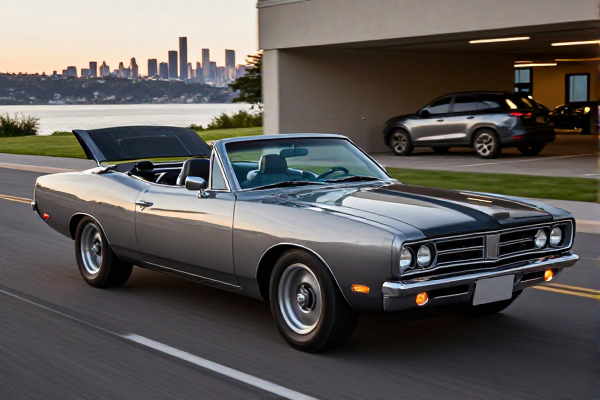
On May 9, 2026, a rare pink 1970 Plymouth Road Runner convertible set a new public auction record for the model. The car, offered by a prominent U.S. auction house, drew a long stretch of competitive bidding before the gavel finally fell. Auction officials confirmed the result topped every previous public sale of a Road Runner convertible, and the buyer walked away with one of the most unusual open-air Mopars ever built.
The color does most of the talking. Plymouth called it Moulin Rouge in 1970, and it sat close to what Dodge marketed as Panther Pink. At the time, it was a shock color, something that looked like it had been mixed in a lab with cherry syrup and showroom willpower. Pink muscle cars had a small following then, but most buyers wanted colors that advertised authority, not a color that announced itself before the engine ever fired. That is exactly why this car matters today.
It is easy to forget that pink was an actual factory order, not a custom one-off respray. In 1970, Mopar was pushing a lineup of "High Impact" colors across its lineup. Some were popular. Others sat on dealer lots. For every Plum Crazy Challenger that found a buyer, a pink Road Runner confused a few people. As a result, very few Road Runners rolled out in pink.
When you combine that paint code with a convertible body, the numbers get tiny. Plymouth built only about 152 Road Runner convertibles in 1970. That total alone makes the body style rare enough for serious collector interest. But a pink one? That takes the car into one-of-one territory, at least among surviving examples.
This car still had its original sheet metal and an intact factory drivetrain. The restoration work was never overdone, which mattered just as much as the color. Auction buyers have learned to be careful with pink cars, because a bad restoration can ruin the very trait that makes the car special. Here, the paint was period-correct and the body details looked crisp.
The record sale is not a fluke. It is a continuation of a pattern that has been building for several years. High-impact-color Mopars are no longer quirky. They are blue-chip collector cars. Cars wearing Plum Crazy, Sassy Grass Green, and Lemon Twist have all outperformed more conservative examples in recent sales. The pink Road Runner now gives fans of the trend a new benchmark.
The auction result also shows how far the collector market has moved past the old rule that "pink doesn't sell." A generation of buyers grew up seeing these colors in magazines, video games, and nostalgia-fuelled culture. Younger collectors are not afraid of loud paint. They chase it. When a rare convertible appears carrying that paint, the result is predictable: heavy bidding and a high hammer price.
The 1970 Road Runner was a completely different car from the 1968-69 version. It grew, gained more aggressive styling, and picked up the "fuselage" look that made Mopars look lower and wider. The convertible was not the centerpiece of the lineup. It was more of a niche model, a way for Plymouth to keep the Road Runner name loud and appealing without turning it into a soft personal-luxury car.
Today, that niche status helps. Muscle car collectors want cars that stand out from a crowd of hardtops. A convertible was already a showstopper. A pink convertible with black interior is impossible to ignore.
The car that sold for a record price was not the most powerful Road Runner ever built. Its value rests in rarity, originality, and the kind of visual impact that photographs poorly but absolutely lands in person. That has always been true for auction cars, but the pink Road Runner proves it again.
Price guides have been playing catch-up with open-top Mopars for a while. Hagerty data has consistently placed Road Runner convertibles near the top of the model's value chart, and the gap between convertibles and hardtops has widened in recent years. This auction record will only push guide values higher, especially for cars with unusual factory paint.
Existing Road Runner owners should also watch the sales pattern. A standard 383 hardtop in a conservative color is still a great car, but it does not generate the same adrenaline at auction. The market rewards originality, rarity, and story. This pink car had all three, and it sold like it.
This sale fits a larger story in the classic car market. Collectors increasingly care about how a car makes them feel, not just how fast it goes. That is not new. What has changed is the amount of money they are willing to pay for emotion.
A decade ago, a pink Road Runner convertible might have been viewed as an interesting oddity. Now it is a record breaker. That shift mirrors what happened to station wagons and pickup trucks in the collector world. Once something becomes rare enough and is presented well enough, it finds its audience.
The auction house did not need a massive media campaign to sell this car. It simply parked a very rare piece of Mopar history in front of bidders who understood that they might never see another one. Then it let the crowd do its job.
First, original condition beats bright ideas. The pink Road Runner was not over-modified. It was presented as a factory piece, warts and all. That is the right way to sell a car that already has a weird story.
Second, documentation matters. This car's paint code, build sheet details, and body style were all verified. Buyers pay record money when they feel confident the car is real. A pink car with no history is just a pink car. A pink car with the right paperwork is a museum piece.
Third, the market for convertible Mopars is still healthy. The record is not a bubble. It reflects a broad shift in the demographics of muscle car buyers. The people bidding today grew up admiring these cars in a completely different way than the generation that bought them new.
The rare pink 1970 Plymouth Road Runner convertible that set an auction record on May 9, 2026 is more than a headline. It is a signal. The collector car market has fully accepted high-impact colors as legitimate, high-value factory specifications. A color once considered hard to sell is now a reason to pay more.
Plymouth's 1970 Road Runner convertible was already a low-production muscle car. Add the pink paint, and the car becomes impossible to replace. That is why the bidding went so high. That is also why this record might not be the last one.
The next time a pink Road Runner shows up, expect the same thing. Auction records are not always about horsepower. Sometimes they are about the car that no one believed would ever get the respect it deserved.