Browse

Log in / Register
 Share

The Proton eMas 5 has become the undisputed sales champion in Malaysia’s affordable battery-electric car segment. But for buyers who want something different from the crowd, several alternatives exist. As of August 2026, how do these rivals stack up against the popular hatchback, and should you consider any of them if you’re looking to avoid the mainstream choice?
Here’s a look at four EVs that compete with the Proton eMas 5: the BYD Atto 2, the TQ Wuling Bingo (imported by Tan Chong), the Perodua QV-E, and the Dongfeng Box. We’ve analyzed their sales through the first seven months of 2026.
For context, the U.S. market offers similarly priced electric hatchbacks like the Chevrolet Bolt EV (starting around $27,000) and the Nissan Leaf ($28,000), though neither matches the aggressive pricing of the Malaysian contenders when adjusted for local incentives.
The first chart below makes the pecking order plain. The eMas 5 sits in a class of its own in terms of sales volume. Remove it from the picture, and the competition among the remaining four becomes much tighter.
The Dongfeng Box brings up the rear but is showing steady month-over-month growth. This cutesy hatchback was actually the earliest to market in this group, launching in November 2024 at RM100,700–RM113,700 (roughly $22,000–$25,000 USD). With a 95 PS motor and up to 430 km (267 miles) of CLTC range from its 42.3 kWh battery, it was a tough sell against similarly priced, larger rivals.
Dongfeng responded with a pragmatic move: a RM30,000 promotional discount on limited units, bringing the Box down to around RM70,000 (~$15,500 USD). At that price, practical touches like auto parking assist, a 540-degree camera, and a ventilated driver’s seat suddenly become generous. For U.S. buyers, that’s comparable to a well-equipped Nissan Leaf S at a much lower outlay—though the Box lacks the Leaf’s reliability record and widespread dealer network.
The TQ Wuling Bingo has been the steadiest of the bunch, sitting at 563 units year-to-date. This little city EV has a notable distinction: it’s the first EV to be locally assembled by Tan Chong, with CKD production starting at TCMA Segambut in January and first customer deliveries in March.
Two variants are offered: the Pro with a 31.9 kWh battery (333 km CLTC) and the Max with 37.9 kWh (410 km CLTC), both driven by a modest 68 PS front motor. List prices are RM67,800 and RM72,800, but a launch package for the first 400 cars knocks RM5,000 off—RM62,800 for the Pro and RM67,800 for the Max—and bundles a 7 kW wallbox. That undercuts the eMas 5 range, and the retro-cute styling has its fans.
The trade-offs: a leisurely pace, DC charging capped at just 50 kW, and no proper ADAS. For context, the U.S. market’s closest analog—the Mini Electric Hardtop—offers similarly playful styling but starts at $30,000 with a 110-mile range, making the Bingo a better value proposition in its home market.
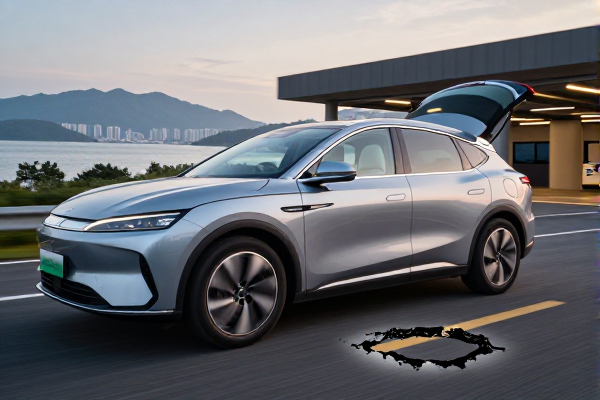
The BYD Atto 2 has pulled clear of the group since spring, climbing to 212 units in July and 875 for the year so far. It’s not hard to see why it leads the chasing pack. BYD is Malaysia’s best-selling EV brand, and the Atto 2 is the most conventional “proper car” of the four—a compact SUV that slots between the Dolphin and Atto 3.
Launched in July 2025 in a single Premium variant at RM100,000 (~$22,000 USD), it packs a 51.13 kWh Blade battery for 345–350 km (214–217 miles) of WLTP range—the biggest battery in this group bar the QV-E. The catch is that RM100,000 price, which overlaps with the larger eMas 7 rather than the eMas 5. However, pre-registered and used units are available from RM89,000 from dealers and around RM77,000 from direct owners.
Another alternative is the BYD Dolphin, a hatchback no longer sold