Browse

Log in / Register
 Share

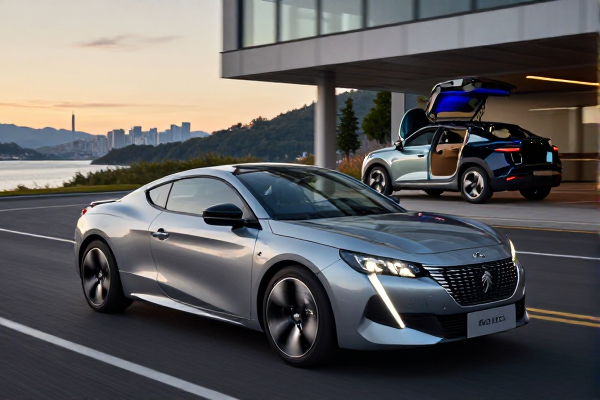
Today, July 19, 2025, Peugeot's RCZ Vision concept reads less like a nostalgic farewell and more like a preview of the reset coming to the entire Stellantis group. With 491 hp, a solid-state battery, and fully electronic steer-by-wire controls, this French coupe showcases two technologies that will spread across many of Stellantis' brands, including American ones. Peugeot hasn't sold cars in the US since 1991, but the RCZ Vision's tech and design language are already aimed at a much wider audience.
Peugeot design director Matthias Hossann sums up the brand's new aesthetic in five words: freedom, courage, elegance, instinct, and "inner force." The last one invites interpretation, but the visual result needs no translation. The RCZ Vision sits low and purposeful, with slim horizontal light slashes at each corner — the signature three-claw motif recut for the electric age. A micro-perforated "RCZ" graphic sits flush within the bumper, a quiet nod to the original coupe's badge.
The original RCZ, produced from 2009 to 2015, sold a respectable 68,000 units and built a following in markets that appreciated French flair. The Vision brings back its double-bubble glass roof and selected triangular cues, but the execution is thoroughly of the current moment. Forged aluminum wheels measure 21 inches at the front and 22 at the rear, and the figure-hugging profile is made possible by a battery pack just 110 mm thick.
Peugeot's concept history includes more than a few outlandish experiments. The RCZ Vision deliberately takes the opposite path. It's a clean, resolved coupe that wouldn't look out of place in a showroom next week, and that restraint is itself the statement. In an era of flashy concept cars, Peugeot is betting that confidence — and a strong surface — will stand out more than shock value.
The thin pack deserves a closer look. It's the reason this concept doesn't become another bulbous electric crossover in coupe clothing; the low floor keeps the roofline believable, the seating position natural, and the whole shape in proportion. It also argues for solid-state chemistry, which packs more energy into less volume than conventional lithium-ion cells, leaving designers the kind of packaging freedom most EVs simply don't have.
Peugeot has been pushing its i-Cockpit layout since the 208 arrived more than a decade ago, and the RCZ Vision takes that philosophy into unfamiliar territory. The centerpiece is the Hypersquare, a control surface that replaces the steering wheel and groups most switchgear into four rings. It will take time to get used to, but the lack of a mechanical steering column gives the design team freedom to place controls where they make sense, not where a metal shaft happens to be.
That freedom comes from steer-by-wire. There is no physical link between the Hypersquare and the front wheels; steering inputs travel electronically, and maximum rotation from center to lock is less than one full turn, versus roughly three in a typical car. A variable ratio keeps the car stable at highway speeds, and braking is fully by wire as well. Torque steer, for what it's worth, becomes a relic of another era.
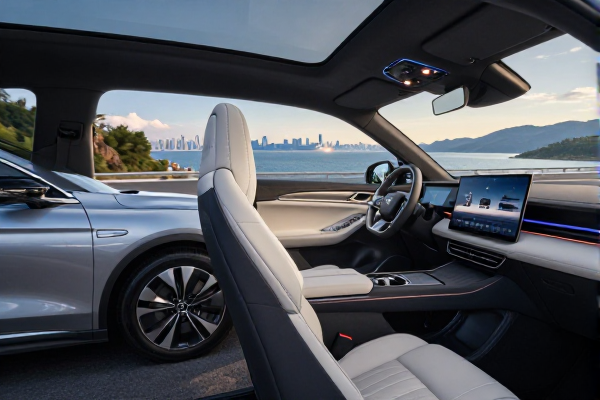
The rest of the cabin plays in the same register. "Mobile" air vents disappear flush into the dashboard when not in use, an aluminum center console carries a frosted-glass top, and a transparent micro-LED display above the Hypersquare can be set to show as much or as little as the driver prefers. Physical controls remain for core functions, which will please drivers wary of all-touchscreen interiors. A mechanical clock from French watchmaker Serica anchors the dash, and the upholstery is Pelinova, a recycled leather made from offcuts that would otherwise be thrown away.
Beneath the skin sits STLA One, the newest entry in Stellantis' modular platform family. The group says that family will underpin more than 30 models across its 14 brands and reach a production rate of two million vehicles per year by 2035. STLA One can accommodate internal combustion, but the RCZ Vision is purely electric. It also runs STLA Brain, the software and control architecture that will handle over-the-air updates, driver-assistance features, and the by-wire systems central to this concept. Stellantis' Dare Forward 2030 strategy calls for half its US passenger-car sales to be electric by the end of the decade, and the STLA family is the backbone of that commitment.
The battery is the part of this story with the longest reach. Peugeot developed the solid-state pack with Factorial Energy, a Massachusetts startup in which Stellantis holds a 9.5 percent equity stake. The concept runs a 1,000-volt electrical architecture, which is how Peugeot can claim a 10-to-80 percent charge in about 10 minutes. The company quotes 491 hp, a target range of 375 miles on the European WLTP cycle, and efficiency around 5.4 miles per kWh — numbers that put it in the same conversation as premium electric coupes while charging far faster than most. EPA-rated range would come in lower, but the direction is unmistakable.
Solid-state has been the industry's most repeated promise. Toyota has targeted the late 2020s for its own solid-state EVs; Hyundai has pointed toward 2030 production; Mercedes-Benz has worked with the same Massachusetts supplier on a prototype. Stellantis is treating the chemistry as something to be proven at scale — and soon.
That's where the story connects to the US. Stellantis has said it plans to put Factorial's solid-state cells into a demonstration fleet based on the Dodge Charger Daytona, a program rooted in the same STLA architecture being rolled out across its American lineup. The chemistry shown in this French concept could therefore be validated on US roads well before the decade ends.
What about a Peugeot return to the US? The brand has been absent since 1991. Former Stellantis CEO Carlos Tavares said in 2023 that Peugeot would come back to America, but no timeline has been locked in since his departure at the end of 2024. Stellantis' immediate priorities have been steadying its US operations and its homegrown American brands; a Peugeot showroom launch looks like a longer-term play rather than a near-term one.
None of that diminishes the RCZ Vision's importance. The coupe body may never be built, and Peugeot isn't saying otherwise. But the ingredients Stellantis selected for this car — the platform family, the software stack, the by-wire controls, the solid-state relationship — are not concept-level fiction. They're the same building blocks being prepped for production across the group, and some are already aimed at US vehicle programs.
For now, the RCZ Vision works best as a statement of intent: Peugeot plans to stay distinctive even as Stellantis consolidates platforms, and the technology underneath carries more weight than the styling alone. It's good news for fans of the original coupe, and for anyone tired of hearing that solid-state batteries are always a few years away. This concept says the wait may be shorter than you think.