Browse

Log in / Register
 Share


Date: February 17, 2025
When it comes to making parking easier, surround-view camera systems are arguably the best tech upgrade of the last decade. But even the best cameras are useless if the button to activate them is buried in a submenu or placed somewhere your hand doesn’t naturally go. Honda almost cracked the code by mounting the camera button on the wiper stalk of the Pilot, but one forgotten Mitsubishi model still has the most intuitive placement of all—the Eclipse Cross’s steering-wheel button. After spending time with both vehicles, I can tell you why that tiny button matters more than you think.
Honda deserves credit for thinking outside the dashboard. In the Honda Pilot (and several other Honda models), the camera button lives on the end of the right-side wiper stalk. It’s reachable without taking your hand off the wheel, and it’s far better than the touchscreen-only approach many automakers still use. Parking a big three-row SUV like the Pilot becomes noticeably less stressful when you can flick the camera on with a thumb while your right hand works the shifter.
Still, it’s not ideal for every situation. The wiper stalk is on the right side of the steering column. If you’re parking with your left hand on the wheel and your right hand on the shifter (common for reverse parking), you have to move your right hand back to the stalk, then back to the shifter. It’s a minor extra motion, but for a feature meant to reduce friction, every extra step counts. Also, the stalk location can be confusing if you grab the wiper control instead of the camera button in a hurry.
Now consider the Mitsubishi Eclipse Cross. Parked in a cramped lot, you can activate the cameras without moving either hand from its natural driving position. That’s because the camera button is on the left side of the steering wheel, just above the voice control button. If your left hand rests at 9 o’clock, your thumb lands directly on the button. Your right hand stays free for shifting, steering, or whatever else. It’s so natural that, once you experience it, every other placement feels like a compromise.
Why hasn’t every automaker copied this? The Eclipse Cross has been around since 2017, yet no other manufacturer—including Mitsubishi’s own lineup—has adopted the same placement consistently. For example, step into a Mitsubishi Outlander, and you’ll find the camera button under the infotainment screen, on the far right—closer to the passenger than the driver. It’s a head-scratcher.
I spoke with Dr. Linda Ng Boyle, a professor of industrial and systems engineering at the University of Washington specializing in driver-vehicle interaction. She explained: “Button placement directly impacts reaction time and mental workload. A thumb-accessible button on the steering wheel, at the 9 o’clock position, minimizes hand movement and keeps the driver’s eyes on the road. It’s a textbook example of good human-machine interface design.”
Boyle also noted that automakers often neglect camera button placement because it’s seen as a secondary control, not a primary safety feature. “But parking cameras are used during low-speed maneuvers where drivers are already under cognitive load. Any reduction in reach distance or visual search improves safety and satisfaction.”
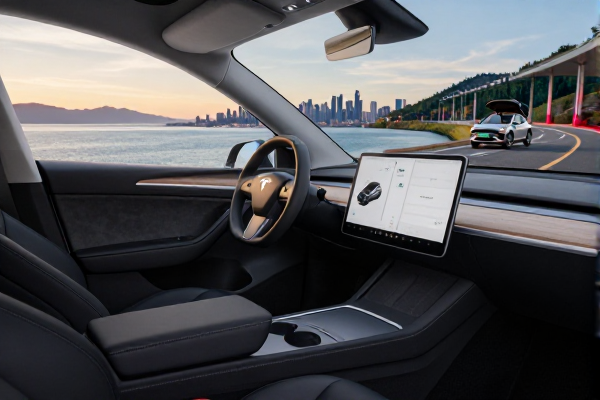
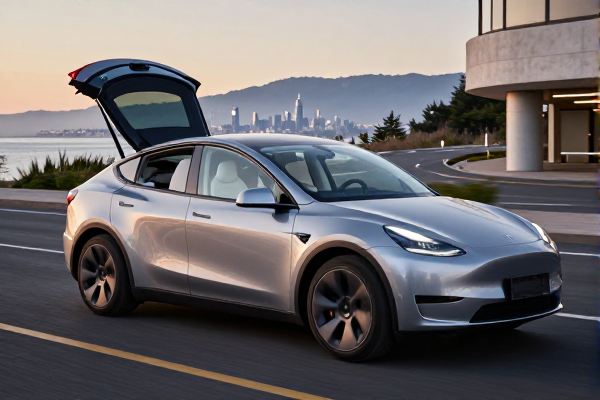
A quick survey of 2025 models shows most brands still miss the mark. Tesla relies entirely on the touchscreen, forcing drivers to tap multiple layers. Ford puts the camera button on the center stack, sometimes near the hazard light switch. Hyundai and Kia have improved with dedicated buttons near the shifter, but they’re on the console, not the wheel. Only a few luxury models, like the Genesis GV70 and BMW X5, offer steering-wheel camera activation, but those buttons are often multifunction and less intuitive than Mitsubishi’s dedicated one.
Perhaps the biggest missed opportunity is that Mitsubishi itself didn’t propagate the Eclipse Cross’s excellent placement to the Outlander or the now-discontinued Mirage. A company spokesperson declined to comment on future product planning, but it’s a classic case of institutional inertia—or maybe the engineers who designed the Eclipse Cross simply got lucky.
You might think camera button placement is a nitpick for journalists and car geeks. But a 2024 J.D. Power study on initial quality found that “parking assistance system controls” were among the top ten most frustrating features, with complaints ranging from “hard to find” to “unresponsive.” When a feature that’s supposed to help you park becomes a source of annoyance, it undermines the whole point of the technology.
If automakers want to win over buyers, they should study the Eclipse Cross. It’s not a luxury car, it’s not fast, and it’s not pretty—but its camera button placement is a masterclass in user-centered design. Until someone puts a camera button on the steering wheel of every new car, the Mitsubishi Eclipse Cross remains the benchmark.