Browse

Log in / Register
 Share


As of Feb. 14, 2026, BMW has shown the eighth-generation 3 Series in its final production form, and the part that will generate the most conversation is not under the hood. It is the glass. The new 3 Series becomes the first model to bring BMW's Panoramic Vision Dashboard to customers, replacing the traditional instrument cluster with a slim, full-width display strip that sits close to the windshield line. The move marks a clean break with the layout BMW has used for decades, and it signals how the brand will approach cockpits across its entire lineup in the coming years.
Instead of burying a cluster behind the steering wheel or forcing drivers to glance sideways at a large center touchscreen, BMW has stretched a narrow display across the upper portion of the dashboard. The screen runs almost from door to door, but the driving data that matters most appears directly in the driver's line of sight. Speed, navigation instructions, assistance status and warning messages are no longer hidden behind the steering wheel rim; they sit slightly above it, near the base of the windshield. The effect is closer to a head-up display in behavior, but it uses a physical glass surface rather than projected imagery.
The system is built around customization. Drivers can arrange widgets on the strip in the same way they arrange smartphones icons, placing the most important information in any position they prefer. A separate center touchscreen allows those widgets to be dragged upward onto the panoramic strip. Passengers can also use the passenger side of the display, which means the same physical segment can show media details on one side and navigation prompts on the other. That flexibility is the reason BMW calls it a panoramic vision system: it is a shared surface that adapts to the person sitting in front of it.
The new steering wheel deserves more attention than it may get during the initial reveal. BMW has shifted away from the conventional cross-shaped spokes and instead used a two-spoke structure positioned at the 12 and 6 o'clock points. That leaves the upper area of the wheel visually open, which is a deliberate engineering decision: it gives the Panoramic Vision Dashboard more physical space to be seen. The center hub now stands taller than before, and the sides are designed as chunky grip zones meant for drivers who prefer a more direct hold on the wheel.
This upright-spoke layout also forces a rethink of how controls are placed. BMW says the goal is to keep every button on the wheel inside the reach of a thumb without forcing the driver's hands to move more than a few centimeters. The raised hub allows thumb pads to rest naturally on both sides, and the controls themselves are part of the "shy-tech" concept that has been quietly rolling out across BMW models.
Shy-tech is not a marketing slogan. It is a functional design principle that the company is applying to interior surfaces. On the new 3 Series, the controls for driving assistance and parking functions on the steering wheel remain unlit until the system detects that they are active or relevant. For example, when the car is parked, the parking-related buttons light up. Once the car moves, those controls fade back into the wheel and the attention shifts to other functions. This reduces the amount of visual clutter in front of the driver and prevents the cockpit from feeling like a wall of icons.
The same principle applies to the infotainment controls. They are not visible as glowing graphics when unused, but the wheel provides tactile feedback when a finger slides over them. The combination of hidden illumination and physical response is designed to let drivers change volume, skip tracks or adjust cruise settings without taking their eyes off the road. BMW's decision to pair shy-tech with the Panoramic Vision Dashboard creates an unusual situation: the car gives drivers more data than ever, while at the same time trying to show it only when it matters.
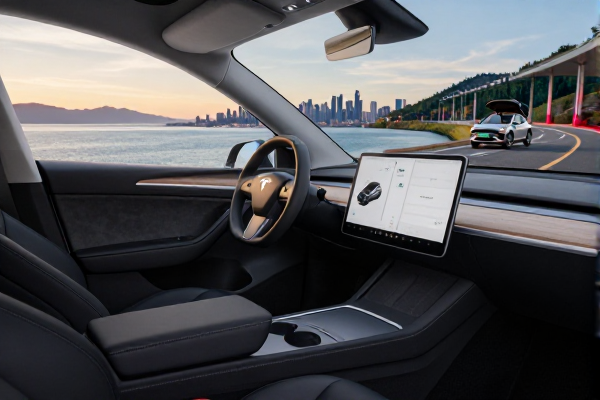
While the panoramic strip handles the primary driving information, the center infotainment screen remains the main control hub. The screen is shaped with a free-cut edge, which means the display glass is not wrapped in a thick bezel. It is tilted toward the driver at an angle that reinforces BMW's long-running driver-centric cockpit philosophy. From the driver's position, the screen appears nearly vertical and close to the line of sight. From the passenger seat, the same screen is clearly oriented away, which is a subtle but important sign that this car still considers the driver the priority.
The two screens work as one system. A driver can swipe an item on the central touchscreen and pull it upward onto the panoramic strip. This bridges the traditional gap between the cluster and the central display. It also makes the panoramic strip feel less like a passive output device and more like an interactive part of the car. BMW says this is only the beginning of the software relationship between the surfaces, and future over-the-air updates are expected to add new widgets and layouts.
BMW is not the first automaker to delete the gauge cluster. Tesla removed the instrument display years ago, and Volvo has pushed the same direction with the EX90. But those cars force the driver to pull most driving information from a centrally mounted screen. BMW's approach is different: the most critical data remains in the driver's forward field of view, just above the steering wheel, while the center screen handles navigation, media and deeper vehicle settings.
Compared with the curved displays used by Mercedes-Benz and Audi, the panoramic strip is less cinematic but potentially more practical. It avoids the issue of a tall screen blocking the windshield base, and because the display is mounted so high, drivers can read it with the same eye movement they would use for a head-up display. The trade-off is that the strip is farther from the driver than a traditional cluster, which means fonts and contrast need to be excellent at arm's length. BMW has not revealed full technical specifications, but the early promotional images suggest the graphics have been tuned for high readability.
The new 3 Series will go on sale after BMW completes the global rollout of the Neue Klasse platform. Company materials describe the model as the first in a wave of new-generation BMWs, and the brand has made it clear that the Panoramic Vision Dashboard is intended to become a defining feature of its EVs and eventually its combustion models. That gives the 3 Series an outsized role in re-establishing BMW's tech credibility after years of iDrive menu screaming.
The reception from early previews has focused almost entirely on the cabin. The exterior of the eighth-generation 3 Series carries a simplified, almost monochrome look that borrows strongly from the Vision Neue Klasse concept, but the interior is where the story is. For buyers who live with the car daily, the dashboard will be the thing they feel and use every time they get behind the wheel. That is why so much engineering attention was spent on making the display feel like a natural continuation of the road.
What is different about the Panoramic Vision Dashboard? It replaces the traditional gauge cluster with a slim full-width display mounted on top of the dashboard. The driving information is positioned above the steering wheel, very close to the driver's normal line of sight, so the driver does not need to look down or sideways to check speed or navigation prompts.
How do the controls on the steering wheel work? The wheel uses shy-tech lighting. Buttons that are not relevant to the current situation remain dark. When needed, such as parking assistance or lane-keeping controls, the relevant areas light up. Tactile surfaces on the infotainment side provide physical feedback when the driver is using them.
When will the new BMW 3 Series arrive? BMW has not yet provided exact timing for the U.S. market, but the model is moving through the final stages of testing and launch preparation. The company has confirmed that the new design represents the standard equipment direction for future models, not a limited edition feature.
BMW's decision to launch the Panoramic Vision Dashboard in the 3 Series is significant because the 3 Series has traditionally been the car that introduces new owners to the brand. It is also the model where BMW has been most conservative with design changes in the past. Choosing this car as the first to get the full-width display suggests the company believes the interface is ready for volume production, not just concept cars.
The result is a cabin that feels cleaner and more open than the outgoing model. There is no cowl, no binnacle and no circular dial blocking the top of the interior. The dash is a flat horizontal line. The screen strip floats above it like a ribbon of light. At night, when the shy-tech controls disappear and the panoramic display dims to its minimum setting, the interior transitions into a highly minimal space.
In a market where large vertical screens are becoming the default solution, BMW's Panoramic Vision Dashboard stands out for the opposite reason: it puts the important information where the eye already wants to look, and it keeps everything else out of view until it is genuinely useful. That is not a gimmick. It is a smarter use of the space right behind the windshield, and it gives the new 3 Series the boldest cockpit in its history.