Browse

Log in / Register
 Share

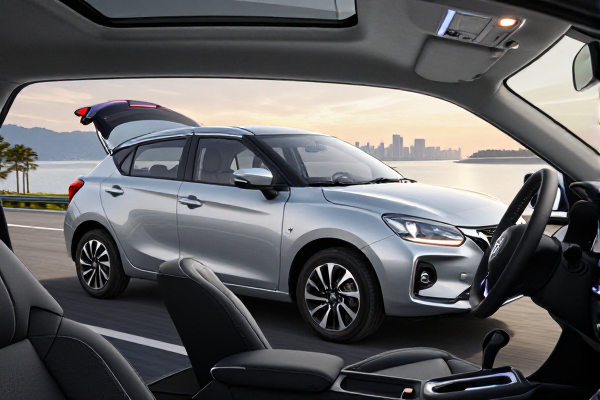
As of March 2025, Indian auto giant Maruti Suzuki has unveiled a significantly updated Baleno hatchback, becoming one of the first mass-market carmakers to offer Level 2 Advanced Driver Assistance Systems (ADAS) in a sub-$8,000 vehicle. The new model, starting at approximately $7,400 (₹6.10 lakh), positions itself as a budget-friendly technology leader in the premium hatchback segment.
The move marks a strategic shift for Maruti Suzuki, which has traditionally focused on cost-effective, no-frills vehicles. By integrating ADAS features such as adaptive cruise control, lane keep assist, and automatic emergency braking, the company is directly challenging the perception that advanced safety tech belongs only in luxury SUVs. The new Baleno also features a 1.2-liter Z-Series three-cylinder engine, ventilated front seats, and a 10.1-inch SmartPlay Pro+ touchscreen infotainment system.
The timing of the launch is deliberate. India’s festive season—typically October to December—drives a surge in car sales, and Maruti Suzuki is betting that the ADAS-equipped Baleno will attract buyers who are increasingly demanding high-end features in affordable packages. The upgrade is also a defensive move. As competitors like Hyundai, Tata, and Kia introduce more feature-rich models, the Baleno’s refresh helps Maruti protect its 40% market share in the compact car segment.
In the US context, automakers like Toyota and Honda offer ADAS as standard on many models, but often at higher price points. The Baleno’s pricing highlights how Indian manufacturers are accelerating the democratization of safety technology—a trend that could influence global supply chains and encourage more budget-friendly ADAS adoption in emerging markets.
Despite the excitement, Maruti Suzuki faces clear headwinds. In its latest quarterly report (Q1 FY2026-27), net profit fell to $400 million (₹33,521 million) from $435 million (₹37,581 million) a year earlier. Operating margins contracted to 8.22%, squeezed by rising input costs and commodity price volatility.
The company is net-debt free, but the cost of integrating ADAS and other premium features into a volume model like the Baleno adds pressure. “Maruti is walking a tightrope,” said Ravi Pandit, an automotive analyst at Mumbai-based Indus Insights. “They need to keep the product fresh without burning margins. The Baleno’s ADAS move is smart, but it’s a test of whether customers will pay extra for safety in this segment.”
For investors, the key watchpoint is demand elasticity. The Baleno’s price increase over the previous model—about $500–$700—must be absorbed by buyers. If successful, it could set a precedent for other models in Maruti’s lineup and even influence Suzuki’s global strategy. Suzuki exited the US passenger car market in 2012, but its technology platform now powers models sold in Japan, Europe, and India. The ADAS system used in the Baleno is sourced from Tier-1 suppliers like Bosch and Continental, and its success in India could lower costs for future Suzuki models worldwide.
Another angle: the Baleno’s ADAS launch comes amid US regulatory pressure to mandate advanced driver assistance features. The National Highway Traffic Safety Administration (NHTSA) has proposed requiring automatic emergency braking in all new cars by 2029. Maruti Suzuki’s ability to deliver Level 2 ADAS at a $7,400 price point suggests that the cost of such systems is dropping faster than expected, potentially accelerating adoption in budget-friendly US models as well.
While the Baleno is not sold in the US, the technology and pricing strategy have global implications. US consumers interested in affordable safety features should monitor how automakers like Nissan, Hyundai, and Kia respond—especially in the subcompact and compact segments. The Baleno’s refresh also underscores that Indian engineering is becoming a testbed for cost-effective innovation, which could eventually trickle up to Suzuki’s global partners.
The Maruti Suzuki Baleno is now the most affordable vehicle in India—and possibly the world—to offer Level 2 ADAS. Whether it translates into sustained sales growth and margin improvement remains to be seen. For now, it’s a clear signal that the race to democratize advanced safety technology is intensifying, and the winners will be those who can balance feature richness with cost discipline.
This article was updated on March 15, 2025, to reflect the latest launch details and market context.