Browse

Log in / Register
 Share

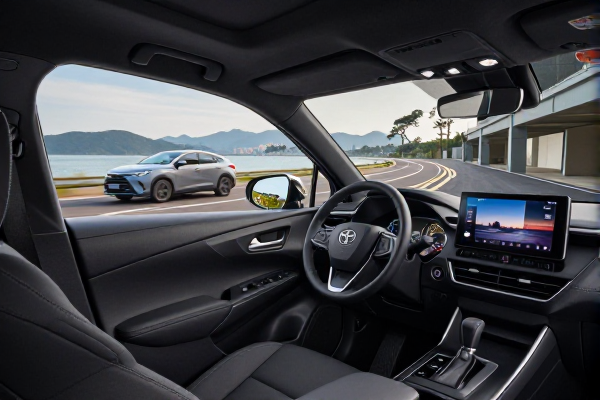
Toyota Kirloskar Motor has pulled the cover partway off the facelifted Glanza. The new teaser focuses on front-end styling, and the company has locked October 14, 2026 as the launch date for the updated premium hatchback. The Glanza is Toyota’s rebadged version of the Maruti Suzuki Baleno, produced through the long-running Suzuki-Toyota alliance, and it occupies a central place in Toyota India’s compact-car lineup. Full specifications and pricing have not been announced yet.
One glance at the teaser makes the main styling change obvious. The Toyota emblem has been relocated to the upper edge of the bonnet, giving the front end a slightly different visual hierarchy. The U-shaped insert in the front bumper now gets a chrome finish instead of the black trim used on the current model. That tweak is small, but it changes the face considerably.
Toyota also appears to have revised the fog lamp housings. The new units sit in squarer bezels, while the main LED headlamps look like they carry over from the pre-facelift model with only minor changes. The teaser shows the car in red, but Toyota has not revealed the full color palette yet.
Since the Glanza is a twin of the Baleno, the overall silhouette should remain familiar. Most of the visual updates are concentrated at the front. Don’t expect a dramatic rear-end redesign, at least based on what Toyota has shown so far. The company has released no images of the tail section, and there is no official word on changes to the rear bumper, tail lamps, or wheel designs.
Toyota has stayed quiet about the cabin. That makes interior updates a matter of reasonable expectation rather than confirmed equipment. The facelifted Maruti Suzuki Baleno, which shares its bones with the Glanza, introduced ventilated front seats, a nine-inch touchscreen infotainment system, a 360-degree camera, and Level-2 ADAS. The Glanza is likely to receive at least some of those items.
ADAS would be a meaningful addition for Toyota’s hatchback lineup. The Glanza currently does not offer any form of advanced driver assistance, while the facelifted Baleno already brought adaptive cruise control, autonomous emergency braking, and lane-keeping assistance into the segment. Whether Toyota will fit the same hardware on the Glanza, and in which trims, remains unconfirmed.
The biggest mechanical change may be under the bonnet. Reports from Indian auto media suggest the old 1.2-liter four-cylinder petrol engine will make way for Maruti Suzuki’s newer Z-Series 1.2-liter three-cylinder naturally aspirated unit. In the Baleno, that engine produces around 83 bhp and 112 Nm of torque. If Toyota adopts the same tune, the Glanza will move from a four-cylinder to a three-cylinder layout.
Transmission choices are expected to include a manual gearbox and an AMT option. The current Glanza also offers a CNG variant, and that could continue in the facelift, although Toyota has not confirmed anything. Buyers should wait for official fuel-efficiency figures, because a new engine design does not automatically translate into better mileage in real-world driving.
The current Glanza carries an ex-showroom price between Rs. 6.73 lakh and Rs. 9.99 lakh. A styling refresh, a new engine, and extra safety features will likely push that figure up, but Toyota has not revealed the revised price list. Since the upgrades may be limited to certain trims, buyers should compare the Glanza against the Baleno trim by trim, not just by starting price.
Once launched, the facelifted Glanza will compete with the Maruti Suzuki Baleno, Tata Altroz, and Hyundai i20 in India’s premium hatchback segment. The Baleno is the closest rival because it is mechanically identical. Tata’s Altroz wins buyers with its safety-focused package, while the i20 draws attention with its feature-rich cabin and wider engine choices. The Glanza’s challenge is to offer a fresh engine and meaningful equipment without letting the price premium over the Baleno get too large.
For U.S. readers, the Glanza is not a car that will ever reach American showrooms. But it is a good example of how Toyota and Suzuki are cooperating to keep small cars competitive in price-sensitive markets. The tie-up is part of Toyota’s broader effort to fill out its compact lineup in emerging regions, and the Glanza is one of the clearest results of that strategy.
From a market perspective, the facelifted Glanza matters less for its own sales volume than for what it signals. Toyota India has been using Suzuki-based models to strengthen its presence in the volume hatchback and compact SUV segments. If the facelift sells well, it reinforces the case for more shared models going forward.
What buyers should watch at the October launch: final power and torque figures, real-world efficiency numbers, the full variant-by-variant feature list, and the price spread between the Glanza and the Baleno. A teaser is only a teaser. The decision will come down to whether Toyota positions the updated Glanza as a slightly more premium alternative to the Baleno or simply as a badge-engineered equivalent with a modest styling change.