Browse

Log in / Register
 Share


On April 3, 2025, a prototype of the next-generation Hyundai Tucson experienced a dramatic brake failure during a high-stress validation test in the Austrian Alps. The crossover, towing a trailer on steep mountain roads, suffered front brake overheating that ignited one of the calipers, causing both front tires to blow out in quick succession. While the scene—captured by a spy photographer—appears alarming, automotive engineers stress that such incidents are a routine part of extreme durability testing, not a sign of a systemic flaw in the upcoming model.
The test was likely designed to push the vehicle’s braking system to its absolute limit: towing a heavy load on a long descent under continuous braking. This simulates conditions that real-world drivers might face in mountainous regions, such as the Swiss Alps or the Rocky Mountains. According to retired brake system engineer Mark Harrison, “Manufacturers deliberately induce thermal runaway scenarios during prototype testing to identify weak points in cooling ducts, pad materials, and electronic brake-force distribution. A fire like this is a data point, not a recall trigger.”
Hyundai has not officially commented on the incident, but the company’s internal protocol typically involves a post-test teardown and simulation analysis. The blaze itself was quickly extinguished by test crew members, who were seen using fire extinguishers in the images. The vehicle’s structure appeared largely intact, and the fact that the fire did not spread to the engine bay or cabin suggests that the team’s safety procedures worked as intended.
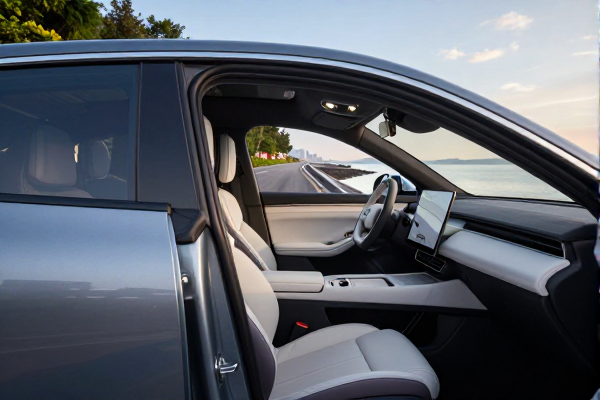
This episode provides the clearest look yet at the design direction of the next Tucson. The prototype’s body is more upright and boxy, echoing the recently refreshed Santa Fe’s styling language. Inside, the spy shots reveal a large horizontal infotainment display and physical buttons for climate and audio controls—a deliberate move away from full touchscreen reliance, which Hyundai has said improves driver focus. The next Tucson is expected to offer hybrid and plug-in hybrid powertrains, building on the company’s growing electrification push.
Hyundai recently unveiled a new 1.6-liter hybrid family featuring two electric motors, 380 Nm of torque, and a claimed efficiency improvement of over 4% compared to the current system. While the automaker has not confirmed that this powertrain will appear in the Tucson, it is a strong candidate given the model’s high volume in Europe and North America. The brand’s broader lineup overhaul, including the integration of the Pleos software platform, was reported earlier by SPEEDME.RU.
What makes this test failure noteworthy is not the fire itself, but the engineering lessons it will produce. If the overheating leads to redesigns of the brake cooling ducts, changes in pad material, or recalibration of the electronic stability control’s trailer-sway mitigation logic, the incident will have directly improved the final product. Similar extreme tests have been conducted by competitors like Toyota, where the RAV4 prototype underwent a “brake fade” test in Death Valley, and by Volkswagen, which simulated alpine descents in the Austrian Alps for the Tiguan.
From a consumer perspective, the Tucson’s safety record remains strong. The current generation scored top marks in Euro NCAP and IIHS, and Hyundai has a history of acting quickly on any real-world defect reports. The 2025 model is expected to retain or improve on those ratings, with advanced driver-assistance features like highway driving assist and remote smart parking assist likely to be standard on higher trims.
The test also underscores the importance of real-world validation over computer simulations alone. While digital twin models can predict thermal behavior, only physical prototypes can reveal unexpected interactions such as heat buildup from brake dust, airflow turbulence under load, or the exact point at which tire bead integrity fails. The blown tires in this case—both ruptured at the sidewall—suggest that the extreme heat transferred from the brake rotor to the wheel hub, weakening the tire structure.
Industry analysts note that the Tucson is Hyundai’s best-selling model globally, and any delays in its launch timeline could have significant revenue implications. The prototype fire is unlikely to cause a delay, but it may prompt Hyundai to extend the validation phase for the brake system by a few weeks. The company is expected to unveil the production version in late 2025, with first deliveries in early 2026.
For enthusiasts, the incident offers a rare glimpse into the brutal testing that new vehicles endure before they reach showrooms. The next Tucson will need to balance comfort, efficiency, and robustness—especially in markets like the US, where towing capacity is a key selling point. The current Tucson can tow up to 2,000 pounds (907 kg) with proper equipment; the next generation is expected to match or slightly exceed that figure, thanks to the hybrid system’s higher torque.
In summary, the Alpine brake fire is a controlled failure that will feed directly into engineering refinements. It is not a recall event, nor a sign of poor quality. Instead, it is a testament to Hyundai’