Browse

Log in / Register
 Share

May 15, 2026 — A newly surfaced Stellantis patent application describes a modular rear wing and matching aero trim that clip or plug onto a Dodge without requiring a drill or screwdriver. The filing, called “Modular Aerodynamic Panels for a Vehicle,” was first spotted by automotive journalist Gary Gastelu and shared on Bluesky, where it quickly made the rounds among enthusiasts.
The patent marks a sharp departure from Stellantis’ last memorable filing, which involved a burning EV dropping its battery pack out of the chassis so the car and its occupants could retreat under 12-volt power. That was about managing a crisis. This one is about managing style.
Anyone who has watched a friend spend a weekend measuring, marking, drilling and cursing while installing an aftermarket spoiler will instantly see the appeal: Stellantis wants owners to snap a wing onto the car by hand, as easily as pressing a button on a storage bin. No permanent holes. No stripped threads. No paint damage.
According to the drawings, the system consists of six main components: a primary wing surface, two “winglets” that flank it, trim pieces that visually blend the assembly into the bodywork, and an optional filler panel. The filler panel is the clever part. With it in place, the wing becomes a continuous extension of the roofline, looking nearly like a factory-integrated spoiler. Remove it, and the wing cantilevers off the rear with open space below — a floating look that channels air both over and under the blade.
The patent also sketches out a few extreme combinations, including one configuration with the winglets and caps attached but the main surface absent. It looks odd on paper, but that is the point of modularity: owners can pick a partial aero kit for a subtle change, or bolt on everything for full track-day energy.
The attachment hardware is the heart of the invention. Stellantis describes two approaches. The first is a “releasable lever-actuated spring clip”: a mechanical clip with a lever that releases tension, letting the part be pulled free by hand. The second is an “extension portion received within a receiver” — in plain English, a plug that pushes into a socket. The receiver contains a detent that catches a groove on the plug, holding the part firmly once seated. No hinges to adjust, no drill templates and no hidden fasteners.
Both approaches aim at the same result: rapid, tool-free mounting and removal. If you’ve ever tried to remove a bolt-on spoiler after two New England winters, you know the value of that idea. Salt corrosion, seized fasteners and shattered plastic tabs are a rite of passage for many DIY installers; this system would bypass that entire pain point.
The more interesting layer is the optional motorization. The patent describes motors housed inside the winglets, with the ability to raise and lower the wing automatically based on vehicle speed. That gives the car something close to active aero — downforce when the math calls for it, low drag when it doesn’t. The driver could also override the automation and pick a fixed height manually.
The execution matters as much as the concept. Most active spoilers today are heavily integrated: actuators bolted to body structure, wiring looms routed through trunk lids, control modules flashed by software specialists. A modular powered wing is a simpler proposition. If the structural parts are shared across vehicle models, Stellantis can use one hardware set and different wing designs — making the wing itself the customizing layer.
This type of system carries real consequences for the aftermarket. A standardized clip-and-plug interface could create an ecosystem of compatible wings, lips and diffuser blades, the way a phone connector spawns a thousand cases and accessories.
But there is a tension between OEM control and design freedom. If Stellantis owns the connector geometry and the attachment method, any third-party part that relies on that interface may face patent infringement or licensing costs. Future vendors would need either to reverse-engineer a non-infringing attachment scheme or pay for access. Smaller accessory brands might hesitate; larger ones might treat it as licensing revenue.
There is also the theft problem. A system that requires no tools to insert also requires no tools to remove. A thief with 20 seconds of access can walk away with the wing, and the receiver sockets left behind won’t be damaged — just empty. That convenience may be the element that pushes insurers and owners to demand locking clips, which would negate some of the tool-free appeal.
Another long-term angle: automakers are beginning to treat exterior accessories as a software-like layer. Tesla has explored configurable lighting and software-locked features; Ford and Rivian sell over-the-air capability upgrades. Stellantis appears to be looking at physical pieces the same way. Instead of offering six different wing shapes from the factory, the maker could offer one attachment interface and several certified blades. The owner picks the mood; the dealer or owner does the five-minute swap. That thinking fits neatly with the industry’s push toward simplified assembly and catalog-driven customization.
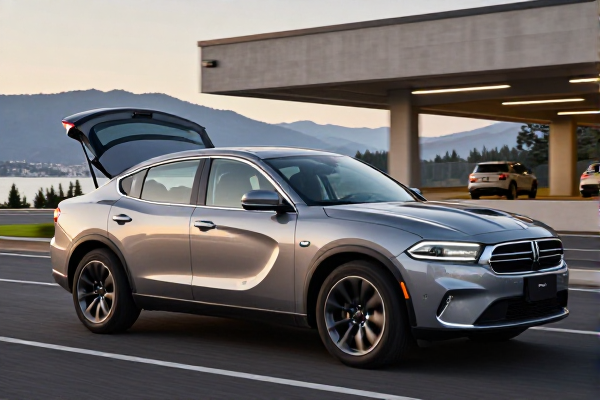
No one should take a patent filing as proof of a launch plan. Car makers file all sorts of future-looking technology to secure their options. The renderings feature a tall hatchback that strongly resembles the now-discontinued Dodge Caliber, which is probably a template for the drawings rather than a product hint.
Still, the timing fits what Stellantis has said about electric performance vehicles. A future Dodge EV built on a skateboard platform could use modular aero accents to offer personality without building a dozen trim variants. Dealers could attach the parts at the port or store, rather than bolting down a fixed factory wing.
For drivers who remember the Dodge Caliber SRT4, the fantasy is especially appealing. Bolting a massive rear wing onto a Caliber was a classic modification — and one that usually involved drilling into the hatch. A modern modular wing would let owners carry a second blade in the trunk and change character in a parking lot. It would also spare the hatch from a lifetime of rust-prone holes, which is more than most factory performance options can say.
Stellantis is proposing an idea that previous generations of aftermarket spoilers could never offer: reversible, tool-free style that works for both the weekend cruise block and the Monday-through-Friday office lot. Whether an actual production car uses the system, and whether third-party parts makers get a real shot at the interface, are questions worth following.
And if Stellantis is listening — please file a follow-up patent for a “wave mode” that flaps the winglets up and down as a polite thank-you to the motorist who let you merge. That, more than any static wing, would be the greatest single invention in the history of automotive body parts.