Browse

Log in / Register
 Share

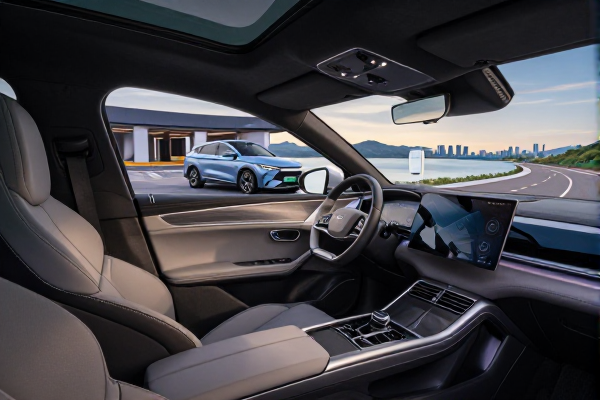
August 28, 2026 – On the same day BYD inaugurated its 10,000th Flash Charging station in Shenzhen, the company confirmed the Great Seagull hatchback will enter the Chinese market by the end of 2026. Priced at an estimated $11,000–$13,000, this 127-horsepower electric car features a roof-mounted LiDAR sensor and the next-generation Blade Battery 2.0, capable of a near-full charge in just nine minutes. For international buyers, the Great Seagull is the boldest test yet of how much advanced technology can be packed into a sub-$12,000 vehicle.
At the 2026 Chengdu Auto Show on August 24, Zhang Zhuo, general manager of BYD’s Ocean network sales division, formally named the car “Great Seagull” (Da Haiou in Mandarin). The name follows the premium tier pattern of the Great Tang SUV and Great Han sedan, positioning the model above the standard Seagull within the Ocean lineup.
Regulatory filings with China’s Ministry of Industry and Information Technology (MIIT) in July 2026 revealed key specs: length 4,205 mm (165.6 in), width 1,810 mm (71.3 in), height 1,570 mm (61.8 in), and a wheelbase of 2,650 mm (104.3 in). That’s 425 mm (16.7 in) longer than the standard Seagull and 65 mm (2.6 in) shorter than the Dolphin, placing it squarely between the two. Its direct competitors include the Geely Xingyuan (E2/EX2) and GAC Aion UT.
The MIIT filing confirmed a single electric motor producing 95 kW (127 hp) – nearly double the current Seagull’s 55 kW (74 hp). Two LFP battery options are listed: 30 kWh and approximately 39 kWh, with a CLTC range of 320–420 km (199–261 miles). Top speed is 150 km/h (93 mph), and curb weight ranges from 1,180 to 1,255 kg (2,601–2,767 lbs). The car rides on 16-inch wheels with 205/60 tires.
Preview images from road tests, published before Chengdu, show the Great Seagull with a roof-mounted LiDAR sensor. However, the official MIIT regulatory photos do not clearly show the unit, and BYD has not formally confirmed it. This detail is highly likely but not yet official. If confirmed as standard or optional, the Great Seagull would offer urban navigate-on-pilot capability via BYD’s DiPilot 300 system, marketed as “God’s Eye B” – the same mid-tier autonomous driving suite found on much pricier vehicles.
For context, the 2026 standard Seagull became the first A00-class mini car in China to offer optional LiDAR, with its God’s Eye B variant starting at 90,900 yuan (about $12,970). The Great Seagull appears positioned to extend this capability into a slightly larger, more powerful vehicle at a comparable or modestly higher price.
The Great Seagull is widely expected to use Blade Battery 2.0, BYD’s second-generation LFP architecture announced in Shenzhen on March 5, 2026. BYD has not officially confirmed the pairing, but battery experts and industry analysts widely expect it based on the launch timeline and BYD’s stated rollout across up to ten models.
Blade Battery 2.0’s Short Blade variant supports an 8C peak charge rate. For a 30 kWh pack, 8C means peak vehicle-side input of approximately 240 kW – enough to justify the claimed 10% to 70% charge in five minutes. The Long Blade variant achieves cell-level energy density of 190–210 Wh/kg. The inherent thermal stability of LFP chemistry (no oxygen release during decomposition, higher exothermic onset temperature than NMC) allows higher charge rates without the same thermal runaway risk.
One important caveat: the 1,500 kW figure describes the charging station’s hardware output, not the power a vehicle receives throughout a session. No standardized third-party test of the vehicle-side charging curve across the full 10%–97% range has been publicly released. A Lynk & Co 10 tested at a BYD Flash Charging station peaked at 430 kW, compared with about 1,100 kW at a Zeekr-branded 1,500 kW charger. Station output and vehicle-side power are separate parameters, and independent validation of the 9-minute full-charge claim remains outstanding.
On August 28, 2026, BYD held an inauguration ceremony in Shenzhen for its 10,000th Flash Charging station, reaching the halfway point of its stated year-end goal of 20,000 stations across China. BYD Executive Vice President He Zhiqi said the company averaged 55 stations per day from March 5 through August 28. The network now spans 325 cities and has registered more than 1.83 million users, about one-third of whom drive vehicles from brands other than BYD.
Each station delivers up to 1,500 kW through a single connector – a 50% increase over the previous generation. The chargers use liquid-cooled cables on an overhead T-rail sliding system and integrate local battery energy storage to buffer instantaneous peak demand. According to BYD Chairman Wang Chuanfu, traditional charging stations run at about 5% grid utilization; the storage-integrated approach increases that to approximately 95%, reducing construction costs by roughly 60% and eliminating the need for municipal power grid upgrades.
Cold-weather performance has also been improved: Blade Battery 2.0 can charge from 20% to 97% in about 12 minutes at -20°C (-4°F), versus nine minutes in standard conditions. Vehicles equipped with Blade Battery 2.0 receive one year of complimentary Flash Charging from delivery.
Internationally, BYD plans to deploy 6,000 Flash Charging stations outside China – including 3,000 in Europe – using the CCS2 standard rather than China’s GB/T interface.
For markets where BYD competes – Europe, Australia, Latin America, Southeast Asia – the Great Seagull represents the clearest test yet of how much technology can be packed into a sub-$12,000 vehicle. But it also raises questions that a product-reveal article should not skip: what China’s laws say about the data collected by a connected, camera-laden, always-on hatchback, and what those laws mean for buyers outside China.
China’s 2021 Personal Information Protection Law (PIPL) and 2022 Data Security Law impose strict requirements on cross