Browse

Log in / Register
 Share

Updated: May 9, 2026
When BYD pulled the wrappers off the Atto 8 at the Paris Motor Show in late 2025, the headline was simple: a seven-seat electric SUV that can add about two-thirds of its real-world range in the time it takes to fill a gasoline car. With the company’s new Flash charging network, the Atto 8 is claimed to go from 10 percent to 70 percent state of charge in five minutes. That sounds like a genuine breakthrough, but it comes with two warnings. First, the charger network is still in its infancy. Second, for drivers in the United States, the Atto 8 is a glimpse of the future rather than a car they can buy today.
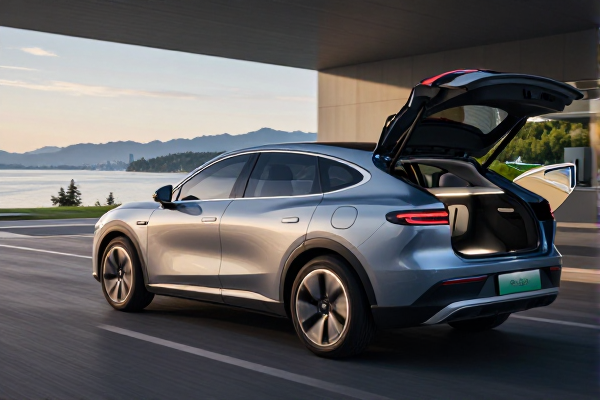
The Atto 8 is not a small electric crossover. It sits above BYD’s Atto 3 in size, with a third row and proportions closer to a premium family SUV than a city car. Under the floor is a 115kWh lithium-iron-phosphate battery pack, which BYD calls its second-generation Blade Battery. In entry Design form, the SUV uses a single rear motor rated at 462hp and 365Nm of torque. WLTP range is 653km, or about 406 miles.
Buyers who want more performance can choose the Excellence version with two motors and 775hp. That changes the character completely: BYD claims a 0-100km/h time of 4.6 seconds. Range drops slightly but remains useful at 603km, roughly 375 miles, on the same WLTP cycle.
The Atto 8 is the first BYD model headed to Europe that works with the company’s own Flash ultra-fast charging system. That means it is not designed around ordinary public fast chargers. BYD’s Flash stations combine on-site battery storage with a high-voltage grid connection to deliver as much as 1,500kW of power.
That kind of output is far beyond typical 150-350kW DC stations. BYD claims the Atto 8 can charge from 10 percent to 70 percent in five minutes. From 10 percent to 97 percent takes nine minutes. Even in extreme cold, at -30°C, the same charge takes about 12 minutes by BYD’s estimates. The company’s shorthand is simple: “Ready in five, full in nine, cold add three.”
There are conditions attached. The Atto 8 works with Flash-compatible hardware, and as of May 2026, BYD has opened only a small number of Flash stations. The first German location opened in summer 2025, and 3,000 sites are promised across Europe, but public station maps still show mostly blank spaces. There are no Flash stations in the United States, and BYD has not published a North American rollout plan.
Fast charging at this level makes some buyers nervous, so BYD points to a durability test. The company used a Yangwang U9 supercar, charged it 350 times over nine days while covering 30,000km, or about 18,600 miles, at a test track. BYD says the battery retained 98.7 percent of its original capacity after that run. That suggests the chemistry is tolerant of high current, though independent verification is still needed.
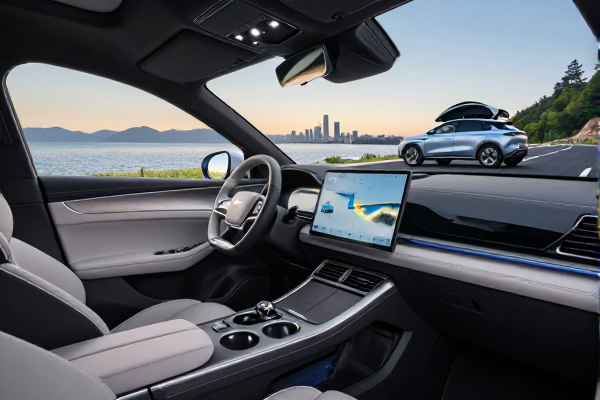
The cabin follows BYD’s newer design direction: wide screens, a flat dashboard and very little physical switchgear. The Paris show car stood out with orange genuine leather, and the glass roof measures 2.39 square meters, or about 25.7 square feet.
Front seats get heating, ventilation and massage functions. The outer seats of the middle row also get massage. There is tri-zone climate control and an optional 21-speaker DiSound audio system. Phone charging is handled by dual 50W wireless pads, and USB-C ports are placed around the cabin: two for front-seat passengers rated at 60W, plus two in the rear rated at 18W and 60W.
For a family SUV, storage is a strong suit. With all seven seats upright, the trunk measures 270 liters, or about 9.5 cubic feet. Fold the middle and rear rows and that expands to 1,960 liters, or about 69.2 cubic feet. There is also a 136-liter front trunk, roughly 4.8 cubic feet, under the hood.
BYD says first European deliveries of the Atto 8 will begin in the first quarter of 2027. That is later than some rivals, but it will arrive before the Flash network is fully built out.
For U.S. buyers, the answer is less encouraging. BYD has no official passenger-car operations in the United States and has never announced an Atto 8 launch for this market. Trade policy is a major reason: Chinese-built EVs face a 100 percent U.S. tariff, and BYD’s North American footprint has focused mainly on buses and commercial vehicles. Even if the Atto 8 were imported, Flash charging would need a local network, and none currently exists.
Stella Li, BYD executive vice president, framed the Atto 8 as proof of the company’s research pipeline. “As a technology company, BYD is all about turning intelligence into reality — and the Atto 8 is the perfect example of this,” she said in a statement. “Flash Charging is the breakthrough for EVs that everyone has been waiting for — recharging as fast as refuelling, removing range anxiety.”
The auto show also gave BYD a chance to present its Shark pickup in Europe. The Shark uses a plug-in hybrid powertrain built around a 32.2kWh Blade battery pack, two electric motors producing 436hp, and a 1.5-liter gasoline engine. BYD quotes about 90km, or 56 miles, of electric-only driving, a 0-100km/h time of 5.7 seconds, DC fast charging at up to 55kW, and 6kW vehicle-to-load. That is enough power to run tools or camp equipment.
The company also introduced a five-seat version of the Dolphin Surf city car for Europe, adding a heated steering wheel and new paint colors.
Five-minute charging is not a marketing fantasy, but it is also not yet a practical reality for most drivers. Europe’s Flash network is growing from almost nothing; America’s is growing from nothing at all. For anyone looking for a seven-seat EV today, the Atto 8 remains a Paris showroom vision. For those watching the EV market closely, it is also a preview of how quickly BYD can move the goalposts. That is a trait that will force rivals, and regulators, to respond. For now, U.S. families will have to wait.