Browse

Log in / Register
 Share

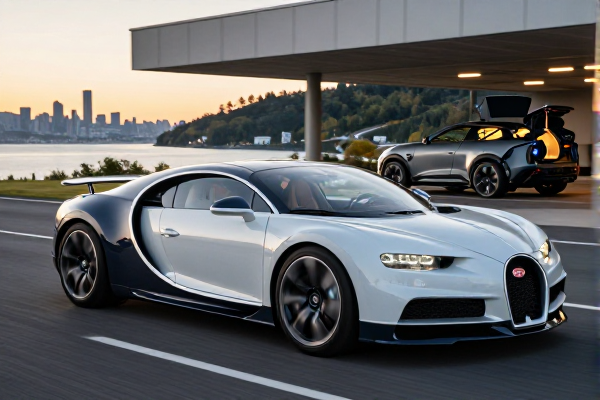
MOLSHEIM, France — May 9, 2026 — Five minutes into my first ride in the Bugatti Tourbillon, I realize this is not just another Chiron chapter. It is a genuinely different animal.
From the passenger seat, things start out familiar. The low-slung body, the horseshoe grille, the C-shaped side elements—all unmistakably Bugatti. The engine also has a familiar, weighty throb. But at around 3,000 rpm, the character suddenly changes. The rhythm becomes harder and more intense, the acceleration sharper, the soundtrack more ferocious than any turbocharged W16 ever delivered.
Mate Rimac, the man who now runs both Rimac and Bugatti, glances over as the V16 howls. “It’s cool, no?” he shouts. It is more than cool. It is a genuine turning point for a brand that had spent two decades perfecting the same basic formula.
The heart of the Tourbillon is a naturally aspirated 8,355 cc V16 built by Cosworth. It has four separate intake systems, 986 horsepower, 664 lb-ft of torque, and a crankshaft that is a full meter long. Because there are no turbochargers, the response is immediate. The rev range feels alive in a way that the old quad-turbo W16 never could.
According to Rimac, when he first floated the idea, Cosworth’s Bruce Wood tried to talk him out of it. A V10 or V12 could hit the power targets, Wood argued. But Rimac, who jokingly described himself as “the electric car guy” at the time, insisted on a V16. The result is actually not highly stressed by exotic-engine standards. It develops about 120 horsepower per liter, while Gordon Murray’s T.50 and the Aston Martin Valkyrie both push past 150 horsepower per liter. That means the Tourbillon’s engine should feel strong and reliable, not fragile.
The V16 also connects Bugatti to a very old tradition. Cadillac, Marmon and Maserati all built production V16s roughly a century ago. More recently, only the 1991 Cizeta-Moroder V16T attempted something similar, and it mounted its engine sideways. Bugatti has mounted the Cosworth V16 as the centerpiece, placed so far forward that the first two cylinders sit hard against the bulkhead—almost within touching distance of the front occupants’ shoulders.
The Tourbillon is a hybrid, but it does not behave like one. Three electric motors are onboard: one for each front wheel, and one integrated with the rear-mounted twin-clutch gearbox. A 25 kWh Rimac battery pack fills the center of the car. The system can provide instant torque and zero-lag acceleration.
Here is the unusual part: the driver can turn the electric assistance off completely and run the car purely on the V16. No other hybrid hypercar on sale today offers that option. Most manufacturers use electric motors to downsize engines or to fill turbo lag below peak boost. Bugatti has done the opposite—layering electrification on top of a large, naturally aspirated internal-combustion engine.
It is also a hybrid that weighs less than the combustion car it replaces. Rimac is clearly proud of this. The V16, the twin-clutch gearbox and one of the electric motors all fit together at around 430 kg. The old W16 engine alone weighed about the same amount. The hybrid system does not count as a penalty because the car’s packaging has been rethought around it.
Moving the gearbox to the rear also allowed a slimmer transmission tunnel. That means the two passengers sit closer together, the greenhouse is narrower, the frontal area is smaller, and aerodynamic performance is better. The car feels intensely packaged but not compromised.
At Molsheim, there is ongoing discussion about why the Tourbillon needed hybrid power at all. The system adds weight, complexity and cost, even if its net effect on mass is neutral. Rimac’s answer is practical: the technology was right to pursue, the performance benefits are real, and it creates a clear link between Bugatti and Rimac’s battery expertise.
But the first-ride experience suggests the V16 is the real star. The electric motors are secondary, almost invisible until you ask for maximum acceleration. In that sense, the Tourbillon is one of the least hybrid-feeling hybrids ever made. The driver can simply enjoy the engine as if the battery and motors did not exist.
Production of the initial 250 Tourbillon coupes is now underway, with a process split between Croatia and France. The cars start life at Rimac’s campus in Zagreb, where most of the engineering and manufacturing work is done. From there, the cars are shipped to Molsheim for final assembly.
Rimac explained the decision during a tour of Bugatti’s facilities. “We used to rely heavily on suppliers to produce components for the cars,” he said, “but instead we have now moved a lot of that in house.” Molsheim has been upgraded with a new building, La Manufacture, alongside the existing Atelier. The move is designed to speed up production and reduce waiting times. Some customers currently face delays of more than three years.
Finding buyers is not a problem for Bugatti. The challenge is building cars fast enough.
Visually, the Tourbillon has far more presence than any photograph suggests. The example I rode in was equipped with the Equipe Pur Sang package, a motorsport-inspired cosmetic option that most customers are choosing. It includes eight striking exhaust pipes, and that rear view is the most compelling angle. The diffuser is enormous, and because the V16 is narrow, there is a large aero tunnel on each side underneath the body.
The design is sparer and more angular than the Chiron. The doors include the A-pillar surface, so there is no visible join line at the top; the pillar flows directly into the roof. Inside, the cabin is snug but surprisingly intimate. The seats do not slide, though height and backrest adjust. The passenger footwell is shallower than the driver’s because the front electric motors and accessories need space. My feet sat nearly level with the back of the front tires.
Starting the engine is an event. Rimac pulled the organ-stop starter, and both of us broke into a grin. The doors whirr upward electrically, and the cabin feels like a cockpit rather than a lounge. After a few minutes on the road, the car’s essential character becomes clear: it rewards hard driving, sharp responses and a willingness to chase the rev limit.
The initial Tourbillon production run is already reserved, and a roadster version is widely expected to follow. More intriguing is what Rimac might do next. Over lunch at the Molsheim headquarters, conversation turned to Ferrari’s new Dodici Cilindri Manuale and the Gordon Murray T.50. Rimac did not hide his interest, and he talked about Bugatti’s deep history of lightweight cars.
A naturally aspirated V16 in a lighter chassis with a manual gearbox sounds like a fantasy. But Rimac has a habit of turning his dreams into production reality. The Tourbillon itself was supposed to be impossible, and it is here. If the next Bugatti is even more focused on analog driving joy, no one should be surprised.
For now, the Tourbillon gives Bugatti exactly what it needed: a break from the past, a new engine character and a bold reason to look forward. The old W16 era was about overwhelming force. This V16 era is about precision, intensity and emotion—and, for the first time in a modern Bugatti, the ability to enjoy the machine with the electric system switched off.
Nothing about the next 20 years of Bugatti will look like the last 20. That became obvious during the first few minutes of this ride.