Browse

Log in / Register
 Share


BMW's India arm has reset the pricing equation in the premium sedan class with the locally assembled i5 eDrive 35L, a long-wheelbase electric 5 Series priced at ₹79.60 lakh ex-showroom — roughly US$93,000. That makes it ₹1.9 lakh cheaper than the entry-level Mercedes-Benz E 200 LWB (₹81.50 lakh) and only ₹3 lakh costlier than BMW's own petrol 530Li M Sport. Updated: February 28, 2026.
The i5 badge made its Indian debut in 2024 via the M60, a twin-motor flagship that was more headline-grabber than volume seller. The eDrive 35L is a deliberately different animal: a sedan built at BMW's Chennai plant with a hard-headed pricing strategy running through every line of its spec sheet.
The arithmetic is blunt. At ₹79.60 lakh ex-showroom, the EV undercuts the Mercedes-Benz E 200 LWB by ₹1.9 lakh while sitting just ₹3 lakh above the petrol 530Li M Sport. In a market where the E-Class has long defined executive transport, that is an unusually aggressive strike. It also creates a genuine internal dilemma: why choose the combustion 5 Series when the EV costs nearly the same money? The decision now comes down to preference rather than financial sacrifice.
Dealers expect to watch this closely, not least because India's luxury market remains SUV-driven and sedans must fight for attention. But the pricing context alone tells you BMW walked into this launch with its calculators out — and it is daring rivals to match the value equation.
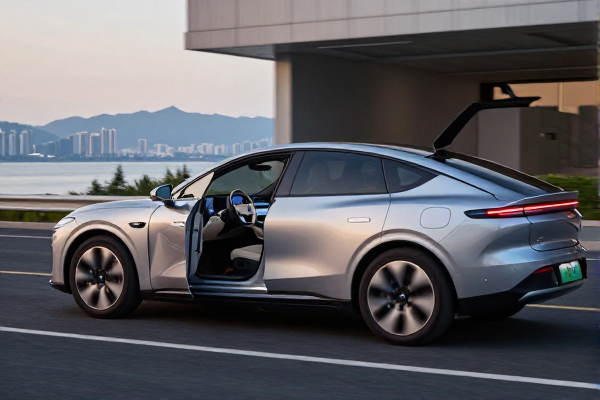
Physically, the i5 eDrive 35L is a big car: 5,175 mm long with a 3,105 mm wheelbase, wider and longer on paper than every direct rival. The proportions lean toward SUV-like visual mass — upright front end, lengthy bonnet, a stance that reads as substantial before you even open the door.
The finer details earn their keep quietly: a satin-aluminium C-pillar trim carrying only a "5" badge, a tiny "i" marker inside the kidney grille, and 20-inch wheels that fill the arches far better than the 18-inchers on the petrol car. Nothing about the exterior shouts "electric" from a distance, which suits buyers who prefer their electrification subtle. Is it conventionally pretty? Not quite. But it is striking, modern and unmistakably expensive-looking in person.
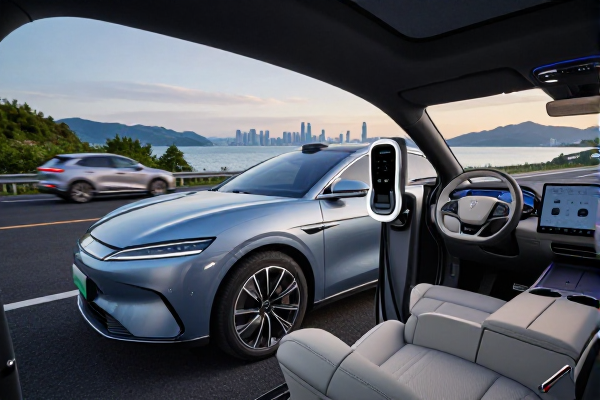
Inside, the i5 follows BMW's current design idiom: twin curved screens sweeping across the dash, slim ambient light strips running through the dashboard and door panels, open-pore wood trim and a layered centre console. The crystal-look gear selector and iDrive dial add a tactile quality that lifts the whole cabin.
The upholstery is tan leather throughout — a shade lighter than some buyers may prefer, but impeccably finished. Front seats offer wide-ranging adjustment and just enough lateral support to hint at sportiness without compromising comfort. The overall atmosphere is refined minimalism, positioned neatly between chauffeured luxury and everyday driving.
The long wheelbase delivers real limousine-grade rear accommodation. The back seat is spacious enough for long-distance relaxation or working on the move, with well-shaped bases and a comfortable backrest angle for extended trips.
There are two compromises worth knowing. First, the battery pack beneath the floor raises the seat height slightly, so taller passengers sit with knees a little higher than in the petrol car — noticeable but not deal-breaking. Second, the equipment list has been carefully managed to protect the price: there is no rear-seat recline, no "boss" button to slide the co-driver's seat forward, and no rear sunshades. The E-Class offers all three; their absence here is a deliberate trade-off.
Boot packaging adds another quirk. There is no under-floor spare-wheel well on this EV — the spare sits on the boot floor, leaving awkward space for hard-shell luggage. The petrol 5 Series hides its spare properly below the floor, so this is an electrification-specific compromise that matters for airport runs.
The powertrain uses an 81.6 kWh battery pack and a single rear motor producing 268 bhp and about 410 Nm (302 lb-ft). Claimed range is 669 km on the Indian test cycle; real-world mixed driving should return roughly 450 km. DC fast charging at up to 160 kW takes the battery from 10 to 80 per cent in about 33 minutes — respectable for a sedan aimed at intercity and urban duty.
On the road, the i5 is comfortable with its role. It is not built for enthusiasts: the steering is light and city-friendly, but lacks feel and weight at triple-digit speeds. Sport mode summons strong, consistent acceleration to a limited 195 km/h (121 mph), and overtaking is handled with minimal fuss.
The real surprise is calibration. Throttle response sets a new benchmark for intuitive, progressive EV control. Four regeneration levels plus a one-pedal "B" mode let the driver tailor behaviour quickly, and within minutes the car feels second nature — a quality that matters more than straight-line numbers in daily use.
Ride quality completes the picture. A heavy, low-slung sedan on 20-inch wheels ought to thud; this one absorbs undulations gracefully and clears nasty speed breakers without drama. Cabin insulation is equally accomplished, delivering the hushed refinement the 5 Series nameplate has always promised and rarely delivered so convincingly in electric form.
The US market will not see this exact car: the i5 sold stateside is a standard-wheelbase, German-built model in eDrive40 or M60 trim. But the India launch matters beyond its borders. India is now the only market outside China to assemble the long-wheelbase i5 bodyshell, using familiar hardware — the same 81.6 kWh battery found in the US-market eDrive40, retuned here to a lower output for the local specification.
The broader takeaway is strategic. Localisation is not just about tariffs; it is about learning to price EVs competitively in markets where buyers weigh cost against tradition. If BMW can build an LWB electric 5 Series at ₹79.60 lakh and undercut Mercedes in the bargain, that cost-management playbook could reshape how aggressively the company approaches other price-sensitive markets — and how it localises future models across regions.
For US readers, the contrast is instructive. The India-market i5 is a different machine from the roughly $67,000 eDrive40 in American showrooms: different proportions, different tuning, different priorities. Yet the Indian price structure shows what BMW can do when it controls the full bill of materials. In India, the i5 threatens its own petrol sibling. In the US, the pressure is on the broader premium EV segment.
At ₹79.60 lakh, the i5 eDrive 35L does more than exploit a price gap. It delivers space, silence, ride comfort and credible real-world range in a body that is genuinely large and genuinely luxurious. The omissions — rear recline, boss mode, sunshades, boot practicality — are real, but they are the trade-offs that made the price possible. As a value-led electric sedan, it resets buyer expectations.
BMW has long said electrification becomes serious when the economics start to make sense. In India, that moment has arrived.