Browse

Log in / Register
 Share

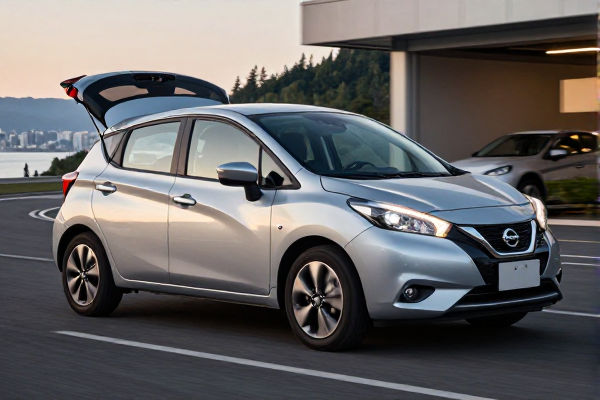
As of June 17, 2026, the 2017 Nissan Note is still remembered as a sensible city car with excellent fuel economy. A current advertisement in New Zealand shows why: this pearl-white Note X has 25,961 km (about 16,100 miles) on the clock, a 1.2-liter gasoline engine, and an automatic transmission. This used-car profile walks through the specs, equipment, safety credentials, and what U.S. buyers should know about the Note's American cousin, the Versa Note.
The Nissan Note is a small five-door hatchback sold in many markets outside North America. It was built to be cheap to run and easy to park, and it appeals to drivers who want the low running costs of a subcompact without giving up a practical body shape.
The model generation that includes the 2017 car debuted in 2012 and brought a much more efficient engine lineup than older Notes. In Japan, the standard car often used a 1.2-liter three-cylinder gasoline engine. Nissan later introduced an e-Power hybrid version, but the regular petrol model is the one found most often in budget used-car inventory.
In North America, this generation was not sold under the Note name. Nissan offered the Versa Note from 2013 to 2019 as the hatchback version of the Versa sedan. That car used a larger 1.6-liter engine. So, if you are shopping in the United States and want something similar to a 2017 Note, the Versa Note is the model to look at.
The New Zealand-listed car gives a snapshot of a well-equipped base-to-mid 2017 Note. It is not a stripped-out bargain-spec car, nor a top-spec hybrid. Among the details:
| Vehicle Detail | Spec |
|---|---|
| Body Type | Hatchback |
| Transmission | Automatic |
| Odometer | 25,961 km / ~16,100 mi |
| Fuel | Gasoline |
| Year | 2017 |
| Seats | 5 |
| Color | Pearl White |
| Engine | 1,190 cc |
A car with 16,000 miles in 2026 is on the low side for a nine-year-old hatchback, which helps explain why it stands out in the current listing. Low-mileage examples like this one are becoming harder to find in many markets, especially if they have service records.
The 1.2-liter petrol engine in the Note is not built for speed. It is built to keep fuel bills low, and for city use it feels lively enough mostly because the car is light and the automatic is calibrated for gentle steps from a stop.
The dealer's claim is 5.2 L/100 km. That works out to roughly 45 U.S. mpg using a standard conversion. It is an impressive number, but it is also a test-cycle figure. Real-world results depend on traffic, load, whether the car is mostly used in the city or on the highway, and how it is driven.
The listing also shows a New Zealand clean-car score of 3.5 stars and CO2 output of 121 g/km. Both are modest figures by 2026 standards, though drivers in the U.S. should rely on EPA data when comparing a local Versa Note.
For U.S. shoppers, the equivalent 2017 Versa Note will come in lower. The EPA-rated 1.6-liter automatic returns roughly 31 mpg in the city and 39–40 mpg on the highway, depending on the trim. That is still good for a regular non-hybrid small hatchback, but it is not a direct match to the Japanese-market Note's 45 mpg figure.
When comparing any used imported car with a local model, keep the fuel figures in context. A U.S.-market Versa Note is easier to service and likely to be EPA-certified; an imported Japanese-market Note may have a different engine and calibration that was not designed for American fuel or driving conditions.
Inside, the Note follows the usual small-car formula: a short nose, a tall roofline, and a rear bench that was planned around passengers rather than luggage. Five seats are standard, and the rear compartment gives enough headroom for adult passengers on short trips, which is not always the case in this class.
The X grade shown in the listing adds convenience features like a smart key and push-button start. The car also comes with air conditioning, airbags, and ABS brakes. None of that sounds exceptional in 2026, but for a 2017 subcompact it is a useful combination, especially for someone buying their first car.
Cargo space is another positive. The Note's upright rear door and tall profile make it easier to load bulky items than some low-slung city cars. The rear seat folds to create more space, so the car can carry seating for five or a week's worth of luggage.
Safety ratings never appear in a simple straight line across the border. The New Zealand listing carries a 4-star Used Car Safety Rating under the 2025 VSRR system. That rating is not an NHTSA star rating and should not be treated as one for U.S. buyers.
If you want crash-test data for the American-market equivalent, use the NHTSA and IIHS websites. The 2017 Versa Note is covered in both databases, and you can look up the specific body style and test results. Also check for open safety recalls through NHTSA's VIN lookup before you finalize any purchase.
On an older car, condition matters more than the original safety spec. Check that the airbags show no warning lights, the tires have even wear, the brakes pull smoothly, and the body panels have no signs of accident repairs. A pre-purchase inspection is worth the money.
This is the part that matters most for U.S. readers. You cannot simply search for a used 2017 Nissan Note at a mainstream American dealership and expect to find a large selection. The Note badge was never sold here in that generation.
If an imported 2017 Note is advertised in the U.S., the legal situation is not the same as buying a used gray-market car from Canada or Mexico. Under federal rules, vehicles less than 25 years old that are not identical to U.S.-certified versions generally must be brought into compliance with Federal Motor Vehicle Safety Standards and EPA emissions requirements. That is expensive and rarely worth it for a budget hatchback.
The smart move in America is to shop for a 2017 Nissan Versa Note. It shares a similar idea—a small, efficient hatchback with plenty of interior space—and it has a domestic supply of parts, normal service documentation, and U.S. safety ratings.
In 2026, used-car prices have settled after the big post-pandemic spike, although interest rates still affect monthly budgets. Small cars like the Note and Versa Note sit close to the cheapest end of the market, which makes them popular with commuters, students, and anyone trying to reduce transport costs.
The trade-off is that subcompacts were never especially exciting to drive. The Note is stable and predictable. It does not pretend to be a sports car. If your priority is a low-cost car that starts every morning and sips fuel, that is exactly the point.
One advantage in a market still full of expensive crossovers is that an older hatchback with a small engine is often cheaper to insure and cheaper to maintain than an SUV. Tires, brake pads, and basic parts are usually inexpensive, and a simple engine layout leaves less to go wrong.
Treat the dealer's fuel-economy number as a starting point, not a guarantee. Look at the owner's manual for service intervals, and try to confirm whether the timing chain or belt has been inspected. At this age, cooling hoses, battery condition, and suspension bushes deserve attention.
Alignment is another common issue on cars that are used for short city trips, because they spend a lot of time bouncing over curbs and potholes. Uneven tire wear is often the first warning sign.
If you are considering a Versa Note in the U.S., check the CarFax-style history for mileage consistency and look for rust underneath, especially in northern states where roads are salted. The Versa Note is generally a durable little car, but any nine-year-old vehicle will need care.
The 2017 Nissan Note remains a sensible low-cost hatchback in markets where it was sold new. It offers compact dimensions, a cooperative automatic gearbox, low fuel consumption, and enough room for five passengers. The specific example listed in New Zealand shows how attractive a low-mileage example can be.
For American drivers, the honest version of this decision is the 2017 Nissan Versa Note. With its 1.6-liter engine, hatchback practicality, and easy-to-find parts, it fills the same role without the import headaches. Look up crash ratings, check recall status, and use the EPA fuel-economy figures when comparing it to other