Browse

Log in / Register
 Share
Share
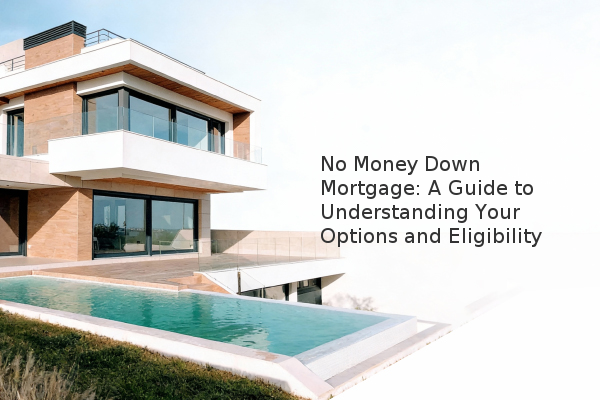
A no money down mortgage allows eligible homebuyers to purchase a property without an initial cash investment, primarily through government-backed programs like VA and USDA loans. However, these programs have strict eligibility requirements related to military service or property location. For those who don't qualify, low-down-payment alternatives like FHA loans (3.5% down) and conventional loans (3% down) are more accessible and often more financially prudent, helping buyers avoid higher monthly costs and the need for additional mortgage insurance.
What is a No Money Down Mortgage? A no money down mortgage is a home loan that finances 100% of a property's purchase price, requiring zero down payment from the buyer. This contrasts with standard loans that typically require a down payment of 3% to 20%. The ability to buy a home with no money down is primarily available through specific government programs designed to promote homeownership for certain groups of Americans. It's crucial to understand that while the upfront cost is eliminated, these loans still involve closing costs, which are fees for services like the appraisal and title search. Buyers often negotiate for the seller to pay these costs or finance them into the loan amount if possible.
Who Qualifies for a True Zero-Down Payment Loan? True no money down mortgages are not widely available to the general public. Eligibility is strictly defined by two main government programs:
Comparing Low-Down-Payment Alternatives For the majority of buyers who do not meet the criteria for VA or USDA loans, several low-down-payment options provide a path to homeownership with a minimal initial investment. The following table outlines the primary alternatives:
| Loan Type | Minimum Down Payment | Key Eligibility Factors | Mortgage Insurance Requirement |
|---|---|---|---|
| FHA Loan | 3.5% | Minimum credit score of 580 (10% down with a score of 500-579) | Upfront and annual MIP (Mortgage Insurance Premium) |
| Conventional 97 | 3% | Minimum credit score of 620; must be a first-time homebuyer in many cases | PMI required until 20% equity is reached |
| HomeReady/HomePossible | 3% | Income limits apply; designed for low- to moderate-income buyers | PMI required, but often at a lower cost |
The Financial Implications of a Small or No Down Payment Opting for a minimal or zero down payment has significant long-term financial consequences. The most immediate impact is a higher loan amount, which translates to larger monthly mortgage payments. Furthermore, with less than 20% equity in the home, lenders mandate mortgage insurance. This additional cost can add hundreds of dollars to your monthly housing expense. A smaller down payment also means you begin with less immediate equity, which could be a risk if property values decline. Based on our experience assessment, a larger down payment generally leads to more stable long-term financial footing.
Is a No Money Down Mortgage the Right Choice for You? The decision hinges on your financial profile and goals. A true no money down loan can be an excellent benefit for those who qualify, effectively accelerating the home buying timeline. However, for others, saving for even a small down payment of 3% to 5% can be a wiser strategy. It reduces your loan balance, lowers monthly payments, and may help you avoid or shorten the duration of mortgage insurance. Carefully weigh your income stability, other debts, and ability to cover ongoing maintenance costs before committing to a loan with minimal skin in the game.
Key Takeaways for Prospective Buyers