Browse

Log in / Register
 Share

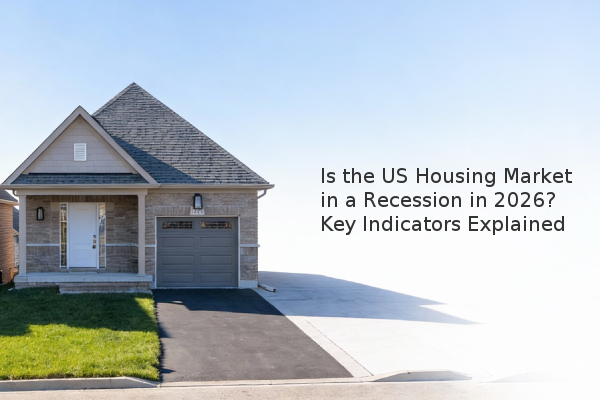
Based on current economic data and expert analysis, the US housing market in 2026 is not in a technical recession, but it is experiencing a significant slowdown characterized by low sales volume and cautious behavior from both buyers and builders. The central question hinges on the Federal Reserve's interest rate policy and its direct impact on mortgage rates, which are the cost of borrowing money to purchase a home. While recent rate cuts have provided some relief, broader economic uncertainty continues to dampen market activity.
A housing recession is typically identified by a sustained decline in activity, not just home prices. Key indicators include a sharp drop in the number of home sales, rising inventory of unsold homes, and a pullback in new construction. It's important to distinguish this from the broader economy; the housing sector can enter a recession even if the overall economy does not. The current slowdown is marked by home sales tracking toward their slowest annual pace in decades, which aligns with some classic recessionary signals.
The Federal Reserve (the Fed) does not set mortgage rates directly. Instead, it controls the federal funds rate, which is the interest rate banks charge each other for overnight loans. Mortgage rates tend to follow the yield on long-term government bonds, which are influenced by investor expectations for future economic growth and inflation. When the Fed raises the federal funds rate to combat inflation, it often leads to higher borrowing costs across the economy, including for mortgages. Conversely, when the Fed cuts rates, it can create conditions for mortgage rates to fall, as seen with the recent drop in 30-year fixed rates. However, the relationship is not one-to-one, and other factors like overall economic uncertainty can keep mortgage rates elevated.
Recent Mortgage Rate Trends (2025-2026)
| Period | Average 30-Year Fixed Mortgage Rate | Key Influencing Factor |
|---|---|---|
| Late 2025 | ~6.50% | High inflation expectations |
| Post-FOMC Meeting (2026) | 6.17% | Fed rate cut |
| Current (2026) | Volatile | Economic uncertainty, labor market data |
Several metrics point to a cooling market. Home sales have failed to pick up significantly even as mortgage rates have retreated from their peaks. This suggests that affordability remains a major hurdle for potential buyers. Simultaneously, homebuilders are pulling back on construction, particularly for entry-level homes, indicating a lack of confidence in demand from first-time buyers. The health of the housing market is ultimately underpinned by the labor market. Based on our experience assessment, softening employment conditions in 2026, where companies are hiring less and conducting more layoffs, make consumers less confident about making a large financial commitment like buying a house.
The outlook is highly dependent on the trajectory of inflation and the Fed's response. The Fed has a congressional mandate to achieve maximum employment while keeping inflation near its 2% target. If inflation continues to moderate, the Fed will have more room to cut interest rates, which would likely lead to further declines in mortgage rates. However, Fed policy is not on a "preset course," and future decisions will be guided by incoming economic data. A sustained recovery in the housing market will require a combination of lower borrowing costs and improved consumer confidence in job security.
For potential buyers and sellers, the current environment suggests a cautious approach.
The housing market is in a period of transition. While not in a classic recession, the slowdown is significant. The path forward hinges on a delicate balance between the Federal Reserve's fight against inflation and the strength of the American labor market.