Browse

Log in / Register
 Share

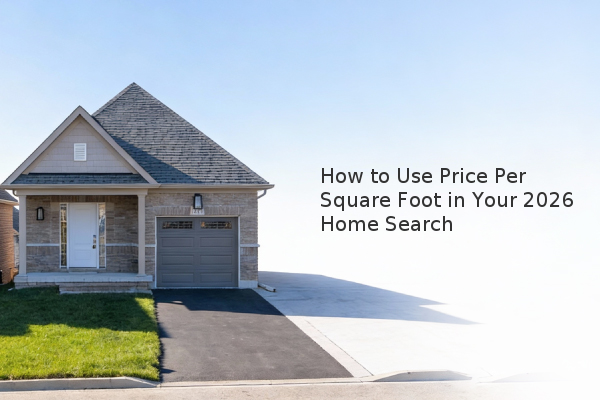
Understanding a home's price per square foot is a fundamental step in evaluating a property's value. This metric, calculated by dividing the home's sale price by its total square footage, provides a standardized point of comparison. However, the most effective use of price per square foot is to compare it against the median for similar homes in your target neighborhood. Relying on this number alone can be misleading, as property characteristics and local market conditions drastically influence its meaning. This guide will explain how to calculate, interpret, and strategically use this figure in your 2026 home-buying journey.
The price per square foot is a real estate metric used to compare the value of homes by standardizing cost relative to size. You calculate it by taking the listing price and dividing it by the home's total livable square footage. For example, a home listed for $500,000 with 2,000 square feet would have a price per square foot of $250.
This figure is often prominently displayed on real estate listings. However, its value is not absolute. A $300 per square foot price might be a bargain in one zip code and overpriced in another. To gain meaningful insight, your immediate next step should be to research the median price per square foot for the specific neighborhood or city. This median value, which represents the middle point of all sales (where half are above and half are below), is a more reliable indicator of the local market's middle ground than the average, which can be skewed by a few extremely high or low sales.
Once you have the median price per square foot for your desired area, you can use it as a powerful negotiation tool. Comparing a specific home's metric to the neighborhood median helps you quickly assess if a property is priced fairly.
Based on our experience assessment, this comparison provides a data-driven starting point for price discussions, but it should not be the sole factor in your decision.
The national median price per square foot is a broad benchmark, but local variation is extreme. This disparity exists due to several key factors:
While useful, price per square foot has significant limitations. It is unwise to let it be your lone deciding factor for these reasons:
The best way to gauge true living space is to walk through the property yourself. The number on paper cannot replace the feel of the home's flow and functionality.
Price per square foot is an essential starting point for comparing homes on a level playing field. To use it effectively in 2026: 1. Always compare a home's figure to the neighborhood median, not the national average. 2. Use the discrepancy as a data point to support your offer price during negotiations. 3. Recognize its limitations and never use it in isolation. Factor in the home's condition, lot size, interior layout, and overall market conditions to make a fully informed purchasing decision.