Browse

Log in / Register
 Share

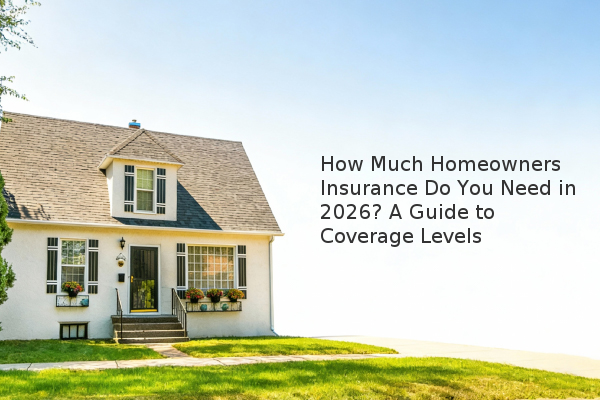
Determining the right amount of homeowners insurance is a critical financial decision for any property owner. The core conclusion is that you need enough coverage to completely rebuild your home at current construction costs (known as the replacement cost), protect your personal belongings, and shield yourself from personal liability claims. Buying too little insurance can lead to significant out-of-pocket expenses after a disaster, while over-insuring means wasting money on unnecessary premiums. This guide outlines the key factors to consider for adequate coverage in 2026.
The main purpose of a homeowners insurance policy is to provide financial protection if your home is damaged or destroyed. The most critical coverage is for a total loss, a situation where your home needs to be completely rebuilt from the ground up, such as after a major fire or tornado. The amount of coverage needed for this is not based on your home's real estate market value but on its replacement cost.
Replacement cost is an estimate of how much it would cost to rebuild your home from scratch using materials of similar kind and quality, at current local construction labor and material rates. This figure can be higher or lower than what you paid for the property. Based on our experience assessment, factors like your home's square footage, the quality of construction, unique architectural features, and local building codes significantly influence this calculation. To determine an accurate replacement cost, it is recommended to consult with an insurance agent who can use specialized reconstruction cost-estimating tools.
Yes, standard homeowners insurance policies typically include coverage for your personal belongings, such as furniture, electronics, and clothing. This is often referred to as personal property coverage. However, the extent of this protection depends heavily on the type of policy you purchase.
A crucial distinction exists between a "named perils" policy and an "open perils" (or "all-risk") policy. A named perils policy only covers losses caused by events specifically listed in the policy document, such as fire or theft. If a loss occurs for a reason not listed, the claim may be denied. For stronger protection, an open perils policy covers all causes of loss except those explicitly excluded in the policy. This type of coverage provides more comprehensive peace of mind for your belongings. Most policies also have sub-limits for certain categories of high-value items, meaning your coverage for jewelry or art may be limited.
Insurance providers often offer different tiers of coverage, such as "basic," "broad," and "premium" or "enhanced" forms. A basic policy provides the most limited coverage, while enhanced policies offer more robust protection, often at a higher premium. The right level for you depends on your personal risk tolerance and financial situation.
If you have a mortgage, your lender will likely require you to maintain a policy that covers at least 100% of the home's replacement cost. Even if your home is paid off, carrying this level of coverage is a prudent financial decision. The key is to balance cost with the security of knowing you are adequately protected. Most insurers allow you to adjust your coverage levels as your financial circumstances change.
A standard policy may not be enough to fully protect high-value possessions or cover certain types of damage. For specific, valuable items like fine art, jewelry, or collectibles, you may need to purchase a scheduled personal property rider. This add-on provides broader coverage and higher limits for these items, often with no deductible.
Furthermore, standard homeowners policies typically exclude damage from specific natural disasters. Flood insurance and earthquake insurance are almost always separate policies that must be purchased in addition to your standard homeowners insurance. If you live in an area prone to these events, securing this additional coverage is essential. The following table outlines common coverage gaps and their solutions.
| Coverage Gap | Standard Policy Typically... | Solution |
|---|---|---|
| High-Value Items (e.g., jewelry, art) | Has low sub-limits (e.g., $1,500 for jewelry) | Purchase a scheduled personal property rider |
| Flood Damage | Excludes it entirely | Purchase a separate flood insurance policy |
| Earthquake Damage | Excludes it entirely | Purchase a separate earthquake insurance policy |
| Sewer Backup | May be excluded or limited | Purchase a specific water backup rider |
To ensure you have the right amount of homeowners insurance in 2026, focus on these key steps: get a professional assessment of your home’s replacement cost, choose an open perils policy for the broadest protection, and evaluate the need for riders to cover high-value items or specific natural disasters. Regularly reviewing your policy with your insurance agent, especially after major home improvements, is the best way to maintain adequate coverage.