Browse

Log in / Register
 Share
Share
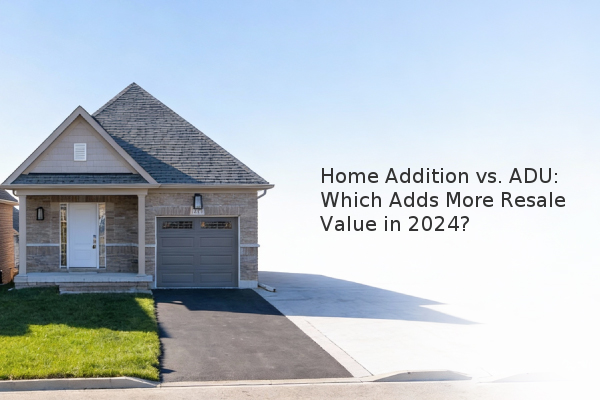
For homeowners needing more space but reluctant to give up a low-rate mortgage, building an addition or an Accessory Dwelling Unit (ADU) are two primary solutions. The right choice depends heavily on your local market. In general, a home addition typically offers a more direct and reliable boost to resale value by increasing the main home's square footage. However, in high-cost, high-demand rental markets, an ADU can provide a superior return by generating rental income, appealing to a different pool of buyers. The best option is determined by your location, budget, and long-term goals.
The fundamental distinction lies in independence. A home addition is an extension physically connected to the main house, adding bedrooms, living space, or a bathroom. It is designed to integrate seamlessly into the existing layout. Critically, most additions do not include a full kitchen, meaning they are not intended for independent living.
An Accessory Dwelling Unit (ADU), sometimes called a granny flat or in-law suite, is a fully self-contained dwelling. It includes its own kitchen, bathroom, and living area, allowing it to function as a standalone rental unit, guesthouse, or residence for family members. "The key difference is that an ADU is a fully independent dwelling, with its own kitchen, and so can house a separate family," explains Breno Neri, a tiny home expert.
A home addition often provides the best Return on Investment (ROI), a calculation of the profit from an investment relative to its cost, when it resolves a functional deficiency in the property. Converting a two-bedroom home into a three-bedroom one, for example, significantly expands the pool of potential buyers. "From my experience flipping and building homes, a home addition gets more in resale value than an ADU, assuming their size is roughly equal," says Paul Dashevsky of GreatBuildz.
This is especially true in markets where buyers prioritize square footage over rental potential. "In most Midwestern cities... buyers prize bigger footprints instead of detached spaces since families are frequently in search of more usable interior space," notes Jacob Naig, a real estate agent. An addition that creates a needed bedroom, bath, or storage space directly increases the appraised value without the complexity of a separate unit.
ADUs shine in regions with intense housing affordability pressures and strong rental demand, such as the West Coast. The potential for rental income can make a property significantly more valuable. "Because of the price constraints in Southern California and high demand for rentals, most people are willing to pay much more for a property that has an ADU over an addition," explains San Diego agent Jessica Vance. The trend is clear: in 2023, San Diego County issued more permits for ADUs (1,348) than for new single-family homes (1,225).
Beyond rental income, ADUs offer flexibility for multigenerational living, allowing seniors to age in place near family while maintaining privacy. In some high-cost markets, detached ADUs have been known to appraise for as much as 1.5 times their construction cost.
Both projects carry financial risks that can erode your ROI. The primary risk with an addition is over-improvement—spending so much that your home's value far exceeds other properties in the neighborhood. "You can spend $80,000 to try to add square footage only to learn that buyers in your market refuse to pay a premium above a certain ceiling," warns Naig. Additions can also trigger unexpected building code upgrades or a property tax reassessment.
ADUs present different challenges:
Before making a decision, your first step must be to consult local zoning laws. Regulations may prohibit second-story additions or ADUs that are too close to property lines. Your choice may hinge entirely on what is legally permissible for your lot.
To maximize your resale value, research is paramount. The optimal choice is not universal but is dictated by your specific neighborhood dynamics. Consult a local real estate agent to analyze comparable sales and provide data-driven advice on whether buyers in your area value more interior space or the income potential of an ADU.