Browse

Log in / Register
 Share
Share
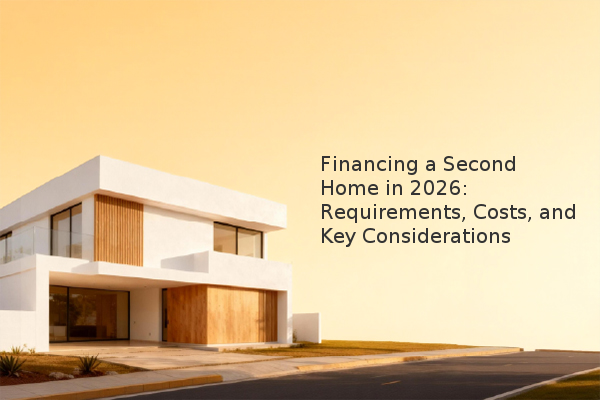
Securing financing for a vacation property involves distinct challenges compared to a primary residence. Based on our experience assessment, successful second-home financing in 2026 hinges on a strong credit profile, a substantial down payment typically starting at 20%, and the demonstrated ability to cover both mortgage payments. Key factors influencing your eligibility and costs include the property's classification, rising insurance premiums in coastal areas, and the significant ongoing expenses of maintaining a second home.
Lenders assess risk more cautiously for second homes. While requirements vary, you can generally expect to need a higher credit score and a larger down payment than for a primary residence. For a jumbo mortgage (a loan that exceeds the conforming loan limits set by government-sponsored enterprises), a down payment of 20% or more is common. Your credit score is a critical factor; some lenders require a minimum score of 740 for the best rates, though others may consider scores as low as 680 with a larger down payment.
The most significant hurdle is proving you can manage dual housing expenses. Lenders will meticulously analyze your debt-to-income (DTI) ratio to ensure you can comfortably cover the payments for both properties, even if you plan to rent out the vacation home occasionally.
While interest rates for second homes can be competitive, they are often slightly higher than for primary residences, especially for loans classified as investment properties. However, for loans up to a certain amount—often around $1.5 to $2 million—some lenders may offer rates identical to primary home loans. The defining factor is the lender's classification of your property. If you plan to rent out the home for more than a certain number of days per year (a threshold that varies by lender), the loan may be classified as an investment property, which carries higher interest rates and stricter qualification standards.
The mortgage payment is just the beginning. Owning a second home comes with a suite of recurring expenses that must be factored into your budget. These include property taxes, homeowners insurance, flood insurance (which is often mandatory and costly in coastal regions), utilities, maintenance, and potential homeowners association (HOA) fees. In areas recently affected by severe weather, such as coastal communities in the Northeast, flood insurance premiums have increased significantly. Since lenders will not finance an underinsured property, these high insurance costs can sometimes preclude financing altogether, leaving cash buyers as the only viable purchasers for some properties.
A significant financial benefit is the potential for tax deductions. The interest paid on a mortgage for a qualified second home is generally tax-deductible, within the same limits as your primary residence (up to $1 million of mortgage debt). This can provide a substantial annual benefit. If the interest rate on your second home loan is higher than that on your primary residence, it may be advantageous to prioritize that deduction on your tax returns. We recommend consulting with a tax professional to understand how these rules apply to your specific financial situation.
In highly competitive luxury markets, cash offers often prevail. Sellers may favor cash buyers because the transaction is more certain and not contingent on a lender's appraisal or approval process. Even if you plan to finance, being prepared to make a cash offer can strengthen your negotiating position. In some cases, buyers secure a mortgage after the purchase through a refinance. Based on our experience assessment, in markets known for all-cash transactions, having financing pre-approval is the bare minimum, but a cash offer is frequently the most compelling.
Financing a second home requires a comprehensive financial review. Before you begin your search, it is crucial to get pre-approved with a lender who specializes in second-home mortgages. This will clarify your budget and strengthen your position as a serious buyer. Carefully calculate all ongoing costs beyond the mortgage payment to ensure the property is affordable long-term. Finally, be strategic about how you intend to use the property, as renting it out for too many days can change its classification and increase your borrowing costs.