Browse

Log in / Register
 Share
Share
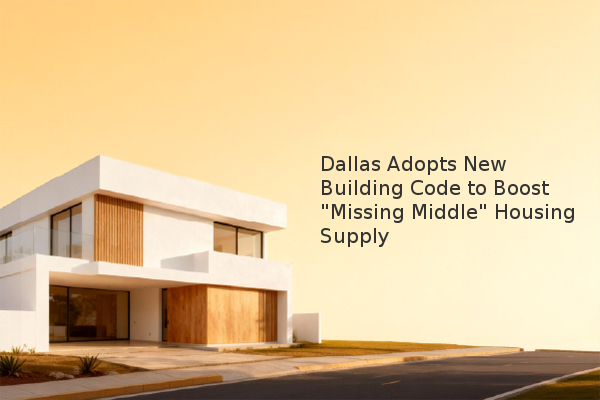
Dallas has enacted a groundbreaking building code reform that allows small apartment buildings with up to eight units to be constructed using simplified residential standards, bypassing costly commercial requirements. This strategic shift aims to unlock the construction of "missing middle" housing—a critical category of compact, multi-unit homes that are more affordable to build and live in. By eliminating the "code cliff" that previously made small-scale multifamily projects financially unviable, the city is taking a significant step toward closing its estimated 88,000-unit housing shortage for middle-income residents.
The term "missing middle housing" refers to multiunit building types—such as triplexes, fourplexes, and small apartment buildings—that sit in scale between a single-family home and a large apartment complex. These housing forms were once common in American cities but became increasingly difficult to build under modern zoning and building codes. They are considered essential for providing gentle density—adding more housing units to a neighborhood without dramatically changing its character—and are typically more affordable than large-scale new construction.
The primary barrier was a regulatory hurdle known as a "code cliff." For decades, Dallas building codes permitted duplexes to be built under the more straightforward International Residential Code (IRC). However, any project containing three or more units was required to follow the complex International Building Code (IBC), which is designed for commercial structures and high-rises. This triggered requirements for features like dual staircases, expensive sprinkler systems, and extensive engineering consultations. Based on our experience assessment, these commercial-grade mandates made small projects cost-prohibitive, leading developers to opt for building only two luxury units on a lot that could otherwise accommodate six more moderately priced homes.
The newly adopted code creates a distinct classification for buildings with one to eight units that are under 7,500 square feet. Key changes include:
This reform directly addresses the financial disincentives that caused what local experts call "underbuilding," where thousands of potential housing units were never constructed.
With Dallas facing a significant shortfall of homes affordable to those earning near the median household income (approximately $67,760), this policy is a targeted intervention. It is designed to increase the supply of housing for middle-income renters and first-time home buyers, a segment often squeezed out of the market. While not an instant solution, increasing the supply of housing is a fundamental step toward moderating price growth over the long term. City leaders have emphasized that this change is crucial to avoid the severe affordability crises seen in cities like San Francisco and Seattle.
For other cities observing Dallas's example, the key takeaway is that building code reform can be as impactful as zoning changes. While zoning often dictates what can be built and where, building codes control how it must be built. Adjusting these technical requirements can remove a major barrier to constructing the diverse housing stock that communities desperately need.