Browse

Log in / Register
 Share

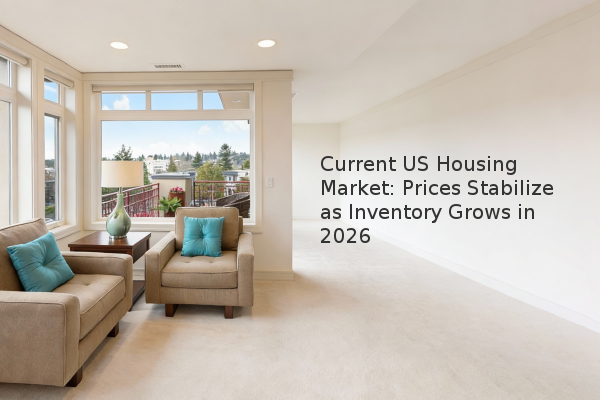
The US housing market in 2026 is characterized by stable listing prices, a significant increase in the number of homes for sale, and a slower pace, offering a more balanced environment for buyers compared to recent years. Based on our experience assessment, the median listing price is essentially flat year-over-year, while active inventory has grown by nearly 37%. This combination provides potential homebuyers with more choices and less pressure to make immediate decisions, though affordability remains a primary challenge due to higher prices per square foot.
What does the current market mean for home buyers? For buyers, the market dynamics in 2026 present a clear shift. The median listing price, which is the middle point of all homes listed for sale where half are priced higher and half are priced lower, has shown negligible growth for 26 consecutive weeks. This price stability, combined with a growing number of options, means buyers have more negotiating power and time to consider their decisions. Homes are staying on the market for approximately four days longer than the same time last year, reducing the frenzy that often characterized previous markets. However, affordability is still a significant hurdle. The increasing price per square foot—a metric used to compare the value of homes of different sizes—means that even with stable overall prices, buyers are paying more for the same amount of space than they did a year ago.
How much have new listings increased? The flow of new homes onto the market continues to improve. Data from recent weeks shows that new listings—a measure of sellers putting their properties up for sale—are up by 6.4% compared to the previous year. This marks the 15th week out of the past 16 with positive annual growth. While this is a welcome development for buyers seeking more options, it's important to view this growth in context. The overall number of new homes for sale remains historically low, still sitting below the average levels seen between 2017 and 2022. This indicates that while the situation is improving, the market has not yet returned to its pre-2023 inventory norms.
| Metric | Change from Previous Year | Key Context |
|---|---|---|
| Median Listing Price | Flat (0% growth) | 26 consecutive weeks of sub-1% growth. |
| New Listings | +6.4% | Growth has persisted for 15 of the last 16 weeks. |
| Active Inventory | +36.9% | Still over 30% below pre-pandemic levels. |
| Time on Market | +4 days | Offers buyers less urgency than the previous year. |
Is the growth in active inventory significant for buyers? Yes, the growth in active inventory, which refers to the total number of homes for sale at a given time, is a crucial factor. For the 37th consecutive week, inventory levels have been higher than the previous year, with a notable 36.9% increase recently. This sustained growth means that a buyer today will see a much larger selection of homes than a buyer one year ago. Despite this positive trend, it's essential to understand that the market is still digging out of a deep inventory hole. Compared to the years before the pandemic, buyers in 2026 are still seeing over 30% fewer homes available for sale. The trend, however, is moving in a favorable direction, especially when coupled with the potential for more stable mortgage rates.
Why are homes taking longer to sell? The increased time on market is a direct result of the changing balance between supply and demand. With more homes available (higher active inventory) and persistent affordability challenges, buyers are acting with less haste. The typical home now spends four more days on the market than it did at this time last year. This slower pace has two main implications: it reduces the sense of urgency for buyers, who can now conduct more thorough inspections and deliberations, and it requires sellers to adopt more patience and potentially more competitive pricing strategies to attract offers. The market is moving away from the multiple-offer scenarios that were common in previous years.
For buyers and sellers in today's market, the key is to adjust expectations. Buyers should use the extra time to their advantage, carefully comparing properties and negotiating terms without feeling rushed. Sellers need to price their homes competitively from the start and ensure their properties are well-presented to stand out in a growing field of options. The core takeaway is that the market is stabilizing, creating a more predictable environment for all parties involved.