Browse

Log in / Register
 Share

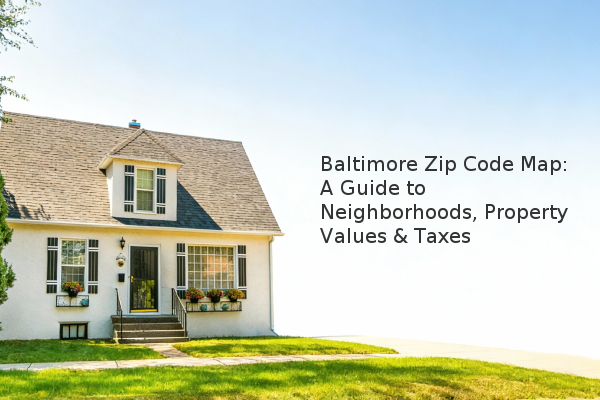
Understanding Baltimore's zip codes is essential for navigating the city's diverse neighborhoods, accurately assessing property values, and calculating tax obligations. This guide provides a clear, data-driven overview of how Baltimore's postal codes correlate with key real estate metrics, empowering you to make more informed decisions whether you are buying, selling, or investing.
Key Takeaway: Baltimore's zip codes serve as a reliable proxy for understanding neighborhood characteristics, with property values and tax rates showing significant variation across different postal zones. A property's zip code directly influences its property tax assessment, which is a critical factor in long-term homeownership costs.
Real estate markets are hyper-local, and in Baltimore, zip codes offer a practical way to segment the market. Prices can vary dramatically from one postal code to another based on factors like school districts, proximity to amenities, and historical housing stock. For a snapshot of the market as of early 2025, consider the following estimated median home values:
| Baltimore Zip Code | Representative Neighborhoods | Estimated Median Home Value |
|---|---|---|
| 21209 | Mount Washington, Pikesville | $450,000 |
| 21212 | Guilford, Homeland | $550,000 |
| 21210 | Roland Park, Tuscany-Canterbury | $600,000 |
| 21218 | Charles Village, Remington | $300,000 |
| 21224 | Canton, Highlandtown | $400,000 |
| 21230 | Federal Hill, Locust Point | $475,000 |
| 21231 | Fells Point, Harbor East | $525,000 |
This variation underscores the importance of researching specific zip codes. A buyer's budget will stretch much further in some areas than others. It's crucial to look beyond the city-wide median price and focus on the data relevant to your target postal codes.
While Baltimore City has a single property tax rate, the final tax bill is determined by the assessed value of the home, which is inherently tied to its location. The city's property tax rate is currently $2.248 per $100 of assessed value. This means a home assessed at $300,000 would have an annual tax bill of approximately $6,744.
However, it's vital to understand the assessment process. The State Department of Assessments and Taxation values properties every three years. A home in a rapidly appreciating zip code, like 21230 (Federal Hill), may see its assessed value—and thus its tax bill—increase more significantly than a home in a more stable market. Always verify the most recent assessed value for any property, as this is the figure used for the tax calculation, not necessarily the sale price.
Each zip code encapsulates a unique community. For instance, 21210 encompasses neighborhoods like Roland Park, known for its historic stone homes and top-rated public schools, attracting families seeking a suburban feel within the city limits. In contrast, 21231 covers the vibrant, waterfront communities of Fells Point and Harbor East, which are popular for their walkability, nightlife, and newer condominium developments.
21224 is a large and diverse area including parts of Canton and Highlandtown, offering a mix of traditional brick rowhomes and newer construction. Based on our experience assessment, neighborhoods within this zip have seen consistent demand due to their relative affordability and strong community associations. Understanding these micro-market trends is as important as knowing the zip code itself.
When evaluating Baltimore real estate, use the zip code as your starting point for research. Compare recent sales data within the same zip code to gauge market value accurately. Be aware that some zip codes, particularly those undergoing revitalization, may have stark contrasts between blocks, so physical due diligence is irreplaceable.
Always verify the exact property tax assessment with the city. Factor these annual costs into your budget. Furthermore, investigate additional costs like community association fees if you are considering a condominium or a neighborhood with a homeowners association (HOA), as these can add hundreds of dollars to your monthly expenses. Ultimately, pairing zip code data with in-person exploration provides the most comprehensive understanding of Baltimore's complex real estate landscape.