
Browse





···
Log in / Register

 Favourites
 Share
Share Washington, DC, USA
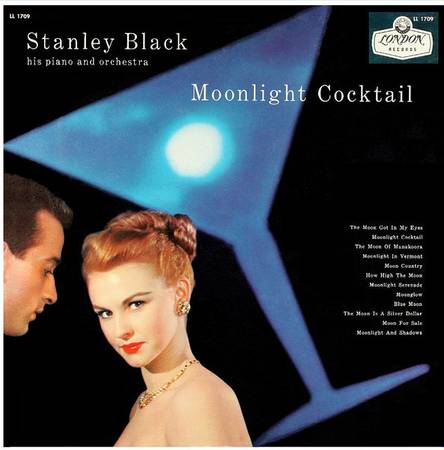
Moonlight ... Feels Right https://youtu.be/xnCPxXYpHKg Stanley Black "Moonlight Cocktail" MOONLIGHT COCKTAIL ... Side No. 1 The moon got in my eyes Moonlight cocktail The moon of Manakoora Moonlight in Vermont Moon country (is home to me) How high the moon ... Side No. 2 Moonlight serenade Moonglow Blue moon The moon is a silver dollar Moon for sale Moonlight and shadows ... STANLEY BLACK, HIS PIANO AND ORCHESTRA ... Some things can be seen more clearly by moonlight than they can by the light of day. These things are for the most part better expressed in music than they are in words. "We are the music-makers, we are the dreamers of dreams, world-losers and world-forsakers, on whom the pale moon gleams". So writes the poet describing a race of people to which we have all belonged intermittently. However busy our lives, however pressing our cares, there have been moments for all of us when we have seen things more clearly by moonlight, experienced life more intensely in the half-shadow. If the titles on this record are anything to go by, it is clearly in the United States that the romantic effects of the moon. are most fully appreciated, despite a certain mercenary tendency in the two titles before the last. In Vermont the moon is substantial and well-defined in the night air that is sharp and tingling against the skin. The light touch of the moonlight brings up the snow-covered hillside in a glow all of its own. If Frank Loesser, in search of his own moon memories, strays across the sea, it is only to the U.S. territory of Hawaii when in Moon of Manakoora he recalls the moonlight which brings a touch of coolness among the palm trees while the sea provides a soft accompaniment as it moves against the shore. Hoagy Carmichael and Johnny Mercer find their Moon country nearer home while Rodgers and Hart fly off with between-the-wars optimism in search of the Blue moon that never Meanwhile everyone will remember the gently sliding horns of Glenn Miller which conveyed so successfully the soothing nature of moonlight. All these different views of the moon are treated with equal care by Stanley Black with his piano and orchestra and are brought together in arrangements as limpidly clear as moonlight itself. comes. Films and the stage, radio and television; composition, execution, arrangement — Stanley Black is a master in all of them. Who can tell how many man-hours of enjoyment have been carried to all parts of the world by his recording sessions alone? Entertainment as Stanley will tell you, can be a serious business, demanding as it does the patience and industry of the craftsman, But it demands something else as well: personality and inspiration; versatility also, for the call for novelty is ceaseless. Above all, in order to delight and entertain others, an impresario and master musician must have the capacity for enjoyment himself. For Stanley Black, as it did for all of us, it all started with piano lessons. But at the Matthay School of Music in London it soon became apparent that Stanley was no ordinary pupil. He was not merely a model student, he was gifted and from the performance of music to composition was for him a short and easy step. At the age of twenty-three he broke into the highly-competitive world of film music with a contribution to "Rhythm Racketeers" a film released in 1936. It was an open door to success and many men would have been content to confine themselves to this field alone. Stanley has continued his association with the screen right up to the present time but nowadays his commitments in the film world are only one of the outlets for his many musical accomplishments. Since those early days nearly thirty-five important British films have received the touch of "Black Magic". Outstanding examples that come to mind are "Top Secret" and "Laughter in Paradise". At the outbreak of war Stanley Black was quick to join up, leaving as he thought, the world of music behind him. But once in the R.A.F. he was soon conscripted into applying his unique talents to the entertainment of his fellow servicemen. Upon his release from the services the possibilities seemed so numerous that at first it was difficult to choose between them. After a brief period of free-lancing, however, he was signed up as conductor of the B.B.C. Dance Orchestra, an appointment which lasted until 1952. It was during this period that Stanley became one of the big names of such shows as "Hi Gang" and "Much Binding in the Marsh" and his distinctive contributions to light music became well-known to the public through the medium of his own "Black Magic," "Top Score" and "Tropical Magic" programmes. Radio also gave to Stanley Black scope for his talents in composition and orchestration. Much of his work has become a permanent feature of listening, in such happily familiar forms as the signature tune to "The Goon Show" and the enlivening interval music for the Light Programme. Stanley Black's work for the B.B.C. was recognised in 1951 by his selection to appear with his orchestra in the Royal Command Variety Performance. In the same year he was honoured by election to the Grand Order of Water Rats. As an authority on music in the Latin-American style, Stanley sits. on the advisory board of "Who's Who in Music" though this is, of course, only one of the many fields of music in which he is an expert. Despite his many commitments, he still finds time for the composition of popular ballads and dance tunes. Two examples of his flair for the Latin-American idiom are Nostalgia and Hold me close tonight, both of which are included in his recent Decca album "Cuban Moonlight." Times change and Stanley Black moves with them. Now in the comparatively new medium of television he is already renowned as a performing artist. He featured a 35-piece orchestra on the first of the highly successful "Off the Record" shows and conducted in the equally popular "Hit Parade" series. Television has also brought him a new and intriguing challenge to adapt his music knowledge to the demands of the present day and age. For it is Stanley who composes a number of the fascinating jingles which cheer- fully implant the advertiser's message through the medium of the television commercial. (album notes) ---------- Stanley Black (14 June 1913 – 27 November 2002) was an English bandleader, composer, conductor, arranger and pianist. He wrote and arranged many film scores, recording prolifically for the Decca label (including their subsidiaries London and Phase 4). Beginning with jazz collaborations with American musicians such as Coleman Hawkins and Benny Carter during the 1930s, Black moved into arranging and recording in the Latin American music style, and also won awards for his classical conducting. Life and career Black was born as Solomon Schwartz on 14 June 1913 in Whitechapel, England. His parents were Polish and Romanian Jews. He began piano lessons at the age of seven and trained in piano and composition under Rae Robertson at the Matthay School of Music. He was aged only 12 when his first classical composition was broadcast on BBC Radio. His first professional job was for a C.B. Cochran 1930 theatrical revue followed by winning a Melody Maker competition for his arrangement of a jazz chorus the next year. In the early 1930s, he was employed in dance bands, and had worked with Howard Jacobs, Joe Orlando, Lew Stone, Maurice Winnick and Teddy Joyce by the time he joined Harry Roy in 1936. Black had also broadcast and recorded with several American musicians, including jazz saxophonists Coleman Hawkins and Benny Carter during their stays in England during this decade. Hawkins had first heard Black on late night radio shows with Lew Stone's band. When the two eventually met in London, the reviewer Edgar Jackson suggested they record together, and the two men collaborated on a duet version of "Honeysuckle Rose". During World War II, Black joined the Royal Air Force, and became involved in managing the entertainment of servicemen based at Wolverhampton. In 1944, he was appointed conductor of the BBC Dance Orchestra, and remained in the job for almost nine years, broadcasting as many as six nights a week. Black's radio work kept him in contact with a large listening audience, through his incidental music for shows such as Much Binding in the Marsh and the first two series of The Goon Show. He also conducted the BBC Dance Orchestra for the popular comedy show Ray's a Laugh, starring Ted Ray. Black later presented his own programmes on radio and television, including Black Magic and The Marvellous World of Stanley Black. In the early 1950s, he regularly topped the Melody Maker lists of the most-heard musicians on radio. He was chosen to be included on Decca's first release of long-playing records in the UK in June 1950. This enabled him to continue his conducting, arranging and performing career and resulted many albums. He was particularly popular in United States, as evidenced by his inclusion in the Billboard best-sellers lists. During 1968–69, he was principal conductor of the BBC Northern Ireland Orchestra. Becoming involved with the film industry, he composed and arranged music for about 200 films. He was appointed music director at Elstree Studios in 1958. He was also principal conductor of the studio orchestra of Associated British Picture Corporation (ABPC) and their musical director composer from 1958 to 1963. ... ... -- Wikipedia ----------/ Great Instrumental Music
 Show map