Browse

Log in / Register
 Share
Share
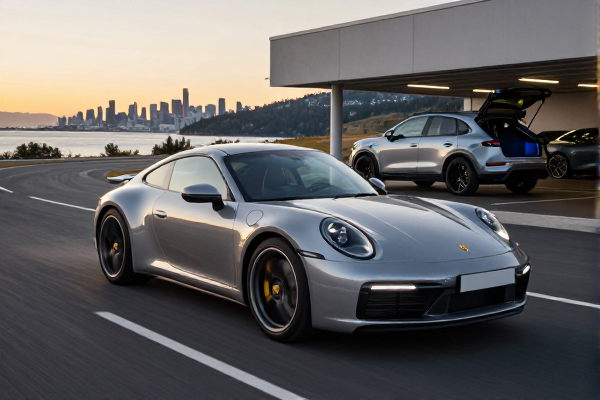
April 14, 2025 – Few car names are as instantly recognizable as “911.” For more than six decades, Porsche’s rear‑engine sports car has carried that three‑digit badge, but the story of how it got that name is far less known than the car itself. It’s a tale of a last‑minute rebranding, a trademark clash with a French automaker, and a stroke of marketing luck that turned a simple number into a global icon.
When Porsche first began developing a successor to the 356 in the late 1950s, the internal project code was simply “Type 901.” The car made its public debut at the 1963 Frankfurt Motor Show as the Porsche 901. It featured a sleek new body, a six‑cylinder engine mounted behind the rear axle, and a clean “901” badge on the tail.
At that time, Porsche used a straightforward internal numbering system: the 356 was Type 356, the 550 Spyder was Type 550, and the new car logically became Type 901. The company expected to sell the production version under the same name. But fate had other plans.
Shortly after the 901 debut, Porsche’s legal team received an urgent message from Peugeot. The French manufacturer had registered a trademark on all three‑digit car model names with a zero in the middle – that is, any combination like X0Y (e.g., 201, 301, 401, etc.). Peugeot had been using this naming convention since the 1920s and had successfully defended it in multiple markets.
Porsche could have fought the claim, but the company realized that a protracted legal battle would delay production and create confusion. Rather than risk a costly dispute, Porsche decided to change the name at the last minute – just weeks before the first customer deliveries were scheduled.
The solution was elegantly simple: replace the middle zero with a one. “901” became “911.” The change required only a minor badge redesign and a few pieces of documentation. Porsche quickly notified dealers, updated press materials, and ordered new rear emblems. By the time the first production models rolled off the line in late 1964, the car wore the “911” badge – a name that has stuck ever since.
Interestingly, Porsche had already used “911” internally for another project (a prototype racing engine), but it was available for the production car. The move was so seamless that many early owners never even knew about the near‑crisis.
In the decades that followed, a popular myth emerged that Porsche deliberately chose “911” to evoke the emergency telephone number – an appealing story for a fire‑breathing sports car. However, Porsche executives have repeatedly stated that the connection is purely coincidental. At the time of the rename (1964), the emergency number “911” had only been adopted in the United States (1968) and was not yet a universal symbol. The name was simply the next available number in Porsche’s internal system after the trademark conflict.
Nevertheless, the myth persists. Some enthusiasts argue that the unintentional alignment with the emergency number only added to the car’s mystique, giving it an aura of urgency and speed.
While the core “911” name has remained unchanged for 60 years, Porsche has added numerical suffixes to distinguish generations. The current generation (Type 992) follows a pattern that goes back to the 1970s:
Each generation code is still built on the “911” foundation. Even the electric‑only Mission E concept eventually became the Taycan – a separate nameplate – while the 911 itself remains the combustion‑engine thoroughbred.
In February 2025, Porsche announced that the next‑generation 911 (Type 993?) – commonly referred to as the “992.2” facelift – will retain the classic “911” badge despite increasing electrification. According to a statement from Porsche’s product chief, “The 911 name is more than a model designation; it’s a promise of our heritage. As we introduce hybrid powertrains, the 911 name will continue.”
This move solidifies the brand’s commitment to the moniker, ensuring that even as the 911 gains electric assistance (the 2025 911 GTS features a hybrid system), it will still be called – and known as – the 911.
In hindsight, the trademark conflict with Peugeot turned out to be a blessing. “911” is shorter, punchier, and more symmetrical than “901.” It fits perfectly on a round badge, rolls off the tongue easily, and – thanks to the coincidental emergency‑number association – has become one of the most memorable automotive names ever.
The story also highlights how a simple, pragmatic decision can have outsized branding impact. Today, the Porsche 911 is not just a car; it’s a cultural icon, a status symbol, and a benchmark for sports car performance. And it all started because Peugeot had a trademark on a zero.
So, why is the Porsche 911 called “911”? Because a French car company forced Porsche to swap a zero for a one. The name has no hidden meaning, no secret German code, and no intentional nod to emergency services. It’s a story of corporate diplomacy, quick thinking, and a little bit of luck – and that’s exactly what makes it so fascinating.
Next time you see a 911, remember: it could have been the 901. And maybe, just maybe, thank Peugeot for giving the world one of the greatest car names of all time.