Browse

Log in / Register
 Share

Volvo is quietly preparing a major upgrade to its plug-in hybrid lineup, and the latest evidence points to a sleek new sedan that could replace the aging S60. Codenamed the S70, a heavily camouflaged prototype was recently spotted testing in China, signaling that the Swedish automaker is moving beyond SUVs to revive its sedan portfolio.
According to multiple industry sources, the S70 PHEV will be built on the same scalable architecture used by Geely’s Lynk & Co 10 – a platform designed specifically for electrified powertrains. While official specs remain under wraps, the prototype’s proportions and wheelbase suggest a mid-size sedan aimed at competing with the BMW 330e and Mercedes-Benz C300e.
Design cues borrowed from the XC70 SUV
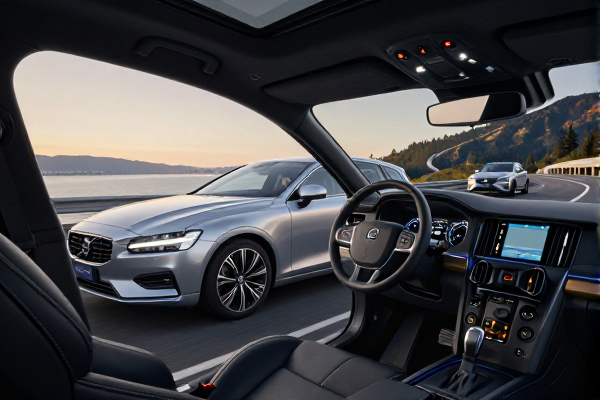
Digital artist Sugar Design has created a set of realistic renderings based on the spy photos, giving us a clear look at the potential production design. The S70 adopts a more aggressive front fascia with a closed-off grille (common on PHEVs to reduce drag), large diamond-cut alloy wheels, flush door handles, and a distinctive elliptical LED tail-light signature that echoes the XC70 SUV.
A notable addition is the roof-mounted LiDAR sensor – likely supplied by Luminar, Volvo’s long-time partner. This hardware suggests the S70 will offer at least Level 3 semi-autonomous driving capabilities, possibly even Level 4 on highway stretches, following Volvo’s “Unsupervised” autonomous driving suite.
Powertrain and range expectations
Volvo hasn’t confirmed the powertrain details, but based on the current PHEV portfolio, the S70 could use a third-generation plug-in hybrid system. The Lynk & Co 10 platform supports a 1.5L turbocharged three-cylinder engine paired with an electric motor, producing a combined output of around 260–280 hp. However, given the S70’s positioning, Volvo might opt for a more powerful 2.0L four-cylinder PHEV setup, similar to the XC60 Recharge, delivering up to 350 hp and an electric-only range of around 50 miles (80 km) under WLTP.
Market launch and China-first strategy
The prototype was spotted in China, and insiders suggest the S70 will launch there first, possibly as early as late 2025 or early 2026, before expanding to other global markets. This aligns with Volvo’s recent strategy of rolling out new models in China first, as seen with the XC70 SUV. A global launch for the S70 PHEV is expected in the second half of 2026, with a fully electric variant (likely the ES70) arriving later.
Wagon version? Not yet
While the S70 sedan is clearly in development, there is no evidence of a wagon variant (V70) at this stage. Volvo has traditionally offered wagon versions of its sedans, but the current focus on SUVs and crossovers may delay or cancel a wagon counterpart. However, given the brand’s loyal wagon fan base, a V70 could emerge if the sedan proves successful.
What this means for Volvo’s sedan lineup
The S70 will effectively replace the S60, which has been on sale since 2018 and is due for a redesign. The S60’s sales have been declining in recent years, particularly in the US and Europe, as buyers shift to SUVs. By launching a dedicated PHEV sedan with semi-autonomous tech, Volvo hopes to recapture sedan buyers who want premium efficiency and advanced driver assistance.
Competition and pricing
The S70 PHEV will compete with the BMW 330e, Mercedes-Benz C300e, Audi A4 40 TFSIe, and the upcoming Lexus IS 500h hybrid. Pricing is expected to start around $55,000 in the US (before tax credits), positioning it above the S60 Recharge ($48,000) but below the XC70 PHEV ($62,000).
Bottom line
The Volvo S70 PHEV appears to be more than just a replacement for the S60 – it’s a statement that Volvo still believes in the sedan body style, even as the industry pivots to SUVs. With a sleek design, advanced LiDAR-based autonomous driving, and a proven PHEV powertrain, the S70 could be one of the most compelling plug-in sedans when it arrives in 2026.
Updated: April 2025 – based on the latest spy shots and industry reports.