Browse

Log in / Register
 Share


Published on April 12, 2025
Volkswagen has shattered expectations with its latest electric concept, the Mission Efficiency — a car that proves extreme range does not require enormous batteries or exotic powertrain wizardry. Instead, the German automaker focused relentlessly on aerodynamics, weight reduction, and energy frugality, achieving a real-world range of more than 1,400 km (870 miles) under tightly controlled conditions.
The Mission Efficiency was designed as a successor-in-spirit to the iconic XL1, Volkswagen’s earlier one-liter diesel-hybrid that pushed efficiency to the limit. But unlike the XL1, which used a plug-in hybrid setup, the Mission Efficiency is a full battery-electric vehicle built on the company’s MEB+ platform. It shares the same electric motor and battery pack with the upcoming ID. Polo, meaning the incredible efficiency gains come purely from vehicle design, not advanced battery chemistry.
Volkswagen submitted the Mission Efficiency to Germany’s Record Institute, which certified it in three distinct categories:
Most aerodynamic road-legal car: With a drag coefficient of just 0.158 and a frontal area of 2.08 m², the Mission Efficiency beats any production car currently on the market. For comparison, the Lucid Air Grand Touring has a Cd of 0.197, the Tesla Model S sits at 0.208, and the Mercedes-Benz EQS at 0.20. Volkswagen’s latest slashes wind resistance by roughly 20% over those premium competitors.
Lowest energy consumption: During an idealized test—ranging over 1,278.36 km from Wolfsburg (Germany) to Vienna (Austria) via Poznań (Poland) and Olomouc (Czech Republic)—the concept consumed just 6.89 kWh/100 km (excluding charging losses). With charging losses included, the figure was 7.51 kWh/100 km. The average speed was 67.72 km/h (42 mph), with a top speed of 138 km/h (86 mph). That translates to an equivalent of roughly 0.69 L/100 km gasoline or 340 MPGe—nearly incomprehensible for a four-seat vehicle.
Most efficient near-production, everyday-use four-seat EV: Under the same certification, the car demonstrated a practical usable range far exceeding any production model. The team needed only a single recharge during the 1,278 km journey, arriving in Vienna with an indicated 164 km remaining, giving a total “paper” range of more than 1,400 km.
The key is a holistic approach to drag reduction, weight savings, and rolling resistance.
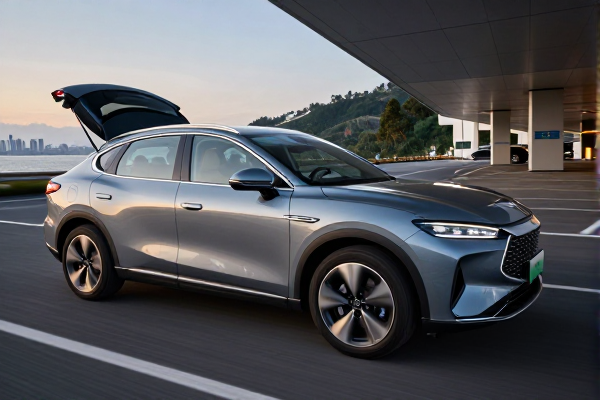
Aerodynamics: The car adopts a classic teardrop silhouette, narrowing toward the rear in what Volkswagen calls “boat tailing.” The roofline is long and smooth, the side mirrors are the only protrusions—cameras were ruled out as they offer marginal aero gains at the cost of weight and electrical complexity. The rear wheels are almost completely enclosed, while the front arches wrap tightly around the tires. The underbody is fully sealed. Active cooling flaps at the front open only on demand; with all three closed, the car hits its 0.158 Cd. Special wheel deflectors reduce turbulence generated by rotating wheels, which typically account for 25–30% of a car’s aero drag.
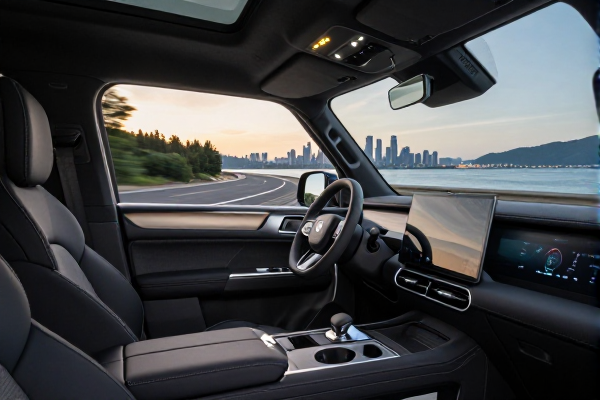
Weight and Materials: The interior is stripped to essentials. Instead of a fixed infotainment screen, the driver mounts a smartphone or tablet on a dedicated rail and connects wirelessly. A portable Bluetooth speaker replaces traditional speakers. Lightweight seats and door panels, a simplified floor using composite material with integrated rubber grips (no removable mats), and storage compartments beneath the rear seats all reduce mass. No total weight figure has been released, but the approach closely follows the ultra-lightweight philosophy.
Tires: Specially developed Continental EcoContact 7 tires combine low rolling resistance with sidewalls that improve aero efficiency. The rear axle is narrowed by 170 mm compared with the ID. Polo, further smoothing underbody airflow.
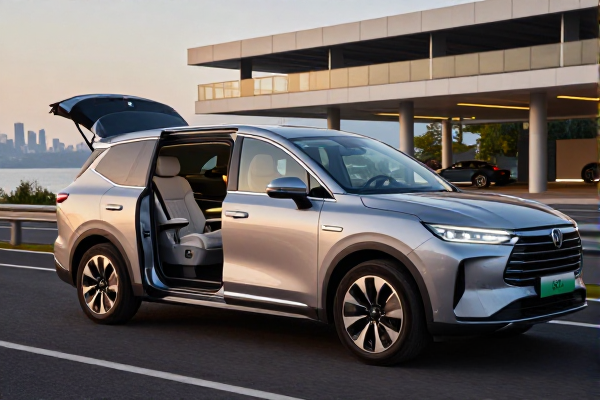
Practicality: Despite its hypermiling mission, the car seats four (2+2) with a total luggage capacity of 481 liters—enough for a young family. The rear seats fold to create an 1.8 m load floor. The car is 4,775 mm long, 1,744 mm wide, and only 1,392 mm tall, with a 2,700 mm wheelbase (100 mm longer than the ID. Polo).
The Mission Efficiency is a concept, but it directly previews Volkswagen’s design and engineering priorities for its next generation of MEB+ models destined for the U.S., including the upcoming ID. Buzz, ID.4 refresh, and the all-new ID. Polo (which may arrive in America as a compact crossover). While no production EV will achieve a 1,400 km range in real-world driving—EPA conditions typically see 30–40% reductions—the underlying efficiency tricks could help Volkswagen close the gap with Tesla and Lucid.
Currently, the longest-range EV sold in the U.S. is the Lucid Air Grand Touring, which offers an EPA-rated 516 miles (830 km). Tesla’s Model S Long Range claims 405 miles (652 km). Even if the Mission Efficiency’s real-world EPA estimate falls to, say, 500 miles, that would still be competitive. But perhaps more importantly, the concept shows how to achieve that range without a massive battery pack—meaning lower vehicle weight, faster charging, and potentially lower costs.
Dr. Carol Reiley, an automotive engineering consultant, told Drive & Run: “Volkswagen’s focus on aero and weight over radical battery chemistry is a sane approach. The Mission Efficiency validates that slicing drag below 0.16 is possible in a car that still looks like a car, not a spaceship. That’s a template that can trickle down to mass production.”
A Volkswagen of America spokesperson confirmed that “the Mission Efficiency is a technology showcase. Several of its features—especially the active a