Browse

Log in / Register
 Share


Volkswagen has confirmed the ID. Tiguan, the electric SUV that will absorb the ID.4 and ID.5 into one mid-size model. The company released full specifications, German pricing and a Wolfsburg debut date of October 9, 2026, ahead of European pre-sales opening October 13 and deliveries beginning in early 2027. U.S. availability remains unannounced. This report was filed May 14, 2026.
The arithmetic is easy to follow. The ID.4 and ID.5 account for more than 950,000 built units, making them the most successful electric vehicles the brand has ever produced. The Tiguan, by itself, has been Volkswagen's best-selling model worldwide for years. The ID. Tiguan takes one heritage name, one electric platform and one product plan, and rolls them into a single mid-size SUV aimed at the high-volume heart of the global market.
The new model will be assembled in Emden, Germany, while the combustion Tiguan continues from Wolfsburg with gas, diesel and hybrid powertrains. The two will be sold side by side in Europe, giving Volkswagen a one-two punch in the continent's most important SUV segment. The company positions the ID. Tiguan as one of its most important electric models for the years ahead.
For U.S. readers, the sentence that matters most is this: Volkswagen has not said whether, or when, the ID. Tiguan will reach North America. The €42,695 German starting price is a useful reference point, but VW explicitly said equipment and pricing will vary by market. Because the ID.5 never crossed the Atlantic, an American ID. Tiguan would effectively be the successor to the ID.4 — a model whose U.S. rollout was complicated by software issues and production pauses.
If the ID. Tiguan does come here, it will walk into a crowded room. The Tesla Model Y, Ford Mustang Mach-E, Hyundai Ioniq 5, Chevrolet Equinox EV and Kia EV6 are already fighting for the same customer, and the list is growing every year. VW's Chattanooga plant already builds the ID.4, and local production is the obvious route to sidestep import tariffs and keep the price competitive. It would also improve the case for federal EV tax credits, though battery-sourcing rules in Washington have been rewritten repeatedly in recent years. None of that is confirmed — but it is the math facing VW's U.S. operation.
One more caveat for American shoppers: the 600 km (373-mile) WLTP figure is a European number. EPA-rated range, once certified, will almost certainly come in lower, as it does for every vehicle that crosses the Atlantic.
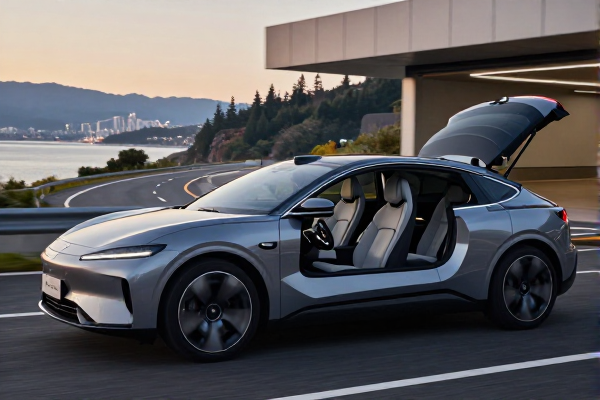
Styling is where the ID. Tiguan most clearly cuts ties with its predecessors. The soft, rounded crossover form of the ID.4 and ID.5 is out. In its place are sharp creases, taut surfaces and a boxier, more upright stance.
Volkswagen says the look comes from its "Pure Positive" design language, and the company openly compares the presence of the car to vehicles from the segment above. The photos support the claim: the ID. Tiguan has stronger shoulders, a more upright nose and a more planted stance than the crossover it replaces.
A small functional detail says a lot. The ID. Tiguan returns to conventional pull-style door handles. The flush handles on the ID.4 were never a major complaint, but going back to the familiar style signals that VW is no longer chasing EV styling clichés just for the sake of it.
Under the bodywork sits a choice of three electric drivetrains. The entry version is rear-wheel drive with 140 kW (190 PS) and a 58 kWh battery. The mid-range model also uses RWD but steps up to 210 kW (286 PS) and a 77 kWh pack. At the top is a 4MOTION all-wheel-drive variant producing 220 kW (299 PS), paired with the same 77 kWh battery.
WLTP range reaches about 600 km (373 miles) in the most efficient configuration. The flagship AWD model is rated between 15.7 and 17.2 kWh per 100 km — roughly 25 to 28 kWh per 100 miles. Volkswagen is upfront that real-world range will vary with driving style, speed, climate-control use, outside temperature, passenger load, terrain and the age of the high-voltage battery. Those caveats are familiar to anyone who has followed EV range testing.
Towing capacity is a genuine selling point: 1,800 kg (about 3,968 lb) with the 58 kWh battery and 2,000 kg (about 4,409 lb) with the 77 kWh pack. Cargo volume is 534 liters (about 18.9 cubic feet), and for the first time on a VW EV, a 32-liter (1.1-cubic-foot) front trunk adds extra stowage. Four trim levels will be offered: Trend, Life, Style and R-Line.
The cabin is the most direct answer to criticism aimed at the ID.4's interior. Drivers face a 10-inch Digital Cockpit, and a 15-inch central touchscreen dominates the console. An optional 12-inch passenger display extends the glass across the dashboard — a first for a European-market Volkswagen.
That co-driver screen features a privacy mode. The driver in the front seat can't see what the passenger is watching, while the passenger can stream video, browse the web or play games through Bluetooth headphones. For families, that alone may be worth the option price.
Equally important is what VW brought back: physical controls. A button bar on the center console handles basic climate settings, and a console dial manages audio volume and track or station changes. The multifunction steering wheel uses real buttons instead of touch surfaces, and the power-window switches have been redesigned. Two Qi2 wireless charging pads with magnetic alignment rings are available up front.
Volkswagen describes the materials as a major leap forward in quality, with layered lighting effects and a deliberate color palette that lift the cabin's atmosphere into the next price class. It's a strong claim, and the feature that backs it up is the retro display on the screens.
Press the View button on the steering wheel and the Digital Cockpit switches to a "Retro" display mode: blue-and-red instruments in the style of the Golf IV. U.S. buyers of that era will recognize the look instantly from the Mk4 Golf and Jetta.
The layout puts a classic speedometer on the left and a stylized gauge on the right that shows drive energy flow rather than engine speed. The central screen gains a matching Retro view, which for the first time can be personalized — drivers choose one of six Volkswagen icons from a virtual garage: Golf I, Golf II Country, Golf IV, Tiguan I, Race Touareg or Beetle.
It's a small feature, but a memorable one. In a segment full of identical dark-tinted screens, the Golf IV homage gives the ID. Tiguan personality and gives older buyers a reason to smile.
The standard-equipment list includes one-pedal driving, which lets the driver slow the car strongly with the accelerator alone. The optional Connected Travel Assist can perform assisted lane changes on highways and bring the vehicle to a complete stop at red traffic lights. Volkswagen notes that both functions work within system limits and that the driver remains responsible at all times.
Comfort options are generous: electrically adjustable front seats with massage, memory and ventilation; a 480-watt Harman Kardon audio system; and a panoramic sunroof. A Digital Key allows a compatible smartphone to lock, unlock and start the vehicle, with access sharable to family, friends or colleagues through the Volkswagen app via text, messenger or email.
Campers and tailgaters get attention too. An optional PowerSocket adapter plugs into the charging port and supplies vehicle-to-load power, enough to run an electric grill, power tools or an e-bike charger.
For Volkswagen, this is a high-stakes product launch. The company frames the ID. Tiguan as central to its BOOST 2030 strategy, which aims to make VW the most desirable brand for sustainable mobility. The scale of the challenge is visible in the 2025 numbers: Volkswagen Passenger Cars delivered more than 4.7 million vehicles worldwide last year, including about 382,000 all-electric models, and employs roughly 170,000 people.
The ID. Tiguan has to do for electric SUVs what the Tiguan has done for internal-combustion SUVs — and Volkswagen CEO Thomas Schäfer summed up the logic in one line: "The ID. Tiguan brings these two success stories together."
What remains unsaid, for now, is whether that story will be told in American showrooms, at what price,