Browse

Log in / Register
 Share


Updated: July 24, 2025
Vauxhall has used the eve of the 2026 Paris Motor Show to reveal a concept that points straight at the next-generation Astra. The STX wagon, with its ultra-low bonnet and inverted glass tailgate, previews a production model that will be offered with both hybrid and battery-electric powertrains. It is also a deliberate rejoinder to the popular belief that a family carrier has to be a tall SUV.
The car was shown to a small group of journalists ahead of the public opening, and the brand’s design director, Mark Adams, was characteristically direct about what it represents. He admitted that the STX’s dramatic proportions are not wholly production-feasible “down to the last millimetre,” but insisted that the principle behind the car will carry over to the new Astra family. That principle includes a new interpretation of the blacked-out Vizor front panel and a bold vertical crease that runs through the Griffin badge.
Adams believes this central spine gives Vauxhall a form of visual identity that other car makers simply do not have. He pointed out that many new entrants to the European market are falling back on variations of the same clean, amorphous front ends. The Vauxhall design, by contrast, draws the eye to the illuminated emblem at the centre of the grille surround. The same signature lighting and crease will appear on production versions, he confirmed.
Beyond the face, the STX is a statement about the architecture Stellantis is building for its next generation of small and mid-size cars. It sits on the upcoming STLA One electric platform, which is flexible enough to accommodate low-slung estates and crossovers alike. Huettl also stressed that the Astra range will not drop internal-combustion assistance entirely. Many Astra buyers are high-mileage drivers, and the brand intends to offer a hybrid option to help them cut costs without worrying about charging stops.
This is a significant decision for Stellantis. The Astra has historically been one of Europe’s top-selling C-segment models, and the decision to keep a hybrid alongside a pure EV means Vauxhall will not alienate buyers who still depend on a cold, familiar fuel pump. Huettl said the company is taking its powertrain mix seriously because “these are high-mileage cars for people who like to drive,” and the driving experience is central to the Astra’s appeal.
That driving experience is exactly why Vauxhall is fond of the wagon body. Adams noted that SUVs are being forced to shrink their frontal areas to claw back efficiency, especially in electric form, and that a well-resolved estate can deliver comparable practicality with far better aerodynamics. The STX concept proves the point: it has a low centre of gravity, a sleek roof line and, with the rear seats folded, a claimed 2,000 litres of load volume. For families and fleet operators, that is just as useful as any crossover.
Huettl reinforced the point with a blunt assessment of current SUV trends. He argued that a car like the STX gives you “fun driving – better than an SUV” because of its weight distribution and lower roll centre. He also called the concept “a car for car lovers,” while stressing that the vehicle remains highly configurable for day-to-day duties. The combination of emotion and utility is rare in today’s market, where most makers have decided that high-roofed vehicles are the only way to sell practical cars.
The concept also gives us a preview of Vauxhall’s product cadence over the next two years. The brand has confirmed three very different models: a new Corsa supermini will land next year; a mid-size SUV, co-developed with China’s Leapmotor, will bolster the line-up; and the next-generation Astra will follow in both hatchback and, now confirmed, estate form. That third model is the one that has been most eagerly awaited, as it will showcase the STLA design language in volume production.
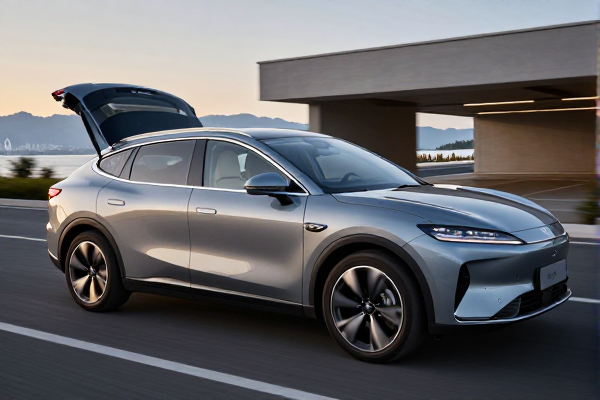
One of the most interesting parts of the STX is the way it combines the new design language with a reinterpretation of the classic estate. The steeply raked rear glass and the deep tailgate aperture are designed to make loading easier, while also creating a distinctive shoulder line. Adams hinted that production realities will force some compromises, but the essential proportions — the low bonnet, the taut surfaces and the flared wheel arches — should survive the translation from show car to showroom.
For fans of performance-wagon models, there is room to dream. Although Huettl stressed that efficiency is the priority, he did not rule out faster derivatives. Given that previous Astra generations have spawned VXR and GSe versions, it would be surprising if the next range ended up with only a lone EV. But the first cars to hit the market will likely be the 48-volt hybrid and a mid-range electric model, both tuned for real-world range rather than headline-grabbing power.
The STX also tells us something about Stellantis’s global approach. Vauxhall is a British brand with close sibling ties to Opel in continental Europe, and its design language often migrates to other parts of the group. For American readers, the concept is not destined for sale in the United States, but its face and platform may well influence future models from Buick or other GM-connected brands—though GM and Stellantis now operate fully separate engineering organisations. Still, the STX is a useful lens for seeing how the European compact segment is responding to stricter emissions rules, Chinese EV newcomers and a public that is growing tired of cookie-cutter crossovers.
The Paris Motor Show will be the first real test of public and industry reaction to the STX. But the signals from Vauxhall’s management are telling. Both Adams and Huettl used the same word over and over: “principle.” They are not treating the STX as a one-off design laboratory, but as a concrete blueprint for the company’s next three production cars. The consequence is that the next Astra will look unlike any version before it—and unlike anything from the wave of anonymous compact EVs arriving in Europe.
In the short term, the new Corsa will be the first car to wear the refreshed face, followed by the Leapmotor-based SUV. But the Astra is the heart of the brand, and the STX has raised expectations for its debut. If the production car can retain the concept’s elegance, offer a genuine driving alternative to an SUV and still swallow a double buggy or a set of scaffolding, the wagon might just have a future. Vauxhall is betting that “inefficient” was the right word to put into the mind of European buyers, and the STX is the evidence it plans to back that argument with.
One question remains: can a shooting brake win in a market that has shifted so aggressively to high-riding vehicles? The answer depends on whether consumers will accept that a lower car can be more practical, cheaper to run and, for many, more enjoyable to drive. The STX, with its 2,000 litres of maximum cargo space and an electric range that promises to benefit from low drag, makes that argument more forcefully than any press release could. The next Astra will therefore be far more than a mid-size estate. It will be a test of whether heritage, design and efficiency can still move metal in a segment that has all but abandoned the old-fashioned car.