Browse

Log in / Register
 Share

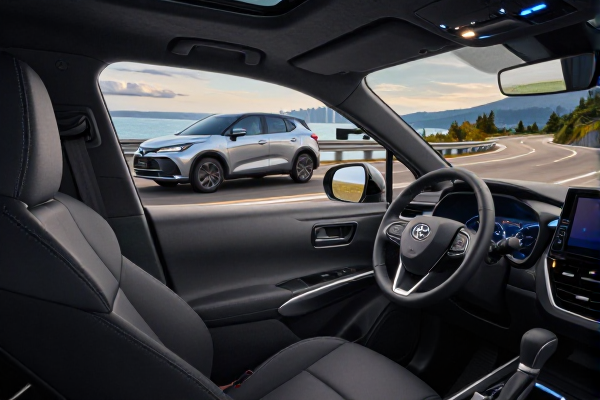
As of October 2026, Toyota Australia has confirmed that some of the data generated by its connected vehicles is processed and stored offshore — specifically in North America and Singapore — even as the number of connected Toyotas on Australian roads passes one million. The admission gives US Toyota owners a rare look at how the automaker routes telematics data across borders, a subject American regulators are increasingly examining.
The confirmation came from John Pappas, Toyota Australia's vice president of sales, marketing and franchise operations. In a statement this month, Pappas said that most of the data collected from the company's connected fleet is held in secure data centers in Australia, but acknowledged that some of it is processed and stored in Toyota-run facilities in North America and Singapore.
His message: data protection ranks alongside physical safety. "Protecting customer data is as essential as protecting their safety on the road," Pappas said, a line he has used in earlier remarks.
Rare is the right word. Automakers routinely publish lengthy privacy policies, but few publicly name the countries where customer data is handled. Toyota's willingness to name two specific regions is unusual — and it invites follow-up questions the company has not answered.
The connected-vehicle program began modestly. In 2020, Toyota introduced the technology on the Yaris Cross, a small crossover, then rolled it out across the range at a rapid clip. By 2026, cumulative sales of connected Toyotas in Australia had crossed the seven-figure mark. Pappas called it "an incredible milestone."
The flagship feature is automatic collision notification (ACN). When a serious crash is detected, the car places a call to a 24/7 Australian call center, which alerts emergency services on the driver's behalf. An SOS button does the same job manually. Both features are standard and free on every Toyota with connected services.
The emergency service has been busy. Since launch, Toyota says it has assisted more than 10,000 customers who required urgent assistance. Pappas added that the program is "potentially saving thousands of lives."
What is missing from the disclosure is detail. The company did not specify which data points travel offshore: location, driving behavior, vehicle diagnostics, personal identifiers, or some combination. It also did not explain what the overseas processing environments are used for, or who within the corporate group can access them.
That gap is drawing attention. Australia's privacy regulator, the Office of the Australian Information Commissioner, has been investigating Toyota and Hyundai over the collection, sharing, and deletion of connected-car data. Consumer group Choice, in a 2024 investigation, named Toyota among brands — including Tesla, Hyundai, and Kia — that had been sending owner driving data overseas. Toyota's current admission is, in effect, a partial confirmation of that pattern.
US Toyota owners use comparable services: Safety Connect for emergency response and Remote Connect for app-based vehicle functions. Behind those systems sits Toyota Connected North America, a subsidiary based in Plano, Texas, that does much of the company's telematics and analytics work on the continent.
Toyota's US privacy policy says the company collects vehicle location, driving habits, and operating data. What it does not spell out is the geography of that data — whether it is transferred to affiliated entities abroad, and whether offshore processing is routine. The Australian confirmation suggests that for at least some regional operations, cross-border data flows are built into the system.
US enforcement is not standing still. In January 2025, the Federal Trade Commission reached a settlement with General Motors and its OnStar unit, prohibiting the automaker from selling precise geolocation and driving-behavior data to consumer reporting agencies without informed consent. The FTC's message: connected-car information is sensitive personal data, not a commodity. California's Privacy Protection Agency has also focused on vehicle sensor data in its rulemaking, signaling continued state-level pressure.
There is a structural difference between the two markets. Under Australia's Privacy Act, when personal information is disclosed to an overseas recipient, the disclosing party must make sure that recipient upholds privacy safeguards, and consumers must be informed. The US has no federal omnibus privacy law; protections are a patchwork of state laws, sectoral rules, and FTC enforcement actions. In practice, that means American motorists may have fewer explicit guarantees about cross-border data than Australian drivers do.
The timing of the disclosure is telling. Through September 2026, BYD had sold 76,614 vehicles in Australia, up 102% year over year — roughly half of Toyota's 152,944 units. The rapid rise of Chinese auto brands has made data protection a marketing battleground, with several Chinese manufacturers playing up local data storage to build trust.
Toyota's admission cuts across that narrative. A mainstream Japanese automaker also runs a globalized data architecture in which customer information can move across jurisdictions. Whether that is a problem depends on what data is involved, who can access it, and how it is secured — none of which is fully public.
For Toyota drivers in the US who want more clarity:
These steps are no substitute for stronger oversight, but they keep pressure on automakers to be more transparent.
Connected cars are multiplying faster than the rules around them. With essentially every new Toyota now leaving showrooms connected — and rivals doing the same — the volume of automotive data will keep climbing.
Data sovereignty questions — who holds the data, whose laws apply, and who can stop misuse — will only get louder. Toyota's one-million-vehicle milestone in Australia marks a moment when connected cars stopped being a niche feature and became a mainstream consumer issue. The debate is no longer about Chinese brands alone. And as US regulators keep building precedent, automakers will need to provide more specific answers about where that data actually goes.