Browse

Log in / Register
 Share
Share
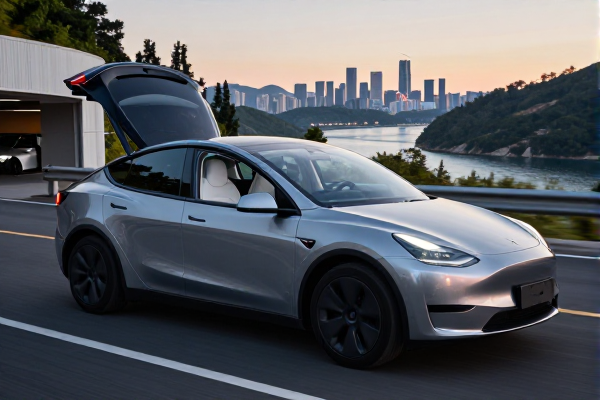
Navigating the Road Ahead: Tesla's Position in the Autonomous Driving Revolution
October 27, 2023 — The journey toward a self-driving future is accelerating, and at its epicenter is Tesla, Inc. (TSLA). More than just an electric vehicle (EV) manufacturer, Tesla has strategically positioned itself as a vertically integrated technology company, with its Full Self-Driving (FSD) software suite representing its most ambitious and debated venture. For investors and technologists alike, understanding Tesla's role in this space is crucial for gauging exposure to the next seismic shift in personal and commercial transportation.
The Core Narrative: Beyond Hardware to a Software-Defined Ecosystem While competitors often focus on sensor suites—lidar, radar, and high-definition maps—Tesla has bet its strategy on a vision- and AI-first approach. Its fleet of millions of vehicles acts as a continuously learning data collection network, feeding real-world driving scenarios back to improve its neural networks. This creates a formidable data moat that is difficult for newcomers to replicate. The company’s transition from selling cars to selling a subscription-based "driver" service through FSD subscriptions represents a fundamental business model shift with potentially higher recurring revenue margins.
A Reality Check: Current Capabilities and Regulatory Hurdles It is vital to maintain a balanced perspective. Tesla's FSD capability, currently labeled as a "Beta" system, requires active driver supervision. Regulatory approval for truly driverless operation on public roads remains a complex, state-by-state, and country-by-country battle. Recent updates, however, like the wider rollout of FSD Beta V12, which moves toward an end-to-end neural network architecture, signal meaningful technological progress. The pace of regulatory acceptance will be a key determinant of the timeline for monetizing this technology fully.
Investment Thesis: Growth Levers and Valuation Considerations For investors, Tesla offers a multi-faceted growth story. The core automotive business continues to scale, with new models like the Cybertruck entering production. However, the long-term optionality lies in its software and AI. The potential licensing of its FSD system to other manufacturers, the development of a robotaxi network, and advancements in humanoid robotics (Optimus) provide multiple avenues for value creation that are not fully reflected in traditional auto valuation metrics. This makes Tesla a high-risk, potentially high-reward proposition compared to legacy automakers.
The Competitive Landscape: Who's Catching Up? Tesla is not operating in a vacuum. Legacy automakers like General Motors (through Cruise) and Ford are investing heavily, while pure-play tech companies like Waymo (Alphabet) and new entrants like Nvidia with its DRIVE platform are formidable players. Waymo leads in commercial robotaxi deployment in geofenced areas. The key differentiator will be which company can achieve scalable, cost-effective, and generalized autonomy first. Tesla's advantage may lie in its integrated approach and massive scale of deployment, aiming for a system that works everywhere, not just in mapped zones.
An Exclusive Perspective: The Energy and AI Symbiosis Often overlooked in the autonomous driving discussion is Tesla's energy business. The future of autonomous fleets—especially robotaxis—relies on efficient, high-uptime charging infrastructure and energy management. Tesla's Supercharger network and Megapack stationary storage solutions create a synergistic ecosystem. An autonomous Tesla vehicle could potentially drive itself to a Supercharger, manage its charging schedule based on grid demand (a concept being piloted), and even provide grid services through bidirectional charging. This closed-loop system of generation, storage, and consumption controlled by AI is a unique competitive advantage not yet replicated by any competitor.
Conclusion: A Strategic Bet on a Multi-Decade Trend Investing in Tesla for its autonomous future is a bet on the company's executional ability to solve one of the most complex AI problems of our time. It requires patience and a tolerance for volatility. It is less about short-term vehicle delivery numbers and more about the incremental progress of its software, the expansion of its data lead, and its ability to navigate the regulatory maze. For those seeking concentrated exposure to the convergence of clean energy, artificial intelligence, and transportation, Tesla remains a primary, albeit speculative, conduit. As with any disruptive technology, diversification within the broader autonomy and AI ecosystem is a prudent strategy, but Tesla's integrated platform makes it a cornerstone holding for many futurist portfolios.