Browse

Log in / Register
 Share

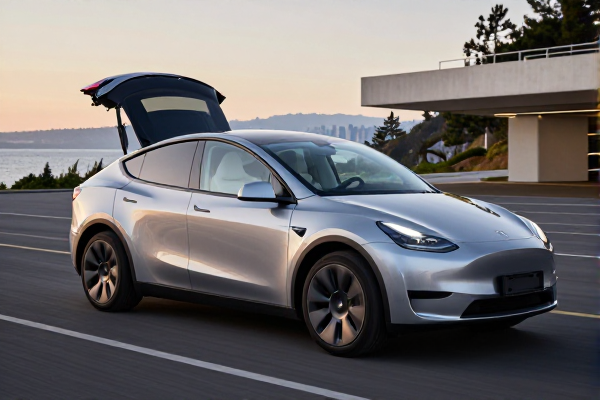
May 9, 2026 — Tesla has taken the wraps off an electric car designed to drive upside down and fire short rocket-style bursts to jump through the air. The reveal turns a long-running Elon Musk promise into a concrete concept, even though the company has not yet released a production timeline.
At a glance, the concept resembles an updated Roadster: a low body, large wheels, and a two-seat cabin. The visual difference is a set of small nozzles around the rear and sides. In footage released by the company, the car sticks to a ceiling, releases, rotates while airborne, and lands on all four wheels. No official specification sheet came with the footage, so the announcement is more a statement of engineering direction than a final product preview.
A rocket-style thruster works by pushing gas out of a nozzle at high speed. The reaction force moves the vehicle in the opposite direction. Satellites have used this cold-gas method for decades to change position or adjust orientation. On a car, the same physics add a second form of control beyond the tires. Braking, steering and throttle affect the wheels, but thrusters can move the whole body even when the car isn't on the ground.
An internal-combustion car needs engine oil at the bottom of the engine. Flip it upside down and the oil sump is at the top, so gravity works against oil pickup. Fuel and coolant systems also develop air pockets. An electric car has no fuel tank, no oil pan and no combustion cycle, which removes several mechanical barriers. Battery cooling under inverted operation is still a challenge, but a sealed electric motor can be lubricated without relying on gravity.
For a car to drive on a ceiling, it needs a continuous upward force pushing it against the surface. An inverted wing would create the opposite of downforce. On top of that, the car must manage roll and yaw while all four tires have minimal grip. The control system has to measure movement dozens of times per second and decide which thruster should fire, at what pressure, and for how long. That's a much harder problem than bolting a wing to the roof.
Once the car jumps, conventional steering no longer works. The vehicle must correct its position using torque at the wheels and pulses from the thrusters. This is similar to how a rocket manages orientation during landing. SpaceX has spent years developing those control loops, and Tesla appears ready to borrow that knowledge. Another automaker could buy the same nozzles and tanks, but it would struggle to recreate the control logic without a similar aerospace background.
Musk has teased a future Roadster with a SpaceX option package for years. In the past, he talked about a car that could do a backflip. The impulse thrusters shown in this concept are essentially the same reaction-control technology used on spacecraft, repackaged for a vehicle that must remain stable enough for a human driver. From the capsule to the car, the underlying physics hasn't changed; what changes is the environment, the safety rules and the cost.
No U.S. state permits driving upside down on public roads, so this is not a feature for commuters. It would have to be sold for use on private tracks or controlled stages. Federal safety standards cover crash protection, airbags, seat belts and electronic stability, but they don't yet have a test for high-pressure gas thrusters. How the tanks are mounted, whether they are refillable, and how they survive a collision are questions NHTSA would have to answer before a road-legal version could be approved.
Tesla's EV lineup is under pressure from legacy automakers and newer Chinese brands. A dramatic concept like this resets the conversation and gives Tesla the same kind of attention it received in the early Model S days. It also fits Musk's argument that Tesla should be viewed as a technology company rather than just another car manufacturer. Even if the upside-down car never reaches high production numbers, it strengthens the brand's image as a place where startling ideas become working prototypes.
Pricing, timing, range, speed, tank capacity and legal status have not been confirmed. Tesla hasn't said how many thrusters the car carries, how many jumps it can make before refilling, or how much the option package would cost. The company's history suggests that some showcase concepts are produced in a more practical form, while others disappear. That's why this week's reveal is best read as progress toward a new kind of vehicle control, not as a guarantee that an upside-down car will appear in a driveway near you.
Electric vehicles are usually judged by battery range and charging speed. The thruster concept points to a different future, one where software and propulsion combine to make cars maneuver like spacecraft. The public should expect a long road from a ceiling-driving demonstration to a saleable product. But the fundamental technology is real, the automotive pedigree has a credible aerospace source, and Tesla has once again made the rest of the industry explain why it isn't thinking bigger.