Browse

Log in / Register
 Share

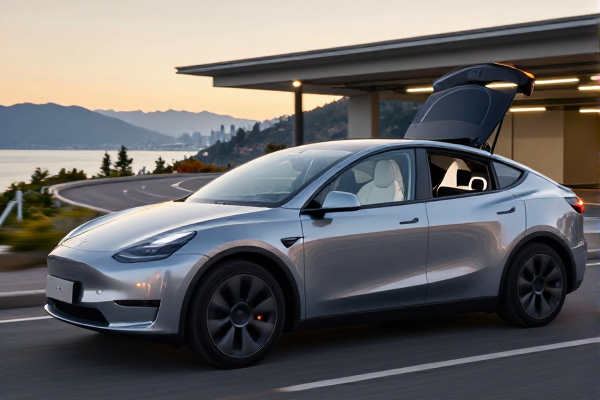
Dubai officially opened its largest integrated autonomous-vehicle testing facility this week, and Tesla is already among the first companies running trials there.
As of May 9, 2026, the Roads and Transport Authority (RTA) and Dubai Integrated Economic Zones Authority have begun operations at Dubai Mobility Labs, located in Dubai Silicon Oasis. The facility is being positioned as the region’s smartest ground-testing site for self-driving technology, combining controlled test tracks with public-road assessments to help companies move from prototype development to commercial deployment.
What sets Dubai Mobility Labs apart is its scale and structure. The site supports 248 distinct test scenarios, with 195 of them housed in a multi-purpose area designed to mimic real traffic conditions. That set breaks down into 143 core scenarios plus 52 additional ones created through design upgrades. The scenarios cover sensing accuracy, decision-making, interaction with pedestrians and other road users, plus response to traffic patterns and weather conditions—an important factor for a region known for extreme heat.
Tesla’s involvement signals more than a symbolic presence. According to Khaleej Times, the facility has already hosted test runs involving autonomous driving systems from Tesla, WeRide, and Pony.ai. Tesla’s participation builds on its earlier extreme-heat testing in Dubai, giving the company a way to validate its Full Self-Driving stack in a desert environment while also positioning itself for a rapidly opening Middle East market.
The timing makes sense. Dubai’s Smart Self-Driving Transport Strategy sets an ambitious target of converting 25 percent of all mobility journeys in the emirate into autonomous trips by 2030. The Mobility Labs are effectively the gateway to that transformation, providing a regulated pathway for companies like Tesla to prove their technology is safe, reliable, and ready for local roads. The broader ecosystem also includes infrastructure projects such as The Boring Company’s Dubai Loop, which is expected to feed into the emirate’s long-term autonomous transit network.
Day-to-day operations at Dubai Mobility Labs have been handed to DEKRA, the international testing and certification firm. DEKRA will manage testing schedules, run the facility’s workflows, and ensure every trial complies with global safety standards. That third-party oversight matters for both regulators and manufacturers, since it adds an independent layer of verification before any technology is approved for real-world service.
From a U.S. perspective, Tesla’s move in Dubai is notable because it shows how international testing hubs can serve as secondary validation grounds while the company continues its domestic rollout. Tesla has long emphasized data collection from its customer fleet, but controlled environments like Dubai Mobility Labs offer structured, measurable testing that is harder to replicate on public roads alone. With U.S. federal oversight of autonomous vehicles still fragmented across states, Dubai’s centralized approach could become a model for accelerating approvals abroad—and a potential template that U.S. regulators may study.
WeRide and Pony.ai’s presence also highlights how global competition is shaping the autonomous-vehicle industry. Both companies have been aggressively expanding beyond China into the Middle East, Europe, and other markets. Dubai’s decision to host multiple vendors at one facility is deliberate: it allows RTA to benchmark different systems side by side, and it sends a signal that no single company has a guaranteed path to the emirate’s roads.
The road to actual deployment still has one major hurdle: regulatory approval. Testing is not the same as commercialization. But Dubai has already taken steps to bridge that gap. The RTA has been expanding its fleet of Tesla vehicles for taxi use, following an order of 269 Teslas from Dubai Taxi. The phased introduction of autonomous taxis will likely depend on how well companies perform in the labs and on the public-road corridor running from Dubai Silicon Oasis to Al Qudra.
Industry analysts see this as the beginning of a more structured validation pipeline for self-driving technology, one that other cities could emulate. Whereas much of the early AV industry relied on open-road testing with limited oversight, facilities like Dubai Mobility Labs bring a controlled element that makes it easier for regulators to set safety thresholds and for manufacturers to identify weaknesses before mass deployment.
For Tesla, the stakes are high. The company has faced increased scrutiny over the capabilities and limitations of its driver-assist systems, including regulatory investigations in the United States. Demonstrating success in an internationally recognized testing environment could help rebuild trust and strengthen the case for wider commercial use—not only in Dubai but in other markets where policymakers are watching.
There is also a commercial angle. With the Middle East being one of the wealthiest and most car-dependent regions in the world, autonomous fleets could become a major revenue source for companies that secure early approvals. Tesla’s participation in Dubai Mobility Labs gives it a first-mover advantage that could translate into lucrative contracts, particularly if RTA continues to integrate autonomous vehicles into its public transportation and taxi operations.
DEKRA’s role adds another layer of credibility. The German-based firm is widely recognized for independent safety testing and certification in the automotive and industrial sectors. Having an established third-party operator run the facility reduces the risk of bias and helps align Dubai’s testing processes with international norms. That alignment will be critical if the emirate intends to attract more AV companies from the United States, Europe, and Asia in the coming years.
Looking ahead, the next phase will be about commercialization. The infrastructure is in place, the test scenarios are running, and the companies are accumulating data. The missing piece is regulatory sign-off. Once that happens, Dubai could become one of the first cities in the world with a genuine multi-operator autonomous mobility network—and Tesla, WeRide, and Pony.ai all appear eager to be part of that milestone.
For now, the facility represents a meaningful step forward in the global race to make self-driving cars an everyday reality. While the technical and regulatory challenges remain significant, Dubai has done something that few other jurisdictions have managed: creating a dedicated environment where competing technologies can be tested under real-world conditions, with independent oversight and a clear pathway to deployment. Tesla’s early presence there is both a strategic bet and a sign of how much the automotive landscape has shifted in just a few years.
As the testing data accumulates and the lessons from Dubai’s roads become clearer, expect other cities to take notice. The model of combining controlled tracks with public-road trials, managed by an independent operator, could soon become the standard for autonomous-vehicle testing worldwide. And Tesla, having placed itself at the front of the line in Dubai, is positioned to benefit from that shift.