Browse

Log in / Register
 Share

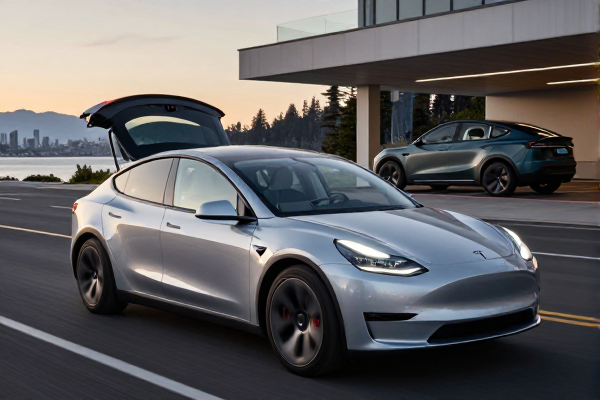
Tesla (TSLA) shares have tumbled 32% from their 52-week high of $499, landing near $340 as of March 12, 2025. The sell-off reflects a sharp disconnect: record deliveries of 480,126 vehicles in the latest quarter, but net income falling 57% year over year as heavy spending on the Cybercab robotaxi and Optimus humanoid robot eats into profits. With the Cybercab set to launch in Austin as early as late August, investors are asking whether this is a temporary reset or the start of a longer grind. Here’s what the numbers really mean.
Record Deliveries, Shrinking Margins – A Temporary Cost Spike?
Tesla’s top-line growth is undeniable. Revenue climbed 26% to $28.2 billion, driven by strong vehicle volume and a doubling of energy storage deployments. But the cost side tells a different story. Free cash flow turned negative for the first time in over a year, and operating margins slid to 4.1% on a trailing twelve-month basis – well below the double-digit margins Tesla delivered in 2022. Management attributes the squeeze to upfront investments in new factories, Cybercab tooling, and Optimus supply chain development. CFO Vaibhav Taneja has warned that capital expenditures will exceed $25 billion this year and keep climbing for the next two to three years.
The key question is whether these costs are one-time scaling pains or a structural shift. Unlike Tesla’s past expansion cycles – where new Model Y lines quickly generated cash – Cybercab and Optimus have no proven demand or production playbook. Elon Musk himself admitted on the earnings call that Optimus “will be the hardest product to scale manufacturing we’ve ever made,” because no existing supply chain exists for a humanoid robot. For now, the income statement is absorbing the R&D and capex with no revenue offset.
Cybercab vs. Waymo: A Different Path to Robotaxi Profits
Tesla is not the only company burning cash on autonomy. Waymo, owned by Alphabet, already operates a fully driverless ride-hailing service in San Francisco, Phoenix, and Los Angeles, with over 100,000 paid trips per week. Its approach uses a sensor-heavy, HD-map-dependent system that costs more per vehicle but has achieved commercial deployment. Tesla, by contrast, is betting on a vision-only system with no steering wheel or pedals, aiming for a radically lower cost per mile.
The bet is high-risk, high-reward. According to a recent analysis from ARK Invest (2025), Tesla’s robotaxi network could generate $1 trillion in annual revenue by 2030 if it solves the regulatory and safety hurdles. But those hurdles are significant. Musk has stated that a single injury could trigger a major regulatory setback. Meanwhile, Waymo’s more cautious expansion avoids the “all-or-nothing” gamble. The contrast matters for valuation: Tesla’s current 127.8x exit P/E multiple in the TIKR guided model only makes sense if Cybercab becomes a real business, not a cost center.
Energy Storage: The Quiet Growth Engine
Amid the robotaxi hype, Tesla’s energy storage business is quietly becoming a higher-margin cash cow. Megapack deployments grew over 50% year over year, and the segment’s gross margin now exceeds 20%. Unlike Cybercab, this business doesn’t depend on regulatory approvals or consumer adoption. It’s driven by global grid investment, which is accelerating as governments push for renewable energy storage. Tesla’s energy business could become a stabilizing force, smoothing out the volatility caused by vehicle delivery cycles.
If energy storage continues to grow at its current pace, it could represent 15–20% of total revenue by 2027, providing a buffer against the capex drag. That’s a narrative the market hasn’t fully priced in yet.
Valuation: Patience or Wishful Thinking?
Under the TIKR guided valuation model, using assumptions realized through December 31, 2028, TSLA stock is modeled with a 14.3% revenue CAGR, 7.2% operating margins, and a 127.8x exit P/E. The model yields a target price of $483, implying 43.5% upside from current levels. That CAGR is actually below Tesla’s 10-year average, so the model is not assuming a miracle. But a 127.8x exit multiple is hard to justify without a clear path to Cybercab and Optimus profitability.
The reality is that Tesla’s LTM operating margin sits at 4.1% – far below the 7.2% assumed in the model. To close that gap, the company needs Cybercab volume to ramp quickly and energy margins to improve. The next two quarters will be critical: if Cyber