Browse

Log in / Register
 Share

By [Your Name] | May 13, 2025
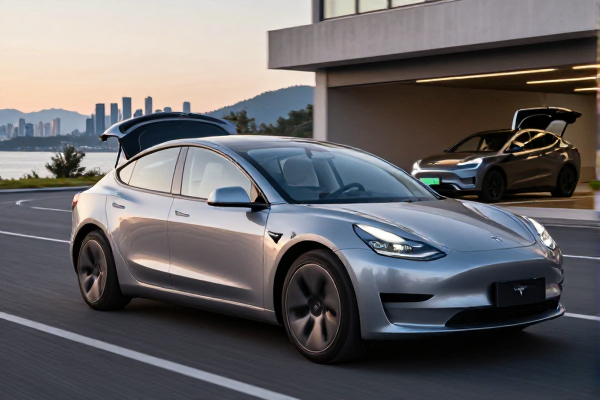
Tesla’s inclusion in the Magnificent 7 is under renewed scrutiny as the electric-vehicle maker’s stock sinks 22% year-to-date, while most of its peers in the elite group continue to climb. With Apple, Nvidia, and Amazon each up 15%–17%, the performance gap raises a fundamental question: Is Tesla still a tech company, or has it become a legacy automaker in disguise?
The Magnificent 7’s 2025 Scorecard
The index of the seven largest U.S. tech-oriented companies has delivered mixed results. Apple (AAPL) leads with a 17% gain, Nvidia (NVDA) follows at 16%, and Amazon (AMZN) is up 15%. Microsoft (MSFT), Alphabet (GOOGL), and Meta (META) have posted modest but positive returns. Only Tesla (TSLA) is deep in negative territory, with a 22% decline. This divergence has prompted some analysts to argue that the group should be renamed the “Magnificent 6.”
The Core Argument: Cars vs. Code
The case for removing Tesla from the Mag7 rests on its business identity. Unlike Apple, Nvidia, Amazon, Microsoft, Alphabet, and Meta—all of which derive the majority of revenue from software, cloud services, digital advertising, or AI infrastructure—Tesla remains overwhelmingly a carmaker. In its most recent quarter, the company produced over 450,000 vehicles and delivered 480,000, generating $28.4 billion in total revenue. Automotive sales accounted for $20.5 billion, or 72% of the top line. Energy generation and storage contributed $3.1 billion, leaving only a small fraction from services and other categories.
AI Hype vs. Real Revenue
Tesla has long pitched itself as an AI company, but tangible evidence remains thin. Its “Full Self-Driving” (FSD) system still requires constant driver supervision, and regulatory approval for Level 4 autonomy has not been granted in any major market. The much-hyped Robotaxi service has been approved for testing in only a handful of cities, and safety benchmarks are yet to be met. Meanwhile, the Optimus humanoid robot program is still in early development, with Elon Musk’s projection of “hundreds of millions deployed in a decade” met with skepticism from robotics experts.
What the Peers Are Doing
While Tesla talks about AI, its Mag7 peers are already spending heavily. Collectively, the group (including OpenAI and Anthropic) is on track to invest nearly $1 trillion in AI data centers next year, with capital expenditures rising each quarter. Amazon announced $15 billion in new AI infrastructure in April, Microsoft committed $10 billion to OpenAI expansion, and Nvidia’s data-center revenue surged 78% last quarter. Tesla’s AI-related spending—primarily Dojo supercomputer and self-driving development—pales in comparison and does not yet generate meaningful independent revenue.
Analyst Perspectives
“Tesla is a car company that happens to have some AI ambitions, but its valuation has historically been propped up by tech sector multiples,” said David K. Lee, senior equity analyst at Morningstar, in a note last week. “If you strip out the AI narrative, Tesla’s price-to-earnings ratio is nearly 80x, compared to 25x for Ford and GM. That premium is becoming harder to justify as vehicle sales growth slows.” Other analysts point to regulatory risks, including potential tariffs on Chinese-made components and cooling EV demand in Europe.
The SpaceX Alternative
Some investors who want pure exposure to Elon Musk’s AI ventures have turned to SpaceX, which operates the xAI division. However, SpaceX is not publicly traded, and its valuation ($180 billion in the latest private round) is not directly comparable to Tesla’s market cap. The notion that Tesla could be a proxy for Musk’s broader AI ambitions is increasingly viewed as a stretch.
Conclusion: A Changing of the Guard?
As the 2025 earnings season unfolds, Tesla faces a critical test. Its upcoming quarterly report (expected in July) will need to show strong vehicle deliveries and progress on FSD or Robotaxi to justify its Mag7 status. Otherwise, the argument for a “Magnificent 6” will only grow louder. For now, the market appears to be voting with its dollars—and Tesla is the outlier.