Browse

Log in / Register
 Share

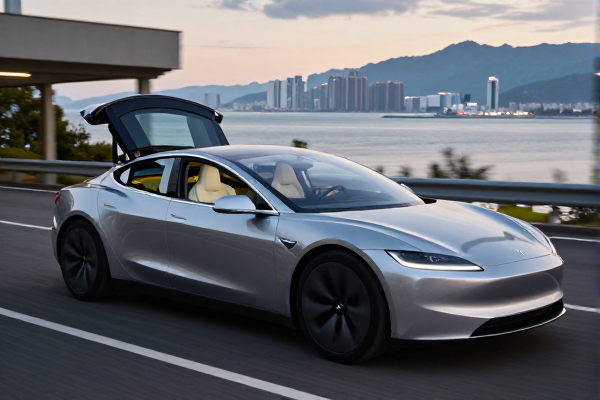
AUSTIN — Tesla pulled the wraps off a redesigned, production-intent Roadster at a private event near Waco, Texas, on March 3, 2026. CEO Elon Musk used the showcase to confirm a 2028 production start and to demonstrate how an array of SpaceX-derived cold-gas thrusters can push the sports car beyond conventional road-car behavior, including a short airborne transition over an inverted ramp before settling back on the pavement.
The latest Roadster reveal is a sharp departure from the original 2017 concept. The exterior has become more angular, with Tesla citing the SR-71 Blackbird and the F-35 fighter jet as visual reference points. The vehicle also now carries pressure vessels and side-mounted thruster units, turning the long-delayed model into one of the most mechanically complex vehicles Tesla has ever shown.
Three configurations, three roles
Tesla plans to offer the new Roadster in three versions. The Performance trim is a two-seat, road-focused model with active aerodynamics and a multi-mode suction system that Tesla says helps stabilize the car on and off the track. It is the entry point to the lineup on paper, though “entry” is relative: the reservation payment for this version is $50,000.
The Thrust trim adds rear-mounted cold-gas thrusters. Tesla says this version is designed to take the 0-to-60-mph sprint under one second. The company showed the car accelerating in roughly one second during the demonstration, and it says the Thrust configuration is meant to shave additional time from that figure. Consumer auto site Edmunds also passed along Tesla’s sub-one-second and 230-mph claims in its own post-event report.
At the top sits the Rocket trim, which drops to a single seat and adds 10 cold-gas thrusters distributed around the car. This is the setup that enabled the aerial rotation and ramp-climbing maneuvers during the demonstration. Tesla described the Rocket configuration as an invitation-only offering and said it would not be available in every market.
Thrusters, air tanks, and the engineering behind them
Tesla Engineering Vice President Lars Moravy said the Roadster’s propulsion system uses 10 cold-gas thrusters connected to roughly 600 liters of compressed air. Tesla says the air supply can be recharged and that the system’s pressure vessels are wrapped in carbon fiber and packed into available cavities inside the car. The result, Moravy explained, is a mid-car air supply that can be redirected through thrusters for straight-line acceleration and yaw or pitch control.
The engineering details matter because they explain how Tesla intends to make the Roadster stand apart from other high-performance electric vehicles. Cold-gas thrusters do not ignite fuel; they simply release compressed air. That makes them simpler than rocket engines and easier to package, but the setup still requires significant tank volume and valve management. Tesla’s decision to make the air supply rechargeable suggests the system is meant to be used repeatedly rather than as a one-time showcase stunt.
Beyond acceleration, Tesla is targeting a top speed above 230 mph and roughly 300 miles of range across the three trims. The official Roadster page adds a significant nuance: the specifications reflect the optional Thrust augment, and certain features will be available only with the Rocket trim, and only in select regions.
Reservations open at supercar prices
Customer reservations for the new Roadster are now open. The Performance trim requires a $50,000 deposit, while the Thrust trim requires $250,000. The Rocket trim is not listed with a standard deposit and appears to be reserved for a smaller group of invitees. Tesla has not published final purchase prices for any of the three configurations.
The reservation structure itself is unusual. Most production cars ask for a deposit well below five figures; a $250,000 deposit is closer to the kind of good-faith payment used in limited-build hypercars. That could be intentional positioning, since Tesla appears to be moving the Roadster away from its original “production sports car” niche and into the same category as low-volume, high-priced machines.
From 2017 to 2028: a long road
The Roadster’s latest reveal comes nearly nine years after the second-generation model was first shown. The program was repeatedly delayed as Tesla prioritized the Model 3, Model Y, and Cybertruck. Musk first publicly raised the idea of installing around 10 SpaceX-style thrusters on the Roadster in 2018, but the company offered few technical details until last week’s event.
For observers who have followed Tesla’s timeline, the 2028 target carries a familiar risk. Tesla has missed multiple internal dates for new vehicles, and the Roadster has been delayed several times as a “next year” program. Today’s acceleration figures, thruster counts, and even trim structure are subject to revision before customer deliveries begin.
A natural fit or a niche bet?
What Tesla showed in Waco is best understood as a proof point rather than a finished consumer product. The key components, particularly the cold-gas thrusters, have clear roots in SpaceX hardware and Tesla’s habit of borrowing aerospace techniques for automotive use. But thrusters add weight, complexity, and a need for regular recharging, none of which helps if the tanks are empty.
The broader timing is also notable. Tesla is unveiling its most dramatic halo car at a moment when EV demand growth has slowed and rival manufacturers are emphasizing cost discipline. A limited-production Roadster with a six-figure reservation fee is unlikely to move the company’s revenue needle in a meaningful way, but it could keep the brand’s image attached to extremes of speed and technology rather than to ordinary commuting.
The 2028 production timeline gives Tesla more than two years to sort out manufacturing details, homologate the system for road use, and decide how much of the Rocket trim’s aerial behavior can be offered legally outside controlled environments. The fact that the company chose to show the Roadster lifting over a Cybercab, a Cybertruck, a Tesla Semi, a Model Y, and a Model 3 during the event suggests the vehicle is already a rolling advertisement for Tesla’s broader portfolio.
For now, the new Roadster exists somewhere between concept, prototype, and production commitment. Tesla has provided enough concrete information to distinguish this version from earlier teasers, but the final product is still a couple of years away. Customers willing to place a five- or six-figure deposit are effectively betting that Tesla can deliver on the packaging, the thrusters, and the timing. If the company hits those targets, the Roadster could become the most unconventional street-legal vehicle to emerge from a major automaker. If not, it will join a long line of automotive showcases that promised more than they could deliver on public roads.